Jewish Liberal Newspaper, August 12, 1921

Translator’s Highlight:
Rabbi Gottschalk offers a different way to regard spiritual development or progress. He suggests that one might apply the same principle of liberalism that is based on freedom and the right to determine one’s own way in life to one’s spirituality? Liberalism lies in the choices we make about which external customs we keep. With regard to the right of self-determination, it’s un-liberal to treat the things of the soul differently from the laws of the soul and its demands.

Otto Jöhlinger continues his survey of Bismarck’s actions and statements to determine whether he was an antisemite. In this part of his analysis, he recounts Bismarck’s important relationships with Jewish journalists, politicians, and advisors. Bismarck comments on the Jewish foreign politicians and diplomats he meets and notes his respect and appreciation for their talent and diplomatic skills. Jöhlinger observes that the more mature Bismarck increases his support of Jewish citizens’ rights and his public statements about Jews are positive and counter antisemitic attitudes. Jöhlinger is keen to rehabilitate this founding figure of the united Germany to give Jewish Germans another argument for defending their status as being included in the definition of Germany from its outset and being seen as valuable contributors to the new country.

Yet, this issue shows that Jews are besieged by antisemitism. Against the backdrop of defamation and outrages, you’ll read how Jewish communities consider their own well-being and how to sustain two important aspects of religious life–the welfare of rabbis and ritual adherence. news from the area report on the dedication of a new mortuary and the growing availability of kosher meals in vacation resorts. The salaries of rabbis are a major topic at a gathering of representatives from various communities. The inequality of how rabbis are paid has been recognized. A proposal is made to establish a regular salary so that some rabbis are not totally dependent on whatever they might receive from congregants for funerals and other services. Others draw a handsome and regular salary from the community’s administration. Spoiler alert: The proposal is adopted. How much did the endorsement from Rabbi Leo Baeck sway the representatives?

In the categories of outrage and defamation, we learn that a court rules in a minor case that Judaism is not an actual religion. History shows us how this kind of ruling has a ripple effect as the arguments made here are taken up in other cases, eventually to take on a formidable tenet. One of the leading German-Jewish poets, Heinrich Heine, is pilloried by a professor of literature as emblematic of Jewish presence in Europe. A flyer from the Breslau chapter of the German Nationalist Protection and Defiance Federation, an antisemitic, ultra nationalist group, laments the injustices that swastika wearers suffer. It concludes with a threat that Jews should watch out. The irony of antisemites feeling mistreated by Jews was certainly not lost on the readers.

Finally, we see the announcement for Hugo Heilmann’s bar mitzvah.

Articles:
Liberalism and Development by Rabbi Dr. [Benno] Gottschalk, Posen
Bismarck’s Attitude Toward Jews by Dr. [Otto] Jöhlinger (continued)
Jewish-Liberal Youth Organization Outings
Rabbi Dr. Hochfeld’s Passing, Berlin
Rabbis’ Salaries Considered, Berlin
The Jews in Europe: A Speech by Ignaz von Döllinger
Affordable room and board for Jewish religious staff in health resorts, Berlin
A Jewish Renegade as Defense Witness for Dr. Dinter, Kassel
Dedication of the Mortuary in Bad Kudowa
From the Swastika Wearers, Breslau
Hermann Naphtali’s 80th Birthday, Breslau
Circus Angelo, Breslau
Bar Mitzvah Service in the New Synagogue

p. 1

Liberalism and Development.

by Rabbi Dr. [Benno] Gottschalk, Posen.

He who reads this title will immediately think of one of the main sources that nourishes Jewish liberalism. Because he carries the principle of development that governs all movements of thought over to religion and justifies religion’s existence and because of which the reader creates his demands.

But all that is said so often that it doesn’t need repeating. Something else appears more important to us: not development as a principle of liberalism that must be fought for, but the struggle is about liberalism in development. Our religion comes to mind. When one sees the external forms of liberalism on our names and signs we also see all the things these bring along just because tradition sanctifies them. When one sees how religious services in Reform temples are weighed down even though they have a worthy purpose—just because what is offered is “gray with age,” we dare not ask, “Where is the principle of development? Yes, it’s accepted – but where is the principle of liberalism that is based on freedom and the right to determine one’s own way in life? It lies in the choices we make about which external customs we keep and on the right to self-determination which maintains that it’s un-liberal to treat the things of the soul differently from the laws of the soul and its demands.

These demands can never be measured by the exterior or by external measures, but only by the interior. The religious soul does not ask, “How long is the service?” but instead “How deeply does it affect my inner self, touches me and uplifts me or comforts me and delights me?” There are few prayers and few chants that can do that. The religious soul does not ask, “How old is this custom, how old is this prayer?”, rather it asks whether it still now moves my religious soul. The religious soul does not ask which teaching about actual conditions brought me to more devotion, rather it asks whether devotion brought me principles and inspiration for my life, which strengths did it increase, which feelings did it arouse.

Whoever doesn’t account for the demands of the religious soul, does not at all recognize it. Perhaps he believes in the development as a principle of liberalism but knows nothing about liberalism in development.

Only, it’s not just a matter of forms and customs, but a matter of the source for these, of the concepts of religion and God, a matter of not just the concepts behind them but what religion and God demnd from us. The person who does not see that the souls of thousands of reformed Jews call for freedom and self-determination, but does not want to hear about liberalism in development. Some will not remain uncommitted once they understand true liberalism, or knows the cultural consciousness of the present (which is much more than “modern”) feels fulfilled, will breathe with relief and, now freed, will live with us and work together when we, fully determined, can say with them, “Religion is the power of our hearts—nothing more! God is the power of our souls—nothing else! Nothing outside of us, nothing over us, but always and ever only in us!

Whoever now asks: “Isn’t that going too far” we tell them “You know that development is a principle of liberalism, but liberalism in development is still beyond you. So far beyond that you don’t even grasp that “we don’t want to stay quiet for Zion’s sake!” Out of love for Zion, that is, love for Judaism, that is, love for our religion!

Bismarck’s Attitude Toward Jews. (continued)

By Dr. [Otto] Jöhlinger, Advisory Councilor to the Ministry of Finance, Berlin.

Bismarck took his helpers wherever he found them; he asked them, when he needed them for his own purposes, about their faith or their past. Lothar Bücher (who, certainly, was not Jewish) was a revolutionary of 1848. Nevertheless, Bismarck appointed him to the civil service and kept him until his death, even though, given his entire past, he would hardly have been suited to the Prussian civil service. Another journalist whom Bismarck recruited was Privy Councilor Ludwig [Ernst] Hahn, who came from a Jewish family in Berlin and became head of the Literary Cabinet and editor of the so-called provincial correspondence. He remained Bismarck’s journalistic advisor for a long time, regularly representing his boss’s point of view in numerous official and semi-official notices.

Another journalistic assistant whose talents Bismarck recognized and immediately recruited was Ludwig Bamberger. It was Bamberger who provided journalistic services to Bismarck during the war of 1870 and was called by him to the Prussian headquarters in France. He was also the one who published the first German newspaper on French soil. Later, however, relations between Bismarck and Bamberger loosened, and Bamberger turned to the liberal wing, so political differences finally separated the two men. Nevertheless, Bamberger remained loyal to Bismarck and wrote a beautiful memorial included in a posthumous publication of Bismarck’s writings.

His relationship with [Eduard] Laster, co-founder of the National Liberal Party, followed a similar development. Here, too, they were initially very close. Later, however, the two also grew increasingly distant politically.

Bismarck’s relationships with Jewish financiers are well known. Bismarck first met Baron Anselm Mayer von Rothschild in Frankfurt (Main) at the time when Bismarck was a Bundestag envoy in Frankfurt. Undeniably, Bismarck had great respect for this man, even though he recounted numerous anecdotes about him, in which Rothschild himself, incidentally, loved to joke about himself. Rothschild lived a strictly observant life, and when a dinner was once to be held at Bismarck’s in the presence of the Crown Prince, Rothschild sent his servant to Bismarck beforehand with the request that he be allowed to bring his own meal, which consisted of kosher food. Bismarck recounts how Rothschild gave him advice regarding the sale of securities. Bismarck wanted to speculate; as he says, it was the only time he speculated in securities based on his knowledge of state secrets. He told Rothschild that he intended to sell the paper. Rothschild warned against it. Bismarck went ahead with the sale anyway, and, as he mentions, he regretted not following Rothschild’s advice!

Another financier who had even closer ties to Bismarck was Gerson von Bleichröder, who played a special role in the Bismarck household, primarily because he managed the Chancellor’s private fortune. As is well known, Bleichröder was Bismarck’s financial advisor in 1871, particularly in the area of war reparations. At Bismarck’s suggestion, Bleichröder was raised to the hereditary nobility. A factor in this may have been the fact that Bleichröder had rendered numerous political services, particularly through his close ties to the Parisian banking house of Rothschild. Among other things, Bleichröder frequently relayed political information from Berlin to Paris before 1870.

It was precisely the civil relations between Bismarck and Bleichröder that gave rise to repeated slanders against Bismarck and a leader of the Conservatives, Captain and former District Administrator 0[tto]  von Diest-Daber, used the opportunity to first warn Bismarck against his relations with Bleichröder, and finally even to embarrass the old Kaiser and slander Bismarck. The result was a three-month prison sentence. Nevertheless, von Diest-Daber wrote a defamatory pamphlet about Bismarck and Bleichröder in 1897. Bismarck himself described von Diest-Daber’s allegations as slander and often complained about the vile manner in which Mr. von Diest-Daber himself incited hatred against him. He himself stated that von Diest-Daber suffered from “active persecution mania,” that he was compelled to persecute, and that he also had delusions of grandeur. Nevertheless, the antisemitic libel literature has repeatedly slandered Bismarck in the most vile manner because of his relationship with Bleichröder. It is disgusting today to read the writings of Gehlsen, Loë, and others, where veiled hints are made that are not criminally prosecutable. No honest person today doubts that Bismarck’s relations with Bleichröder were entirely upstanding, but in the 1870s, party hatred had produced nasty results. It is common knowledge that it was Bleichröder who finally mediated the conversation between Windthorst and Bismarck. Windthorst did not want to approach Bismarck directly, knowing full well that mediation by Bleichröder would achieve his goal, and he was not mistaken.

Bismarck often met with foreign statesmen of Jewish descent. The most important among them was undoubtedly Beaconsfield (Disraeli). Bismarck held Beaconsfield, who was also a master of statesmanship, in extraordinary high esteem, undoubtedly much higher than all other statesmen, and Bismarck’s accounts of the Congress of Berlin in particular show us the enormous importance Bismarck attached to Beaconsfield’s personality. Moreover, it was Beaconsfield who, at his first meeting with Bismarck (long before Bismarck became a minister), predicted his major role in European political life—quite the opposite of Napoleon III, who proved himself a poor judge of character!

Bismarck also met with Jews among the French statesmen. Here it was Jules Simon, a scholar by training. Jules Simon was the last person to attend an official dinner hosted by Chancellor Prince Bismarck in the Reich Chancellery. According to Bismarck’s opinion, [Léon] Gambetta, as well as [Gyula] Andrassy, with whom Bismarck concluded the triple alliance, were also of Jewish blood.

The question of Bismarck’s attitude toward the anti-Semitic party is a chapter in itself. In the first period, this question was irrelevant. At that time, there was no organized party of anti-Semites. The conservatives were not friends of the Jews, but they were also not the professional enemies of the Jews, as they later portrayed themselves in the anti-Semitic party. In the second period, a separate party emerged: the anti-Semites, who, under the leadership of [Adolf] Stöcker, played a role at court, among others. Bismarck was said to have connections, the existence of which was often unclear. In any case, the fact remains that Bismarck was never an anti-Semite in Stöcker’s sense, not to mention [Hermann] Ahlwardt. The fact that Bismarck initially did not suppress the anti-Semitic movement as some had desired is due to political circumstances. Apart from the Free Conservatives, Bismarck had no party he could count on permanently. The National Liberals were inconsistent, the Center Party was not compliant with Bismarck’s demands, and thus arose the policy of constantly forming new majorities. Bismarck either worked together with the Conservatives, the Free Conservatives, and the National Liberals, or against the Conservatives with the National Liberals  

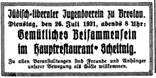
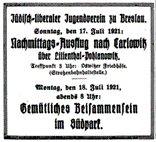
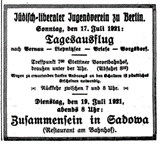
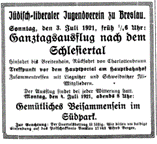
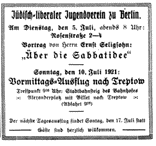
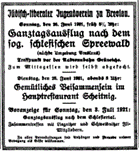
[Outings with the Jewish-Liberal Youth Organization]
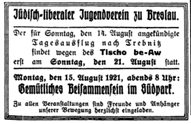
Jewish-Liberal Youth Organization of Breslau.
The outing to Trebnitz planned for August 14 will take place on Sunday, August 21 because of Tischo be-Aw [Destruction of the Temple]

Monday, August 15, 1921 8 p.m.
Social Gathering in the South Park
Friends and well-wishers are always most
welcome to our events.

Jewish-Liberal Youth Organization of Berlin.
Sunday, August 14, 1921,
Morning outing to the Saubucht in Grunewald
Meet at 9:00 a.m.: Zoo station, City platform with a ticket to Grunewald
(Departure at 9:10)

Tuesday, August 23, 8 p.m.:
Social Gathering
Schloss Wannsee near Beelitzhof
(Lake Nikolas station)


p. 2

and whenever they stood in the way of his policies. He hurled his lightning bolts at all his opponents. To my knowledge, he never once publicly mentioned Judaism or the Jewish press.

One thing is certain: he did not esteem the anti-Semites, and that’s no wonder, for only an exceptional genius could harmonize with a man like Stöcker. He even hated Stöcker in his soul, just as he hated all “politicians in long gowns.” A personal circumstance later came into play. Stöcker belonged to a party that was working toward Bismarck’s downfall and had Count [Alfred von] Waldersee at the ready for this purpose. At one point in “Thoughts and Memories,” Bismarck says:

I have always been suspicious of politicians in long gowns, both female and priestly, and this pronunciation by several hundred Protestant pastors in favor of one of the most frivolous slanders directed against the country’s leading official was not likely to strengthen my trust in politicians who wear a priest’s gown, even a Protestant’s one.

(This refers to the actions of the so-called Declarants, where hundreds of Protestant clergymen renounced Bismarck’s policies in statements published in the Kreuz-Zeitung.) Bismarck soon turned sharply against Stöcker, and it eventually came to open hostility between the two men. Stöcker even claimed that Bismarck had considered allowing him to be expelled, a suspicion that does not seem entirely unjustified. For in fact, Bismarck once had considered the idea—when he found his complaints  to the Kaiser about Stöcker fell on deaf ears–of allowing the Socialists Law to be applied against Stöcker.

The last sentence of this letter in particular shows how far Bismarck personally was from the activities of the anti-Semites, who were treated with marked goodwill by [Robert Viktor von] Puttkamer, the then Minister of the Interior, and the Berlin Police President [Guido] von Madai.

More than once, moreover, Bismarck took the opportunity to shake off the anti-Semites and poured bitter scorn on Stöcker, Ahlwardt, and others. In the third period, when Bismarck was in charge of his work, he thoroughly dispelled them. He declared the anti-Semite to be one of the most repulsive phenomena of our time, and moreover, one cannot demand more from a man like Bismarck.

Already as Chancellor, Bismarck left no doubt about his position on anti-Semitism. For example, on April 2, 1881, he delivered a speech that indisputably represented a reckoning with anti-Semitism. This is Bismarck’s speech at the discussion of the Reich budget with reference to the proposed accident insurance law. Eugen Richter had just spoken and pointed out that those conservatives who were instigating the anti-Semitic campaign were in a lively exchange of telegrams with Bismarck. Bismarck first explained in his speech what the telegram was about. He answered thousands of telegrams every day without checking who the sender was, and then added verbatim:

If anyone takes pleasure in portraying me as a member of an anti-Semitic organization, they can have it. As my official position requires, I have refrained from all of these movements, which are not welcome to me. I would only like to hope that the other gentlemen, and especially those who honor the government and me personally with their goodwill, will also refrain more than before from inciting one class against another and from turns of speech that stir up class hatred.

The break between Stöcker and Bismarck had long since been completed when the so-called “funeral-pyres” letter), which Stöcker addressed to the then editor-in-chief of the Kreuz-Zeitung, became public knowledge. In this letter, Stöcker suggested building pyres between the young Emperor and the Reich Chancellor, which would separate them without the young Emperor noticing… — It is understandable that Bismarck could not take a moron like Ahlwardt seriously; he called him a “funny fellow” and a “political tertiary.”

Nothing characterizes Bismarck’s changing stance toward the Jews more than a conversation Bismarck had on January 10, 1871, at headquarters. While Bismarck, as a Junker, had spoken out sharply against civil marriage and in an almost sneering manner about mixed marriage, as the statesman of Versailles, he expressed himself quite differently. The conversation is recorded by [Julius Hermann] Moritz Busch, and since Busch himself is an anti-Semite, there can be no doubt about the accuracy of his portrayal. Busch recounts (p. 31) that the conversation turned to the Jews, and Bismarck then jokingly said that he was of the opinion that the Jews were probably made harmless through crossbreeding. The results of racial crossbreeding were quite good. Bismarck then mentioned several noble families, such as Lynar Styrum and Gusserow, and remarked: “All very clever, nice people.”

Busch then writes: “Then, after some thought and an interlude, he noted that the marriage between distinguished Christian baronesses and rich or talented Israelites, he added:

By the way, it is probably better, conversely, to bring a Christian stallion of German breeding together with a Jewish mare. Money will be able to circulate again, and there is no such thing as a bad breed. I don’t know what I will advise my sons one day.”

Here we find a representation of a thought that Bismarck later expressed in a more eloquent manner on another occasion. In 1892, he said to Hermann Hofmann: “The Jews bring a certain spunk to the mixture of the various German tribes, which should not be underestimated.”

It is known how Bismarck repeatedly and decisively supported the Romanian Jews and how, completely against the will of the surly government, he forced them to grant the Jews equal rights. Of course, neither the humane sentiment of the Reichstag nor any sympathy for the Jews played a role here. Here, it would be political reasons. Bismarck had definite intentions toward Romania, and the Jewish Question served him to achieve his goal. He repeatedly spoke out against the Romanian government when it came to protecting the Jews.

The difference in the attitude of Bismarck during the second period compared to Bismarck during the first period becomes clearly apparent in several speeches. While “Junker Bismarck” had completely rejected equal rights for Jews, it was a matter of course for him that Prussia was a Christian state, the mature state minister took an opposite standpoint, among other things in his speech on January 80, 1872. There he said literally:

As soon as we divide the state into its confessional parts, in which each confession must have its proportional share, the very considerable number of the Jewish population also comes into consideration, the majority of whom are distinguished by their special ability and competence for state affairs.

Bismarck rarely bestowed such an honorable characterization on a section of the population. At the same time, in the same speech, Bismarck distances himself from the standpoint of a confessional state, stating: “A government can only function professionally if it has a state religion. Such a state religion is established.” (Conclusion follows.)

Aus dem Reich.

Berlin. Rabbi Dr. Hochfeld suffered a stroke at the age of 50 while travelling from the Zoo station to Charlottenburg at the start of his summer vacation. The burial rites will take place in the Lützowstrasse synagogue. The funeral service will be held the following Sunday morning at 10:30. Dr. Hochfeld was also an instructor at the College for Jewish Scientific Studies.

Berlin. During its recent meeting, conference of representatives of Jewish congregations discussed the replacement of fees with fixed salaries for rabbis in great detail. Professor Türk (reform) opposed the proposal to continue the discussion in a closed session. This question concerns the whole community and the decades-long administrative practice. Professor Türk explained that ending the fees concerned all parties in the conference. The question was first proposed about twelve years ago in a Zionists’ election and hasn’t been let go since. It was maintained that the rabbis were primarily there for the rich, which Türk  denied. There are other reasons for reforming the dependency on donated fees. It’s a great injustice that some rabbis became wealthy from this system of donation-based fees whereas others are paid little for their service. The overworked rabbis must be freed from collecting these fees and apply themselves to more important matters, for true spiritual care and not just performing funerary and burial rites. (continued on p. 3)

The Jews in Europe

A speech by Ignaz von Döllinger on July 25, 1881. Newly published by Philo-Verlag, Berlin 1921.

We have the Philo-Verlag to thank for an interesting, cultural-historical excavation. They have reprinted the valuable and generous historical lecture on Jews by the famous professor of theology from Munich, Ignaz von  Döllinger.

[Heinrich] Heine’s pronouncement that Döllinger was meant by “every cotton boll has its donkey.” But that’s certainly not right. More accurate is that the praise of today’s greatest Christian theologians A. von Harnack, who heard Döllinger’s speech in the Munich Academy for Sciences, noted:

Where is there today a second historian who has the same industriousness and insight, to understand foreign attributes, to become completely familiar with the historical texts through the ages as Döllinger? Like with the universal history of the church he seeks to provide an account of not only Germany’s political and cultural history, but of the whole of Europe, even to as far as India!

Döllinger’s works are somewhat outdated and largely forgotten, no longer available in bookstores. This historian is perhaps better known for Heine’s attacks than for his many significant books.

He was born on February 28, 1779 in Bamberg, the son of a famous anatomist and physiologist, J. von Döllinger. After completing his studies in theology and having passed all his exams with the highest distinction—he became professor of church history and church law at the Ashaffenburg Lyceum in 1823. In 1827 he became a full professor at the newly founded University of Munich. At the age of 91 he died there after an extraordinarily productive life dedicated to the religious and political renewal of Catholicism.

Recent research has shown clearly that Heine’s many “fights” with famous contemporaries, as for example, with Platen, started with Heine as the one who was attacked first and he was just defending himself and sought to gain our sympathy for his side as in the battle the great poet fought with the Munich theologian, where he did not act the part of the “misbehaving favorite of the muses.”

The jokes Heine made in his travel journals [Reisebilder] about some of the Catholic mysteries were well aimed to wound some orthodox-Catholic souls. The poet admitted the same for in the second edition of his depictions, he removed the passages.

The attacks Döllinger made in Eos, Munich’s newspaper for poetry, literature and Art in the August 18, 1828 issue on Heine were indeed also hateful and insulting. But one must consider the many, truly mean and base antisemitic insults Heine suffered and give him some understanding when the injured poet goes off the rails when he takes revenge.

In “Ex-Natchtwächter” from the Romanzero collection, Heine makes the academic seem ridiculous:

Apropos! The arch-notorious
Priest Dollingerius—
That’s his name, I think—
Does he still live by the Isar river?

I can’t forget him!
In the pure sunlight!
I’d never seen such an ugly
miserable sinner’s face.

They say he came
Into this world quite wondrously,
Took the back way,
To his mother’s shock and shame.

I saw the pilgrim on Good Friday
In the procession’s train,
Of all the dark men there
He was the darkest one.

That was of course just too much! When Heine applied to do his post-doc in Munich, Döllinger fought against it strenuously. (See Allgemeine Deutsche Biographie, Vol. 48, p. 3).

Whoever wants to learn more about this long forgotten, today quite comical, feud should read Karpeles’ Heine biography, Leipzig 1899, p. 114 and J. Freidrich’s collected Döllinger works, Vol. I, p. 207. There you’ll find everything in more detail.

We recognize from the newly reprinted Jewish lecture by Döllinger that he was certainly not the “repulsive clown” that Heine made him out to be, but rather a great and right-thinking historian.

The talk about the “History of Jews in Europe” held in the Academy of Sciences in Munich is an unprejudiced journey through the terrible history of Jewish suffering. Already in 1849 when Döllinger was an elected representative in the Bavarian parliament, he argued for the complete emancipation of Jews. He must have already worked on Jewish history, for his extraordinary knowledge of the fate of this unfortunate people comes to the fore in his later speech.

His taking of the Jews’ side isn’t due to some sort of philo-semitic impulse but dictated by his sense of justice. At the start of his speech he sharply decries some of the supposed flaws of Jews such as fanaticism and self-promotion. Here he clearly exaggerates (cf. the well-known book by Professor Berliner).

Then he describes the fate of Jews since the destruction of the temple. He refers to many documented points of evidence how they were exploited by lords and kings over the centuries, how because of being prohibited from participating in civil life, Judaism was made to seem like a socio-pathological condition. He told of the countless attacks by the upper class and the lower-class folk. Organized by historical epochs, he ascribed the rulers’ and the folk’s drive to persecute Jews to medieval superstition. In short, he unrolls the Jews’ entire trail of sorrow  before our eyes with shocking openness and  rightly calls it the ”most awful drama that world history has ever seen.”

He concludes with his hope for better times and ends with the wonderful words from Sophocles’s Antigone: “Not to hate, but to love am I here!”

The honorable old man’s hopes have unfortunately not been fulfilled until now; we live in a new flood of the most idiotic Antisemitism and from Munich we hear some distressing stories of the activities of the local knights of the swastika.

All the more, we Jews must the recognize the love of truth and justice shown by the exceptional Bavarian church historian.

There are countless more comprehensive, better and more thorough historical overviews of the Jews’ sad history, but such a short, meaningful, and clear walk through world history is seldom attempted in a lecture.

We want to lay a wreath on the grave of this courageous professor who spoke such in the Bavarian Academy of Sciences and give heartfelt thanks to the Philo-Verlag for its reprint of this excellent speech. Dr. L.[udwig] D.[avidsohn]

______________________________________________

p.3.

Aus dem Reich, Berlin

[continued from p. 2]

Professor Türk, who spoke on the issue, noted that the abolition of the rites is on the agenda of all parties in the Representatives’ Assembly. The issue was first broached about twelve years ago at a Zionist agitators’ meeting and has not been settled since. It has been claimed that rabbis primarily serve the rich, a view the speaker disputes. There are other reasons for reforming the rites-based system. It is a monstrous injustice that some rabbis become wealthy through the rites, while others receive no equitable compensation through their salaries. The overburdened rabbis should be freed from the rites, and their energies should be freed for more important tasks, for genuine pastoral care that does not consist solely of wedding and funeral orations. The rabbis’ field of work are social welfare and religious education in secondary schools. The final impetus for discussing this issue came from the letter from Rabbi Dr. Baeck. The work was interrupted by the war. As a result of lengthy deliberations, a mixed commission proposed abolishing all financial relationships between rabbis and the communities.Going forward, communities are to pay a certain amount into the communities’ treasuries for the rabbi’s services, two-thirds of which goes to the rabbis and one-third to the community. A guarantee fund will be established for those rabbis who receive few fees for services. True pastoral care can, in fact, only be exercised if all financial relationships cease. The rabbis have already given their approval to the new regulation. It is therefore to be hoped that the ideal goal of freeing rabbis for higher duties will be achieved. — Attorney Stern (liberal) expresses his satisfaction with the proposal, which protects the rabbi’s feelings, which can be violated by a “donated” fee, and thereby enhances the ideal connection between rabbi and community. – Mr. Kirsten, on behalf of the communities’ boards, expresses his agreement that the proposal will be approved unanimously in the assembly as well as in the mixed commission. He thanks the community rabbis for agreeing to this regulation by waiving a legally binding right. According to the new regulation, every community member will still be free to turn to a rabbi of their particular trust. After some further comments from the assembly, the proposal was unanimously adopted.

At the February meeting of the Representatives’ Assembly, the Zionist side, during the resolution on subsidizing the College for Jewish Science, requested that the Orthodox rabbinical seminary in Berlin also be granted a contribution equal to the amount granted to the College. This request was postponed for business reasons because no request from the rabbinical seminary was submitted and the basis for calculating the subsidy was lacking. In the meantime, the subsidy request from the rabbinical seminary has been received with a detailed justification, which shows that of the rabbis trained in the seminary, 26 are employed in Berlin, four of whom are employed by the Jewish community. The seminary’s budget, which amounted to 45,000 marks before the war, has grown to approximately 280,000 marks; in the past year, the income amounted to 125,000 marks, compared to 223,000 marks in expenditure.

The municipal council proposed an annual contribution of 20,000 marks for the institution. — The Representatives Assembly considered this proposal at its last meeting. The speaker, Medical Councilor Dr. Steinthal (liberal), recommended acceptance of the proposal on grounds of fairness. As the first speaker, Professor Dr. Türk (liberal) objected to a statement made during the previous discussion by representative Dr. Abrayam Löb (First Vice President), who had declared that he was not able to vote for the subsidy for the liberal College for the Science of Judaism. According to these statements, Professor Dr. Türk, as Dr. Löb’s religious opposite, is unable to vote for the subsidy for the Orthodox rabbinical seminary. He does not deny the rabbinical seminary’s right to exist; as a liberal, he believes that both schools of thought have their full justification. However, he accuses the rabbinical seminary of fostering a spirit of intolerance it fosters in its students. The rabbinical seminary and the Adass-Yisroel community have repeatedly and disastrously interfered in the development of the greater Berlin community:  For example, in the question of employing a school inspector for the community, then in 1912 with the planned expansion of the community administration through the proposed increase in the number of members of the executive board and the Representatives Assembly, and more recently with the creation of the comprehensive organization of the Jews of Germany, whose development is seriously endangered by the stance of Orthodoxy. From all these considerations, the speaker concludes that it is necessary to speak out personally against the adoption of the proposal. Attorney Stern (Liberal) comes to the same conclusions as the previous speaker and declares that he will abstain from voting. The rabbinical seminary cultivates a spirit of intolerance and denial of any other view; it denies the legitimacy of liberal development in Judaism and has never shown parity toward liberal demands. Dr. Neumann (Conservative.): Maintaining parity is not the concern of the institutions, but the task of the community administrations. The subsidy application submitted at the time was also intended to work in the spirit of this parity. After the Conservatives voted without hesitation to subsidize the liberal college for the science of Judaism, they expect the Liberals to also support the conservative institution. Professor Dr. Loewe (First Vice President) explains that the community has an obligation to provide for both institutions, since each of these institutes represents a necessity for Judaism. Dr. Abrayam Löb (First Vice President) asks that fundamental questions, such as the position towards liberal and orthodox Judaism, not be decided by vote. History will decide the worth or worthlessness of both directions. Medical Councilor Dr. Steinthal (Liberal) also opposes abstentions. It is a matter of promoting science [knowledge], regardless of who is pursuing it. The Berlin community, which comprises almost half of all German Jews, is obliged to support both schools of thought. After a correction by the representative, Professor Dr. Tűrk the session ended. The board’s proposal for an allocation of 20,000 marks for the rabbinical seminary is adopted by 10 votes to 2, with 2 abstentions.

Berlin. Affordable room and board for Jewish religious staff in health resorts.

The Central Committee for Jewish Welfare in Frankfurt am Main recently proposed the following to the Central Welfare Agency of German Jews in Berlin:

As a result of the current economic conditions a large part of the middle class, especially the religious staff, teachers and cantors can no longer afford to go to a health spa or cure resort when they are ill for the prices of room and board are simply too high for their income levels. Efforts should be made to arrange that the health facilities in the spa towns offer midday meals at wholesale cost. The Central Welfare committee of the German Jews joined with the Association for Ritual Dining in Hamburg to survey the kosher restaurants in their area. The results were favorable. The hotels and restaurants in nearby resort towns have said they are prepared to offer at-cost prices (or discounted rates) for meals: Baden-Baden, Bad Brückenau, Bad Kreuznach, Bad Mergentheim, Bad Nauheim, Bad Renndorf, Bad Orb, Bad Teichenhall, Segeberg, Bad Tölz, Wiesbaden, Wildbad, Bad Wildungen.

For additional information, contact the Association for Ritual Dining, E. B., Hamburg, Königstrasse 21/23.

Kassel. A Jewish Renegade as Defense Witness for Dr. Dinter.

Following our report on the blasphemy trial of the all-too-well-known Dr. Dinter, a sometime colleague aptly illuminates the peculiar role played by an editor, a baptized Jew, in the proceedings before the Kassel Criminal Court. On July 11 of this year, according to our source, the trial against Dr. Dinter for blasphemy took place before the Kassel Criminal Court. At a meeting the previous year, he had spoken of the Jewish God as a businessman enthroned above the clouds and had criticized the Old Testament Scriptures—especially the prophets. They described them as journals of Jewish racketeering and fraud, and claimed that the Kol Nidre prayer permitted Jews to commit any kind of perjury or fraud. In the trial before the criminal chamber, the editor Dispeker, who had followed Dinter’s statements from the press table, was also heard as a witness. He confirmed that those statements had been made. When asked by the presiding judge whether he had personally taken offense at them, whether he had found the statements blasphemous, this man, who had been Jewish just six years earlier, could only reply that he had not seen any blasphemy in them. I could only admit that strongly religious people must have felt that Dinter’s words were blasphemous; he was not sufficiently religiously inclined to be outraged by such turns of phrase. Dispeker denied any knowledge of the Kol-Nrdre prayer and vigorously emphasized his Protestant faith. Everyone who attended the hearing had the impression that Dispeker was primarily trying not to reveal anything about his Jewish past. — But in vain! —Deeply ashamed, he had to confess in response to Dinter’s question that his ancestors (!) were of the Semitic race. This is the behavior of a Jewish renegade who, despite all his negative religious orientation, considered it necessary to convert to the Protestant faith. While another witness, a dissident, in whose veins hardly any Semitic blood circulates, stated that he, as a human being, was outraged by Dr. Dinter’s blasphemous speech, a former Jew and now Protestant Christian could not admit that his human sensibilities had been affected in any way. And such a man is a welcome guest in certain Jewish social circles—only in such circles. It is shameful, deeply shameful for those Jewish circles, that need the intellectual sparks of such a man to give their social gatherings a “higher tone”—even if those are just well-told—Jewish jokes.

Lebens=Erinnerungen einer alten Frau. A memoir by Regina Neisser

p. 4

Dedication of the Mortuary in Bad Kudowa

On August 3, the Chebra kadisha in Bad Kudowa held its general assembly at which the newly built mortuary was ceremoniously handed over to the community. The Chebra was founded five years ago by spa guests who wanted to build a mortuary for sick guests and a place where a worthy service could be held during the high season. The war caused the construction to last until now. The mortuary is about ten minutes away from the spa town’s main square on a gentle hill guarded by trees. It can hardly be seen from the street and only the gilded Star of David shines over the trees. After the builder, Master Builder Prinz from Breslau made a short speech and gave the head of the Chebra, the optician Dr. Josef Schlesinger (Breslau) the keys to the mortuary, the latter invited the many guests to celebrate the dedication. He based his speech on the Schehechejonu. He noted the members of the Chebra board who had died in the last five years, the brothers from Posen and West Prussia whom the war had taken away from us, and expressed the hope that at least our Upper Silesian brothers will fare well and remain close to us German citizens of Jewish faith. Then he thanked everyone who had supported the construction, the general contractor, the craftsmen and workers, Bad Kudowa’s civic administration kindly accommodated deceased Jewish spa guests in their mortuary, and the representatives of the synagogue communities of Breslau, Glatz, Gleiwitz, Tarnowitz, Kattowitz, and Beuthen, as well as the Bne Briss order who had come to the celebration. He wished that the mortuary be only rarely used, but in case it becomes necessary, that it would not be a place of despair, but a source of comfort and the assurance that the death was in accordance with God’s will.

With that he handed the hall’s key to Rabbi Dr. Ellguther (Neisse or Reisse) who opened the doors and performed the dedication worthily. After a presentation of a psalm by  Cantor Wartenberger (Breslau) he described the Jewish virtues that led to the hall being built: love, loyalty and unity. After him, Kudowa’s mayor, Dr. Schindler, and the general director of the spa’s administration, Mr. Offenberg expressed the hope that one of the next goals of the Chebra would be building a house of God in Kudowa. The uplifting ceremony closed with a German song by Cantor Wartenberger.

In the general assembly that immediately followed, the board was unanimously re-elected. The chairman, Dr. Schlesinger declined to be re-elected, was then replaced by Mr. Wolf Gottheiner from Breslau. Additionally, a committee sitting in Kudowa and under the leadership of the health spa’s doctor, Dr. Cohn, which should address the Chebra’s local matters.

In the evening a celebratory dinner attended by many was held in Pollak’s restaurant. In a perfectly formed, intelligent and humorous speech, Rabbi Dr. Lewin (Kattowitz) honored the Chedra’s board and drank to the future flourishing of the association. Dr. Schlesinger (Breslau) dedicated his glass to the representatives from Kudowa’s community staff. In a charming manner, General Director Offenberg responded and expanded with an assurance that Kudowa’s spa directorship and the community administration would take pains to make Jewish guests’ stays as pleasant as possible. About 65% of the spa’s guests were Jewish, but the number of complaints from the Jewish guests made for a small number of the complaints that the director received. That would indicate that the Jewish guests felt good about Kudowa. He promised to continue to strive to make their stay in Kudowa pleasant. That’s why the community administration will give the Chebra its fullest support if it takes on building an admirable synagogue. Rabbi Dr. Ellguther’s naming the former chairman, Dr. Josef Schlesinger, an emeritus member and chairman, was met with applause from all. An auction of the benchen took in 765 marks for the Chebra. The respectful and in-every-way successful celebration will certainly leave a lasting impression in the hearts of those who attended.

Breslau.

From the Swastika Wearers.

Foerder, the lawyer, sent us a flyer that came to him from the German Nationalist Protection and Defiance Federation, Breslau chapter. Here is its content:

Attacks on the swastika!

Our members continuously report that men and women who wear the swastika are bothered, scolded, threatened, and physically attacked by Jews who even steal the swastika. We have already brought a number of these attacks to the courts.
We now make you aware that the swastika is an “historic Germanic symbol of well-being: and that we as Germans make our German heritage and attitude known by wearing the swastika.
Wearers of other symbols, especially the Jewish Star of David, have never been bothered  by our side.

As Germans, we claim the right to wear our German symbol in public.
In light of the many cases that have occurred, we warn you that assaulting wearers of the swastika in any form will force us to take defensive measures.

German Nationalist Protection and Defiance Federation

The following handwritten note was added:

Germans showed the whole world not only courage but true heroism on the front. The Jews? Etappe, homeland, etc. The reproach that the German folkish were “cowardly” will be proven wrong and in full daylight.

[Editor’s note:] It is probable that the flyer was sent following an appointment with the Schoeffengericht where the leader of the local German-folkish group was accused of harm last Saturday. The  German Nationalist Protection Federation’s defense attorney, Schmidt, thought his argument was completely political but followed the usual antisemitic themes, until the head judge told him to stay on the matter at hand.
A flyer with the same content has also fluttered across our editor’s desk. However, the handwritten message is “Cavete Judaei!” [Jews, take heed!]

80th Birthday. Mr. Hermann Naphtali, Körnerstraße 46, recently celebrated his eightieth birthday. We wish the active supporter of our movement best wishes.

Circus Angelo. The Circus Angelos has set up its traveling circus on the right bank of the Oder next to the Kaiserbrücke for its Breslau shows. These have already started with a good, nicely executed program. The much-celebrated director and equestrian, Carl Strassburger Jr. displayed his brilliant horse act with truly excellent dancing horses that certainly deserved the laurels they’ve collected. On the tightrope, the foxtrotting Joe Gilbert executed incomparable artistic stunts like headstands, somersaults, and dancing. The gymnastics performed on the backs of proud horses in the double-joockey act was one of the most enjoyable circus acts. As an entre-acte, a group of moody clowns terrified the audience with jousting that included a creative act where riders tried to knock top hats off each other’s heads. The Spanish riding act by Will and Wine had buffalo and horses performing. A light fairy making serpentine movements on the back of an illuminated white horse made for a colorful effect. The artistic part of the show was brought by the Aregos acrobats and their springboard stunts, the gymnastic ladies’ troup “Three Rostocks”, and the fire-breathing human volcano. The program offered so much and such high quality performances; and its harmlessness makes it something that families and children will certainly enjoy. The special family performances take place at the same time as the daily 7:30 p.m. evening show and on Sunday at 3:30 in the afternoon. F.A.K.

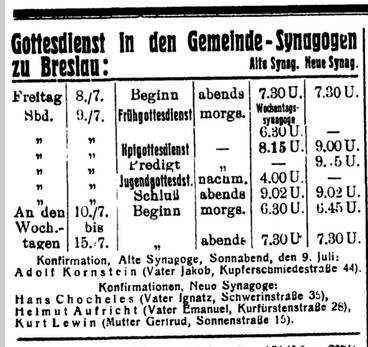
Bar mitzvah Service in the New Synagogue.
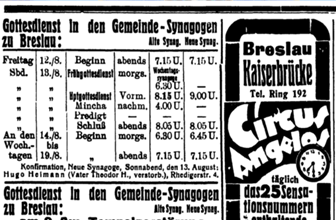


New Synagogue
Hugo Heimann (son of Theodor H., deceased) Rhedigerstr. 4.

[Announcement from the board of the synagogal community]: The Jonas Hirschel estate will provide support for poor Jewish craftsmen and small businesses. Those receiving this money are bound to repay it once they are in a better situation. Applications must be submitted by September 1.

Advertisements

Link to the newspaper’s last page.
Posted in Anti-Semitism, German Jewish History, German Jewish Literature, German Jewish Newspapers, German Jewish Poetry, Jewish History, Reform Judaism, Translations | Tagged , , , , , , , | Leave a comment

Jewish Liberal Newspaper, July 29, 1921

Translator’s Highlights

“Causes of Conflict” by Hugo Unikower and “Bismarck’s Attitude Toward Jews” by Dr. [Otto] Jöhlinger are the central articles in the July 29. 1921 issue). ChatGPT generated themes from “Causes of Conflict”:

  1. Lack of Understanding and Misjudgment: A major theme is that ignorance of others’ cultures, religions, and perspectives leads to misunderstanding, unfair judgment, and ultimately conflict.Sstaying withinthe  narrow confines of one’s own community fosters prejudice.
  2. Conflict as a Consequence of Self-Interest: The document concludes with the idea that conflict arises when people act out of self-interest, seeking advantages that they believe will bring them happiness. Atonement or peace can only come when individuals move beyond these selfish desires.

And from the article on Bismarck:

  1. Bismarck’s Changing Attitude Toward Jews: Bismarck’s views on Jews evolved over time, reflecting three distinct phases of his life. Early in his career, he was opposed to Jewish emancipation and held anti-Jewish sentiments, which were influenced by his conservative circles. However, later in his career, his views became more pragmatic and less openly antagonistic.
  2. Influence of Social and Political Context: The article suggests that Bismarck’s attitudes were shaped by the sociopolitical environment in which he lived, including the circles of conservative, noble elites, and his family background. His views were not static but changed in response to the broader transformations in German society and politics.
  3. Misinterpretation of Bismarck by Antisemites: The article critiques how Bismarck has been mischaracterized by both antisemites and their opponents. While he made anti-Jewish remarks early in his career, these are not representative of his overall legacy, and many of his later actions showed a different attitude.

Dr. Walter Brinitzer concludes his essay, “Judaism and the Death Penalty,” opposing the death penalty. It’s an example of how contributors to this newspaper, knowing that the readership was keenly interested in the Jewish perspective on current affairs and important international debates, examine these from the unique position of historical experience and modern philosophies. The argument he makes is framed by contemporary social justice theory and rooted in the Torah and Talmud as well as historical Jewish practice of keeping the death penalty, however, only very rarely carrying out executions. For those who are interested in knowing more, Mishnah Makkot 1, 10 illuminates the law with the pronouncements of the Talmudic sages urging against compounding murder by executing the murderer.  The context for the international examination of the death penalty is the scrutiny of pre-war imperialistic or monarchical in light of political reforms.

In this issue, we read more examples of antisemitism occurring throughout Germany. At this point in time, they still appear to be isolated instances, but we begin to see the rise of nationalist or right-wing publications and the fearlessness of antisemites staging public events.

On a brighter note, a short report on the Brelsau 1990 Tennis Club’s winners, shows the comprehensiveness of Jewish social life at the time. The topic of German-Jewish tennis players was an interesting tangent to follow. Germany’s tennis champion before 1933 was a half-Jewish athlete named Daniel Prenn. (Source: https://bruckfamilyblog.com/post-19-game-germanys-1929-davis-cup-team-vs-czechoslovakia/)

Articles
Causes of Conflict by H[ugo] Unikower
Judaism and the Death Penalty by Dr. Walter Brinitzer (Continuation)
Bismarck’s Attitude Toward Jews by Dr. [Otto] Jöhlinger
From My Diary poems by Ludwig Davidsohn
About Keren Hajesod: United Israel Appeal
The Teachers Association and the Central Organization of German Jewry
Immigration to the United States
Bolsheviks and Jews
Kolberg. Summer Solstice Celebrations and Antisemitism
Göhren (Rügen). Big Mouth – Small Brain
The New Palestinian Parliament
The Jewish Pogroms in White Russia
From the Administration of the Breslau Synagogue Congregations
Breslau Tennis Club 1909
Family Announcements

p. 1

Causes of Conflict.

by H[ugo] Unikower, teacher.

In narrow circles thinking also narrows,
And mankind grows, expands with larger purpose.
[Friedrich Schiller, “Wallenstein’s Camp”]

The truth of Schiller’s thought is the key to the great puzzle of the cause of dissatisfaction in the world. Whoever doesn’t leave the narrowness of his hometown, who doesn’t have the chance to know other people except the nearest ones, who only knows the manners and customs, the language, the thinking of his own country or only knows his own religion, has a difficult time understanding the world of others, another country, another people, or another religion. And if we don’t know and understand others, we misunderstand them easily and judge them unfairly. Wrong judgment leads to the wrong treatment of people and nations and thus to conflict. Our natural defense mechanism of being distrustful of everything unfamiliar hinders us in correcting our prejudice against people. This feeling of mistrust is subject to our reason. Whatever we can’t directly recognize through our reason is conveyed through our feelings.  “What no logician’s logic can see, the child-like mind sees obviously. [Friedrich Schiller, “Wörter des Glaubens,” translation by John Sigerson.]

Feelings however should never be the deciding judge in the case of things and people. As long as we let our feelings judge we can reach the wrong conclusion and make a false judgement. Only when there is no logical understanding does one have to resort to emotional judgments. Correct judgments require thought, especially when making comparisons. It’s by comparing that we learn early in our intellectual development the concepts of space, time, etc. Comparing is also required for correctly judging our fellow men. Peoples, cultures, religions must be compared if we want to make a just assessment and not prejudice.

Here is just a small example of our old German and old Jewish traditions are similar although the old-German impatience and cold-heartedness claim to be the source of all good, as if the mind Geist depended on the shape of the nose or the color of hair and eyes.

The Bible tells of Joseph that he was loved and cherished by his father Jacob more than his other sons. The father thought he could protect him from all mishaps as long as he didn’t let him go far from home. Although he thought he could keep other dangerous influences away from his favorite child by doing this, so that he had not sent him as a shepherd with his other sons to the furthest meadows, misfortune came from within: the pride and arrogance that had grown in the child thanks to his being spoiled and fussed over drew his brothers’ hatred. They sold the proud brother who had told him of his dream where he was master over his father and his brothers as a slave. The boy who had grown foolish through his perceived good fortune ended up being bent to the yoke of slavery in spite of his overly careful father’s efforts. The fate of men follows its course and cannot be influenced by outside forces. He must go through his apprentice years like every other person otherwise he stays childish and arrogant—useless for the practical life. Joseph learns to be modest, to resist temptations and feels the consequences of willfulness on his own body that his earlier ways would have dealt him had he not gone to the rough schooling of life. Intellectual ability, symbolized through the art of interpreting dreams is what allows him to become a useful member of society after his dramatic fate: he reaches the highest level of human achievement and follows the path of tragic experiences to external and internal satisfaction that one tends to call “happiness.”

Although this story grew from the Orient, from Egyptian dream interpretation and Canaanite nomadic life, it has the same core thought, the same perspective on life as the Parzival legend that grew from the adventurous life of German knights.

Herzeleide had lost her husband, King Gamuret, to knightly combat. So she withdrew into the lonely forest with her son to prevent him ever being tempted by knightly battles. Cut off from the life of the world, he learned only a few things about it in theory from his mother’s explanations. As her explanation and portrayal of God gave him a strange idea of this concept, when he one day did see a knight he thought him to be a God. What his mother had always feared and put all her thinking and actions toward that happened anyway. When he saw the knight Parzival immediately felt the urge to perform knightly deeds: He leaves to seek adventure which his mother could not prevent. His unfamiliarity with the world, the fruit of his isolated upbringing, appears as a flaw throughout his battles with the many obstacles in his way. But courage and confidence, the art of sacrifice and self-control overcome this flaw so that he does finally reach the “holy grail” on whose delivery his good fortune depends.

The comparison shows that people strive here and there for the light. Only the ones who want conflict, and live by the sword, will always want to know the deciding point that will turn things to their benefit. Atonement can only be in the service of those advantages which they believe will make them happy.

Judaism and the Death Penalty.

by Dr. Walter Brinitzer – Chemnitz. (Conclusion.)

[Translator’s note: Warning! Part One contains explicit descriptions of methods and instruments for carrying out the death penalty up until the period immediately following WW1, when some European countries had revised their capital punishment laws and practices in light of the devastating experience during that war.]

We uphold the idea of reparation when we see punishment as a means to restore the disturbed sense of justice, but we let the Talion and with it the death penalty which can actually only be justified by the Talion.

Thus we deepen the idea of reparation by aligning it to ethical requirements.

We should only have such a right and allow it when it does not contradict our ethics, but rather supports them.

However, the executioner’s assistant doesn’t get to escape the sixth Commandment.

The state, as the protector of justice, has above all the duty to respect human life unconditionally. –

The death penalty also contradicts the essence of punishment.

Punishment should befall the criminal, not annihilate him.

The commandment to love one’s neighbor also applies to the criminal. The sinner remains God’s child, even if a ruined child (Jes. 1, 4, Deut 14,1).

Just as the shattered tablets lie in the chest, God holds all people equally in his heart (Menachot 99a).

Not the sinner, but the sin should vanish from this earth (Ps. 104,35).

The godless one who becomes better will leave his earlier sinfulness behind, “all the wrongs he has committed are not to be considered; through the piousness he practices shall he continue to live (Jer 18, 22).

“Do I take pleasure in the death of the godless one?” asks the Lord. Would I not prefer that he turns from his ways and lives? (Jer. 18. 23).

In criminal psychology, the murderer is certainly not at the lowest level of inhumanity.

If one removes the chance to learn a moral lesson from the criminal, the whole idea of reparation risks turning into seeking vengeance.

Through punishment, the criminal is to be brought to a moral sense of responsibility for one’s actions. For that, it is absolutely essential that he remain alive. –

Should someone still not be convinced by all the reasons against the death penalty, so the fact alone that a mistake can be made and an innocent executed (and we know innocents have been executed) should be enough to make every intelligent person be repulsed by the death penalty.

There is no more cohesive entity than human nature. The whole universe is not more complex for every person a particular reflection of the universe itself.

Hence it is simply impossible that anyone besides God can fully understand how a person’s nature develops. Even if people became much smarter than they already are we can assume that there would still be some mysteries.

As long as there is a part that one cannot know with complete certainty there is a doubt that the accused is the actual perpetrator—one must always take into account that there might be an undiscovered condition that makes the perpetrator incapable of understanding their action and their responsibility for it.

Of course, in this case, there are certain norms that are foundational and must be considered, but when in a life or death issue no doubts at all can be dismissed. **

Whoever saves one life, saves an entire world. (Sanhedrin 37a).

IV. Judaism’s Position

The death penalty was so circumscribed by the Pharisees that despite the Bible’s laws it was as good as abandoned.

The Talmud created a great number of guarantees and requirements that all had the purpose of making the death penalty impossible to carry out.

In civil cases 3 judges sufficed; the lightest criminal case called for 23 judges and the most important court required 71 (Sanhedrin 1, 4,1).

Before a judgment could be pronounced, the guild of the accused had to be proven without a doubt.

Confessions of guilt could not cause a death sentence or any other punishment because the confession was evidence of some improvement and regret. Or it could happen that someone confesses to a murder out of desperation or to save someone else’s life  (Sanhedrin 4, 5).

Someone could be accused of murder only by two trustworthy witnesses who warned him that he would receive the death penalty and despite the warning committed the crime anyway.  

The witnesses must have seen the act from beginning to end and cannot contradict themselves in the smallest detail (Sanhedrin 5,3).

The witness interrogation was extremely painstaking and intense. Witnesses involved in death penalty cases were admonished with the following words: “And He said, “What have you done? Hark! Your brother’s blood cries out to Me from the earth.

If a person sins, whereby he accepts an oath, and he is a witness [to some matter] by seeing or knowing [it], yet he does not testify, he shall bear his transgression; Leviticus 5 Translation source.

HOW WERE THE WITNESSES INSPIRED WITH AWE? WITNESSES IN CAPITAL CHARGES  WERE BROUGHT IN AND INTIMIDATED [THUS]: PERHAPS WHAT YE SAY IS BASED ONLY ON CONJECTURE,  OR HEARSAY,  OR IS EVIDENCE FROM THE MOUTH OF ANOTHER WITNESS,  OR EVEN FROM THE MOUTH OF A TRUSTWORTHY PERSON:  PERHAPS YE ARE UNAWARE THAT ULTIMATELY WE SHALL SCRUTINIZE YOUR EVIDENCE BY CROSS EXAMINATION AND INQUIRY? KNOW THEN THAT CAPITAL CASES ARE NOT LIKE MONETARY CASES. IN CIVIL SUITS, ONE CAN MAKE MONETARY RESTITUTION  AND THEREBY EFFECT HIS ATONEMENT; BUT IN CAPITAL CASES HE IS HELD RESPONSIBLE FOR HIS BLOOD [sc. THE ACCUSED’S] AND THE BLOOD OF HIS [POTENTIAL] DESCENDANTS UNTIL THE END OF TIME,  FOR THUS WE FIND IN THE CASE OF CAIN, WHO KILLED HIS BROTHER, THAT IT IS WRITTEN: THE BLOODS OF THY BROTHER CRY UNTO ME:  NOT THE BLOOD OF THY BROTHER, BUT THE BLOODS OF THY BROTHER, IS SAID — i.e., HIS BLOOD AND THE BLOOD OF HIS [POTENTIAL] DESCENDANTS. (ALTERNATIVELY, THE BLOODS OF THY BROTHER, TEACHES THAT HIS BLOOD WAS SPLASHED OVER TREES AND STONES.)  FOR THIS REASON WAS MAN CREATED ALONE, TO TEACH THEE THAT WHOSOEVER DESTROYS A SINGLE SOUL OF ISRAEL,  SCRIPTURE IMPUTES [GUILT] TO HIM AS THOUGH HE HAD DESTROYED A COMPLETE WORLD; AND WHOSOEVER PRESERVES A SINGLE SOUL OF ISRAEL, SCRIPTURE ASCRIBES [MERIT] TO HIM AS THOUGH HE HAD PRESERVED A COMPLETE WORLD.  FURTHERMORE, [HE WAS CREATED ALONE] FOR THE SAKE OF PEACE AMONG MEN, THAT ONE MIGHT NOT SAY TO HIS FELLOW, ‘MY FATHER WAS GREATER THAN THINE, AND THAT THE MINIM  MIGHT NOT SAY, THERE ARE MANY RULING POWERS IN HEAVEN; AGAIN, TO PROCLAIM THE GREATNESS OF THE HOLY ONE, BLESSED BE HE: FOR IF A MAN STRIKES MANY COINS FROM ONE MOULD, THEY ALL RESEMBLE ONE ANOTHER, BUT THE SUPREME KING OF KINGS,  THE HOLY ONE, BLESSED BE HE, FASHIONED EVERY MAN IN THE STAMP OP THE FIRST MAN, AND YET NOT ONE OF THEM RESEMBLES HIS FELLOW. THEREFORE EVERY SINGLE PERSON IS OBLIGED TO SAY: THE WORLD WAS CREATED FOR MY SAKE. PERHAPS YOU WILL SAY: WHY SHOULD WE INCUR THIS ANXIETY?  [KNOW THEN:] IS IT NOT ALREADY WRITTEN, AND HE BEING A WITNESS, WHETHER HE HATH SEEN OR KNOWN, IF HE DO NOT UTTER IT?  AND SHOULD YE SAY: WHY SHOULD WE BEAR GUILT FOR THE BLOOD OF THIS [MAN]:  — SURELY, HOWEVER, IT IS SAID, WHEN THE WICKED PERISH, THERE IS JOY!

After these admonitions the witnesses were examined by seven questions:

IN WHAT SEVEN YEAR CYCLE?  IN WHAT YEAR? IN WHAT MONTH? ON WHICH DAY OF THE MONTH? ON WHAT DAY?  AT WHAT HOUR [OF THE DAY]? AND, AT WHAT PLACE? R. JOSE SAID: [THEY WERE ONLY ASKED:] ON WHICH DAY [OF THE WEEK]? AT WHAT HOUR? AND, AT WHAT PLACE? [THEY WERE FURTHER ASKED:] DID YE KNOW HIM?  AND, DID YE WARN HIM? Sanhedrin translation source

Even if the witnesses say it happened yesterday, they are asked these seven questions to uncover contradictions.

As soon as there is a contradiction, the testimony is declared void, without them being accused of false bearing false witness.

When Rabbi Johanan ben Zakkai was judging a case where the murder happened under a fig tree, he asked the witnesses whether the stalks of the tree were thick or thin to see if they contradicted each other or simply did not know. (Sanh. 5,2).

If the witnesses had seen someone running out of a ruin with a bloody sword and found a victim’s still-bleeding body, they can’t accuse him of this murder because an infinite number of possibilities could indicate that the suspect is not necessarily guilty of this murder (Sanh. 37b).

If someone kills someone whose bones,  intestines, and the like are damaged, he cannot be guilty [of murder] (because this person—who is Terefah [unfit or impure, not kosher]and would not have lived long). If a Terefah kills someone he will be condemned to death only when the murder occurs in the presence of the court.

The connection is thus: Witnesses who are found to have lied because of the defendant’s alibi will get the punishment they had wanted the defendant to get (Deut. 19,19). However, the witnesses could say, “We only wanted a person to die who would have died soon anyway” (Sanh. 4,1).

A trial will be re-opened only upon the defendant’s request (Sanh. 4,1).

Everywhere we see the efforts to avoid the death penalty.

In Mishnah Makkot 1 10 it states:  A Sanhedrin that executes a transgressor once in seven years is characterized as a destructive tribunal. Translation source

 [Rabbi Elazar ben Azarya says:This categorization applies to a Sanhedrin that executes a transgressor] once in seventy years.

We hope that this mindset finally wins.

Indeed already today all countries give clemency to most murderers.

The time when we see the death penalty much as we see witch trials and torture is not far off.

May we free the new legal code from the medieval remnant of the death penalty so that the State forever fulfills the sixth Commandment’s holy demand.

[Outings with the Jewish-Liberal Youth Organization]

Jewish-Liberal Youth
Organization of Breslau.
Sunday, July 31, 1921: Afternoon outing to Obernigk Train to Hennigsdorf, Hike to Liebenau, Jäkel, Obernigk. Meet in front of main gait to the main train station 1:15. Train leaves at 1:30.
Montag, August 1, 1921,  8 p.m.:
Friendly Gathering
in the Südpark.

Jewish-Liberal Youth Organization of Berlin.
Sunday, July 31, 1921
Morning walk to Grunewald.
Meet 9:15 at the Zoo, on city train platform.
Depart at 9:20.
Return around 2 p.m.
Sunday, August 7, 1921:
Day trip to Fürstenwalde-Berkenbrück.
Meet at 7:40, the Alexanderplatz city train platform with ticket in hand to Fürstenwalde {depart at 7:54).

p. 2

Remember Jewish Children's Aid

Bismarck’s Attitude Toward Jews

By Dr. [Otto] Jöhlinger, Advisory Councilor to the Ministry of Finance, Berlin.
This article was first submitted to the “Kölnische Zeitung.”

Gustav Schmoller wrote in his thoughtful essay on the changes in Bismarck’s views that they were shaped by seemingly unresolvable contradictions, and these contradictions were indeed many. Not only that, the incongruity between Bismarck during the time he entered government service and when he became President of the Prussian Ministry was extraordinarily sharp. Firstly, Bismarck believed in the feudal state, yet it is he who introduced the general, equal, and private right to vote to the German empire. He was originally an arch-conservative, one of the main supporters of the far-right wing, and yet when he was Chancellor he made the conservatives pay their due. He founded the “Kreuzzeitung” in 1848, but he in his memoir “Thoughts and Recollections” he wrote most disparagingly about his newspaper, more than any other national or international newspaper. He referred to “the newspaper’s poisonous mixtures” and its lies. In 1876 he held a speech in parliament against the “Kreuzzeitung.” Until 1850 Bismarck was supporter of the guild system. As Schmoller says he regarded the reinstatement of the guild-system as one of the most important economic measures to reverse the false equalization brought about by the liberals’ laws, yet he is the one who brought about far-reaching freedoms for business and industry, for the stock market in Germany. Until 1876 Bismarck believed in the free market, however in 1879 he introduced tariff-based policies. In terms of socio-politics Bismarck’s opinion was that the state should institute productive co-ops—later he is actively engaged in socio-politics.

These are only a few of the contradictions in Bismarck’s life of which there were many more. But what do they  tell us? Certainly not that Bismarck had a mercurial character who hung his coat as to how the wind blew and let his politics serve whatever means. Bismarck was not this sort of “Politician of Opportunity.” If there is such a great difference between the Bismarck of 1848 and the Bismarck of 1870, if Bismarck after 1890 is a completely different man as the “first servant of Wilhelm I”, it’s because the world had undergone change. Between the Bismarck of 1848 and the one from 1890 are 42 years and so many events! Three wars were waged, a unified kingdom was created. Economically, culturally, and sociologically Germany was very different. Should Bismarck have been inure to these developments? Just as the old Goethe had a very different take on things as the young Goethe of Frankfurt, the same is true of Bismarck. The saying [from Nietzsche], “Only he who changes, stays akin to me” applies to Bismarck as well. Precisely in this do we perceive Bismarck’s greatness, that he is not an obdurate reactionary, that he’s not just a follower of groups with blinders on, but a person with open eyes, a bright mind that can quickly surmise the necessary. He had a rare and extraordinary ability to observe that was supported by an unusual amount of knowledge, and the courage to separate himself from his surroundings and tradition whenever he recognized their falseness. The break with the conservatives which alienated his personal friends, the circle in which he had met his beloved wife must have been the hardest thing to bear. The bitterness over what his faction had done to him mirrored the break with the conservatives and left a hole in his soul, but Bismarck was too great to make concessions in order to avoid a crisis. Schmoller correctly states, “If he had stayed the feudal nobleman and reactionary captain of 1848, he would not have had the wherewithal to become a Ministry President, unlike a Senfft von Pilsach, Gerlach, Kleist-Retzow, and Wagner. Bismarck distinguishes himself by standing high above his landed peers and his own family. One loves calling Bismarck an arch-reactionary, a Junker, a nobleman, an agrarian. But nothing is more wrong than this. Bismarck was not so much a Junker as is commonly thought—half of his blood was not at all noble, but liberal and bourgeois. His mother was the daughter of a well-known liberal administrator, Anastasius Mencken, who came from a long line of scholars and administrators and who was thought of as “suspect” in conservative circles. Into this mix of city bourgeoisie and landed nobility comes the union of both sets of characteristics: the gigantic strength and energy from his father’s side and the intellectual abilities inherited from his mother. Bismarck is a half-breed in the true sense of the word and the combination brought him an overabundance of intelligence and talent. (Karl Scheffler described this beautifully in his book on Bismarck which unfortunately did very much distort Bismarck’s image.)

One had to keep these psychological principles before one’s eyes in order to understand who Bismarck was and how we changed. The same changes we see in politics and society were experienced by Bismarck and his attitude toward Jews. One loves labeling Bismarck an antisemite. One has not held back— antisemites as well as Jews—to characterize him as the father of the antisemitic movement. The Antisemites have held him up as the face of their movement, often completely misunderstanding the Chancellors’ true position, often purposely twisting his words. Believers on both sides seek to hand onto sayings that Bismarck made in public before 1848, forgetting that Bismarck thoroughly recanted his old views and sharply criticized those from his circles of friends who brought these up.

If we want to understand Bismarck’s views on Jews, we have to divide this man’s life into three parts that are sharply distinct. The first period spans his public appearance to his entrance into civil service as a representative from Frankfurt to the national congress; the second period from his service as the ambassadorship, as the President of the Prussian Ministry, and as Reichs Chancellor until 1890; and the third his time in the Sachsenwald until his death.

His statements from the three periods are so fundamentally different, often contradictory that when one finally sees them one would believe different people had said them. The “crazy Bismarck” is no friend of Jews. He tries to oppose them objectively, but many anti-Jews would not be completely mistaken to use his words as evidence of his antisemitism. No wonder. For in the circles from which Bismarck came and in the circle he met Johanna v. Puttsamer, his wife, one did not love Jews, perhaps because one didn’t know them, maybe because the ones whom this landed nobleman met weren’t always the best representatives. It’s from this time the statements come that deal negatively with Jews or want to limit their rights. The young Bismarck had no sympathy for the equal rights of Jews.

Of course it must be noted that not every word that Bismarck spoke in anger or on some occasion as though it were some legal declaration meant for posterity as undeniable proof of Bismarck’s views. Bismarck himself pointed this out and Bismarck researchers have found more than one quote that don’t fit into his communication patterns. The exceeding loyalty with which Bismarck served his king and Kaiser William I is well known yet we know of some strong statements Bismarck made when he was frustrated or disagreement. Should we take these as bearing witness to his true feelings about the king? The same goes for the occasional observations he let drop about Jews in private conversations or letters. But young Bismarck, the crazy nobleman from Kniephof, did not have much love for Jews, which is well-known speech to the entire National Congress of 1847 in which he was very reactionary and drew the attention of the congress through his speeches, especially the one on June 15, 1847 where he spoke on “Prussia as a Christian State.” He emphasized from the outset that he belonged to those known in the parliament as “dark and medieval.” He said:

“I am not an enemy of the Jews, and if they want to be my enemies, I forgive them. I even love them in certain circumstances. I grant them all rights, except to have leading positions in a Christian state…I see Prussia as a Christian state, as a state that has the duty to realize Christian teaching, to actualize it. That the Jews could help us fulfill this goal I greatly doubt… Therefore, Gentlemen, let us not diminish the people their Christianity by showing them that it is necessary for their lawmakers to be Christian. Let us not rob them of the belief that our laws drink from the sources of Christianity, and that the state is charged with the realization of Christianity, even though it doesn’t always succeed….When I imagine myself, the representative of the holy majesty of the king, in front of a Jew whom I should obey, I must confess that I would feel oppressed and dissatisfied. The joy and honor with which I fulfill my duties to the state would disappear. I share this feeling with the masses of low-born folk and would not be ashamed of their company.”

In this same speech, Bismarck mentioned a region where there were farmers who owned nothing except for their land. The furniture, the animals in the barn, the grain on the field—everything belongs to Jews. “I have never heard of similar usury from Christians, at least in my practice.”

We find some observations about this speech in his letters to his bride. June 15, 1847:

“Yesterday was a boring Jewish debate. 25 speeches for the emancipation of Jews that repeated the same sentimental pablum. Early this morning Jews again. I made a long speech against emancipation, said a lot of bitter things, don’t go through the Königsstraße after dark because the Jews will kill me.

On the 18th of June he wrote his bride about the discussion on marriages between Jews and Christians and mentions the vote on “the Jewish marriage question. I really don’t care. I have to go to the wool market.” Jewish marriage doesn’t seem to be of great importance to Bismarck.

On November 15, 1849 Bismarck opined on civil marriages and the people’s Christian consciousness. He opposed civil marriages and did so in crass language. Bismarck explained that the introduction of civil marriage would reduce freedom of religion to an empty phrase if one considers what the Christian, especially the Protestant, church requires, and that their members must follow their constitutional articles of faith, before they are allowed to claim, “the blessing of the Church, only through which the marriage is valid. Bismarck fought the introduction of civil marriage which he thought was hostile and could cause people to choose civil marriage over church marriage. Then he expressed himself:

I can only see that civil marriage could be a requirement in the case of reformed Jews. For a true Jew marrying a Christian would be a moral impossibility, and vice versa. If those Jews, who are no longer real Jews but only falsely call themselves Jewish, and Christian women, who falsely call themselves Christian, want to join in a civil marriage, we could allow an exception. I still find it puzzling that for these few renegades, we would lay such an unheard-of requirement on the millions of people who have stayed faithful to the beliefs of their fathers.”

In these speeches, one can clearly see the influence of the Puttkamer and Blankenburg circles, and other such Pietists, who have succeeded in swaying the “crazy Prussian nobleman.” (continues in the next issue.)

From My Diary

By Ludwig Davidsohn (the editor of this newspaper.)

Koheleth. [Ecclesiastes]
O, vanity of vanities, pointless effort
A short, thorny life long
Full of the eternal pain of being – And all is vanity!
O wise king, in  your soul too
Rings that old question: “God, why?,” –
That sounds in the breast of the lonely millennia
And never rests, like the mighty sound of the sea. . .
“Why all this? God, why?” —
__ __ __ Give yourself up to it, move forward in faith
and become dust! – The mysterious depths of the earth
remain lost to you! – Shout the anguished question
to the mountains in sunset’s glow:
“What is the purpose of this miserable life?”
And the echo answers clear and softly: “Life!” . . .


 Omnes una manet nox . . . [Horace, Ode XXVIII, “One night awaits us all”]
  There is no road or path that leads from one to another,
There is no understanding of each other,
Longingly stretching out one’s arms is only
Passing one another by.
  No comforting light glows in the night of your “I,”
No mouth can tell you about the other,
In loneliness do we all dream, forever alone
Even those souls meant for each other.
  Often longing thinks there are bridges
From one world to the other; —
Oh! Over the sea and from land to land
can no one ever walk!
  Forever spellbound by your “self” must you
Alone, longing and lost, feeling your way,
You can never free yourself from this prison
Never clarify the confusion.
 Darkness rings you, the fog rises,
Makes all the stars disappear. …
Pray! – But God is occupied and stays silent,
You will always seek yourself, yet never find yourself.

 To Doralice Glory with an example from my “Geschichte der Berliner Juden.” 
You shadowy memory of an old sorrow,
You’re still alive, you haven’t descended!
Since then, I too have drunk only feverish longing
from the cup of time…
  As dreamily the singing sounds, this whispering
From misery-filled years, —
And what the sad song carries,
I can only understand too well!
— — — An echo rings within like a dark tone
of bells that toll for the dead, — —
Oh, your comforting soul could
Take from me that doleful song! . . .

Doralice Glory. [She enchanted a Tatar king, her capturer, in Canto XIV, Orlando Furioso.]

                                   I.
Peacefully I sat with you at the forest’s edge
And read to you, …. at ties looking up,
Glanced quickly into the shining blue of your eyes
And the last rays of sun in your golden hair.
— Your pale face was oddly light….
You stood up then, … before the emerald fir
Stood your slim figure, — quiet and still and white
You stepped through the breath of the summer’s day. —
Steadfastly, I stared at your beloved image and it were
as if it transported me to the stars’ eternal pictures.

                                             II.

Have you ever circled a crystal glass
slowly with a wet finger? —
Did you then hear the dreamy tone
That rose like silver waves?

See, my heart is such a glowing bowl,
Filled with your being,
And in the depth of the quivering glass
Blossoms and glimmers your lovely image. Bring carefully with a light hand
The delicate crystal to ring and quiver,
And the sounding rim
Will quietly sing you a magical love song….

p. 3

Aus dem Reich.

About Keren Hajesod: United Israel Appeal.

A few weeks ago, the head of Keren Hajesod, that is, Rosenblüth, made a proposal to a union of Jewish leading organization to hold a conference in Berlin to make a decision on whether or not they should participate in Keren Hajesod. Such a conference would cost about 4,000 Marks. We leave it to our readers to think about whether this sum, which was collected for the development of Palestine should be allowed to be wasted in this way, and whether this kind of waste has happened in other organizations.

The Teachers Association and the Central Organization of German Jewry

With regard to the rejection of the teachers’ requests at the fifteenth Synagogue Congress—as well as of the Association of German-Israelite Congregations’ special committee’s recommendations “to study the situation of Jewish teachers,” the board of the Teachers Association has issued this decision:

“The board of the Teachers Association would like to recognize and thank its delegates to the fifteenth Congress of congregations for their strong representation of the teacher’s demands while at the same time regretting that the Congress rejected the most important demand “to regulate the work conditions and salary of teachers by decree. Although it is no substitute for teachers’ rights, we can see that there is an attempt by the Association of Congregations’ emergency action an attempt to make partial amends for the injustice that’s been done to them.

Berlin. Immigration to the United States. The heavy-handedness and prohibitive effect of the United States of North America’s new immigration law that limited the number of foreigners immigrating to the U.S. to 3% of its total population starting in 1910 was spurred by the following event. Because of a telegraph from New York all Poles, 254 of which were Jews, were prohibited from boarding the Mount Clay steamship leaving for New York from Hamburg on July 14. The group was then allowed to board the Mount Carroll on July 21 so that they would arrive in August and then be within the quota.

Königsberg. Bolsheviks and Jews. The German Nationalist Federation felt itself obligated once again to provide the number of Jewish members of Russia’s government. The numbers were so ad-hoc that even the “Ostpreußische Zeitung” gave them a very modest placement. Now the Königsberg chapter of the Central Organization of German Citizens of the Jewish Faith completely stamped out the sparks of hatred by stating:

“The German Nationalist Federation published a report in Number 328 of this newspaper under the above-mentioned title that was “based on unquestionably reliable research” by the local service of the German Telegraph Information. This report had already been published by the Parisian newspaper, “La Marseille France” and then the “Kreuzzeitung” on February 12. This list has been proven to be wrong. According to Dimitri Bulaschow, among the 17 People’s Kommissars, that make up the actual governing Cabinet, the Commissar for War [sic], Trotsky, is the only Jew. In all governing Soviet organizations there are 10 Jews—according to two former members who have since died.

Doesn’t matter, the Jew will be burned. Says the Patriarch.

[more poems by Ludwig Davidsohni]

On a Romantic Novelle.
Cheerful jests from great-grandfathers’ days.
How far are you from our times,
Which are troubled by sorrows and plaints;
— Vanished are you now, trusted feeling of belonging! — —

Oh! Memories of a never-lived existence
With its fairytale-like starlight
Quietly echo, so quickly becoming silent
Yet holding men though they hear it not!

Like a rare bouquet of flowers, that’s no longer seen,
Because it blooms in gardens of long-forgotten castles,
Dream on, until a lover cherishes you
And enjoys your mysterious scent.

Dedication.
Years pass and disappear,
Time never too tired to remember,
Yet the life of the soul
Blooms always anew in us!

Some familiar figures,
Whom we knew and loved,
Can so hold our thoughts,
That no forgetting disturbs them!

And the magician called Memory
Erases all the shadows,
Brushes her images quietly
With glimmering gold. . . .

p. 4

From the Ocean Spa Towns

Kolberg. Summer Solstice Celebrations and Antisemitism. Almost every in this province and in all of Germany, the German Nationalists held solstice celebrations. We should certainly recognize when old traditions are kept up or brought back. Even Goethe when serving as a government minister wanted to make sure the old tradition wasn’t lost for the youth in Jena when the police wanted to prohibit their Saint John’s fire. However, it is completely intolerable to misuse such a celebration to agitate against a whole class of fellow citizens. That is what happened here at the German Nationalists’ solstice celebration because of the guest speaker, a neurologist. The centerpiece of his speech was a comparison between the Gotterdammerung and our times in which he said that Loki, the god of fire from the Edda songs was like the Jews. Where is our evil spirit? The Jews in Berlin and Vienna…he poisoned our soul so that we barely fought and finally just gave up. And so it went on in the childishly naïve medieval way, that blamed the bad harvests and the plague on the evil witches who atoned on burning stakes. It’s not worth analyzing the speaker’s superficial interpretation of the difficult and complex question of the cause of our loss with a simple answer—the Jews are at fault.

Göhren (Rügen). Big Mouth – Small Brain. Recently there’s been a spate of “glueing.” One of those little hate fliers testifying to German culture were glued to fences and walls by busy antisemites as they are wont to do, naturally decorated with swastikas. There’s a poem on it that starts: In our lovely Göhren, where Jews don’t belong…” It shows how someone can be German-folkish without having gotten the least bit of sense from German schooling. Truly: “Antisemitism is the socialism of fools!”

Palestine.

London. According to a Reuter message from Alexandria a delegation from Palestine comprising four Muslims and three Christians, led by a previous mayor of Jerusalem, has gone to England to convey to the English government the wishes of these groups for the administration and constitution of this country.

The new Palestinian parliament. Sir Herbert Samuel, the Chief Commissioner of Palestine recently announced that the formation of a representative body in Palestine is imminent. Reports from Jerusalem deal with this question, especially about the relationship of the new body to the existing Advisory Council. According to these reports the membership of the parliament will be considerably larger than the Council’s which numbers 20 members. Certain is also that the parliament will be elected by the entire population of the country following a process that is yet to be determined. With regard to the character of this people’s representation body one believes that it simply broaden the advising function of the Advisory Council. In any case, the new representative body will be more similar to the European type of parliament without being its equivalent. One hopes that the question of the representation of the people will be finally clarified over the next two months.

The Jewish Pogroms in White Russia.

Kowno, in July. The White Ruthenian government that is in exile here condemned the Jewish pogroms conducted by Poles and Bolsheviks in the occupied parts of White Russia. It states: For centuries we’ve lived and worked shoulder to shoulder with our Jewish fellow citizens. Culture and wealth in our country have been built by working together. White Russians have never stained their hands with the blood of a brother-people. Now the dark powers are at work to plant the hatred of Jews in our moral White Russian people. It is strange that the occupation forces tolerate this hateful agitation in our domain. Your lawful government, that is now forced to cede its own country to the enemy, appeals to you, the White Russian people: “Don’t fight against the Jews, but fight together with them against our common oppressor and enemy, fight against injustice so that a better and happier relationship between people, without any religious differences.?

Breslau.

From the Administration of the Synagogue Congregations.

In its closed meeting on the 24th, the representatives of the synagogue congregations voted unanimously to elect District Court Official Dr. Rechnitz, Beuthen, Upper Silesia to be the administrative director. The elected is 39 years old and is beloved among judges and Beuthen’s citizens. May this election, for which we have been preparing for many months to fill this vacancy for the Breslau congregation be a boon for those whose affairs have taken so long due to this unforeseen delay.

Breslau Tennis Club 1909. This year’s International Clubs Tournament had the following results: Men’s Singles: First place—Alfred Foerder, who also won the club championship in men’s singles in 1921; Second in Men’s singles Herbert Rund; Third Richard Pacyna. Women’s Singles first place went to Miss Erna Grünbaum.

Family Announcements.

Engaged:  Thea Mislowitzer to Erich Toczek, Lublinitz; Rosa Cohn, Berlin-Schöneberg, to Leo Wiener, Breslau.

Married:  Dr. Willi Jonas and Käthe Wurst, Berlin; Edmund Gabor and Hedda Weiß, Breslau; Bruno Markiewitz, M.D. and Else Pincus, Breslau; Artur Lubinski and Margarete Bergmann, Breslau.

Births:  Sons:  Arthur Loewe and Klärle, née Helding, Breslau; Walter Kary and Käte, néeTockuß, Breslau; Martin Friedmann and Frieda, née Cohn, Berlin; Wilhelm Kieser and wife, née Hohberg, Breslau; Siegbert Brandt and Margarete, née Conrad, Breslau.

Daughters: Leo Stein and Maria, née Berg, Dortmund; Robert Singer, M.D. and Lotte, née Bodlaender, Neisse; Erich Kassel and Ada, née Friedlaender, Oppeln.

Deaths: Helene Israel, née Kristeller, Glogau, Hermann Tworoger, Breslau; Josef Esrem, Bernstadt; Paula Goldberg, née Kramer, Breslau; Ottilie Landsberg, née Hausmann, Posen; Margarethe Koenigsfeld, née Heimann, Breslau; Else Schüftank, née Prager, Karlsruhe; Margarete London, Breslau.

Posted in Anti-Semitism, German Jewish History, German Jewish Literature, German Jewish Newspapers, German Jewish Poetry, Jewish History, Jewish-Liberal Newspaper, Palestine, Translations | Tagged , , , , , , , , , | Leave a comment

A Letter from Palestine.

by Dr. Abraham Mibashan

The „Israelite Weekly for Switzerland“ [“Israelitisches Wochenblatt für die Schweiz“] published a letter from Palestine that describes the great difficulties with the Palestinian situation from the Zionist pen. We bring our readers this letter as an especially valuable complement to the reports published in the previous issue. The Editors.

Jaffa, June 6, [1921]

The change in the political and diplomatic announcements is unfathomable. They have taken new and unforeseen forms incredibly quickly. Barely two months ago Churchill endorsed the unassailability of the Balfour Declaration, and now this same Declaration is being watered down and made milder, for the sake of peace with the Arabian instigators of mob violence. But let’s methodically analyze the current situation in Palestine and consider the larger context.

The mood in the whole country, especially in Jaffa and the Jewish colonies, is very uneasy. The Arabs are not pleased with the course of events and threaten openly and secretly to repeat the events of the first of May. The Jews are unarmed and not organized, prey to the worst panic-causing rumors, and are incredibly nervous. Both Arabs and Jews have been looking toward the 3rd of June, on which day, which happens to be the English king’s birthday, they await a political clarification from the High Commissioner. About this statement, legends are already circulating. On the evening before that momentous day, as I arrived in Jerusalem with other invited guests, people were conjecturing about the content and the effect of this declaration. It came. In the same resplendent room in the Governmental palace on the Mount of Olives where Herbert Samuel gave his inaugural speech on July 5, 1920, and where his eldest son married the Palestine-born Hadassah Grasowsky, the Commissioner made his declaration that to many Jews seemed to be an initial impetus toward our hoped-for attainment of Zionist goals. After a certainly interesting depiction of the progress that the country and the “people of Palestine” had made in the intervening eleven months under Samuel’s governance, he turned to the political side about which he gave a deeply significant explanation. I’m sure you have heard these via telegrams so I will just briefly review them.

First came–not a condemnation of the Arabs’ incendiary propaganda which has already led to the spilling of so much blood as many had maybe expected–but a new “Beirusch” to the already often cited Balfour Declaration. Because the Arabs are greatly upset about the British statesman’s declaration and because the children of this land must be calmed above all else. The newest version of the Balfour Declaration signals “that the Jews, who are scattered throughout the world and have loved the Holy Land since forever, could be offered the possibility of creating their homeland here and that a few of them, according to the ability of the country to absorb them—as determined by the number and interest of the current inhabitants—could come to Palestine, to help develop the country to the benefit of all inhabitants through their means and energy. Earlier, Sir Herbert Samuel had rejected the creation of a Jewish state that might rule over the non-Jewish majority., which struck the English sense of justice as too bold a proposal. Further, the High Commissioner assured that steps would be taken to convince the Christians and Muslims that their rights truly were protected.

He also spoke about immigration—he admitted that among the new immigrants, some with Bolshevist ideas had arrived, many of whom had already been imprisoned and their entry had been denied. Immigration has been paused until calm is re-established. There will be five categories of immigrants: tourists, people of independent means, people with certain professions, relatives of residents of Palestine, and people who can immediately work in Palestine. This would apply to those already on their way to Palestine. The High Commissioner reminded us that the condition in which Palestine currently finds itself does not permit mass immigration. Then Herbert Samuel promised to increasingly involve the people of Palestine in governing this country starting immediately with the introduction of municipal elections which would ensure that the interests of the non-Jewish inhabitants had indeed been secured by the League of Nations and its mandate. He expressed his regret over the incidents in Jaffa and expressed his hope that the guilty would be punished. He concluded with the assurance that a glorious future awaited Palestine and its noble, peace-loving people.

It’s hard to say what kind of impression this speech made on the country. The Jews are hurt and disappointed; the Arabs are not yet satisfied. Everyone agrees that amazing ineptitude and an astounding lack of organization are mostly responsible for this political debacle. That the English government and its highest statesman in this country have been deceived by the Zionist leadership with exaggerated claims of our ability to colonize in order to justify complete freedom to immigrate. After just a few weeks, the country’s ability to absorb immigrants was exceeded. Admittedly, our Zionist organizations burned through huge budgets in the first few years and since the last several months have nothing to contribute to the great colonization efforts. Still, the High Commissioner’s speech isn’t completely justified by our faults. The situation is much more serious and the growing resistance of the Arabs against the Europeans that has appeared here and in Egypt forces certain actions that would not be taken in normal times.

What seems to matter is to calm the Arabs who are constantly being riled up by irresponsible instigators to turn on us and the government—to chase the demons from their brains and to restore the normal relationship between the neighboring and once-friendly nations. This and human nature (discord and crisis exist on this whole planet) have caused Jews (who will lay waste to the land) to sacrifice other Jews for the good of the Arabs, which seems unbelievable. As seen from this perspective the High Commissioner’s speed loses some of its bite and we can see it as a means to an end. For us, it means we stay patient, reflect, and maintain a sensible reserve until better days come and the consequences of the current events fade. We must not, however, stop loudly and openly declaring our right, but announcements that are intended to make the position and actions of the High Commissioner more difficult are absolutely of no use and are to be avoided. It’s a tragic irony of fate that the Zionist Samuel had to go against the Zionist wishes and that after the governments of all the great nations have made us promises with such great ceremony. However, agreements alone would not be able to solve the tangled problem of the founding of the Jewish homeland in Palestine under today’s difficult circumstances. The person who must establish peace and order in this land has better things to do than make promises.

Great tension yet exists between Arabs and Jews so that every Arab celebration must be accompanied by guards and rolling canons through the streets. We should realize what our true situation is here. Then we will also be forced to analyze our own mistakes, which I have mentioned here, and if possible, eradicate them and start our work in Palestine anew, building on new, healthy foundations.

[Translator’s note: This letter was published on the front page of the “Jewish Liberal Newspaper” on July 1, 1921. The translation of the rest of the issue is forthcoming. Given the current war between Israel and Hamas, I wanted to surface this reflection by an important Zionist journalist (a contributor to Haaretz and newspapers internationally) on the situation in the British Palestinian Mandate 102 years ago.]

Posted in Jewish History, Jewish-Liberal Newspaper, Palestine, Translations, Zionism | Tagged , , , , , | Leave a comment

Jewish Liberal Newspaper, June 17, 1921

Guidelines for Revising Our Religious Services

by Rabbi Dr. H. Fuchs (Chemnitz).

Revolutionary times demand that we don’t just make small or larger improvements here and there but discuss foundational problems. Normal times rarely have the energy for this. Most people and communities can only drink watered down wine. Even so, pressing the grapes, seeking ideals and acting on them, has value. In certain times, it is our duty.

It seems that the time is right for the problem of the religious service because of the new, deeply religious movement emerging.

That not everything in our religious service is ideal does not need to be examined at length. For a hundred years it’s been worked on without any satisfactory results. For one person it’s too long, for another there’s too much Hebrew; some pass the time with mischief, and others don’t even bother attending. But our young Jews long for a meaningful service. They don’t want to be caretakers of antiquities but want to get something for their souls. For them Jewishness mainly means (let’s not touch on political questions) a religious spirituality. That’s why they have started attending services. Woe to us if we can’t satisfy their longing. Then we are lost. Now, and most quickly, services must be designed so that young Jews don’t lose their passion: otherwise Judaism will vegetate toward its demise in the next generation.

We religious leaders of the Jewish religion must therefore ask ourself: Can individual reforms help or must we plow new ground? With the order: “You shall attend services,” or with pleading and convincing achieve nothing in the long run if people don’t want to gladly come to the synagogue for their own reasons. The willingness is now present. Are the problems with our services superficial or do they go deep?

1.

The purpose of the Jewish religious service is, in the conservative perspective, the fulfillment of the relevant laws and the recitation of traditional prayers. The word of the wise one: “Don’t see your prayer as a fulfillment of a duty, but as an outpouring of your heart” refers to the attitude of the one praying, not to the meaning of the laws. These have been given us once and for all—applying them is Aboda, obedient “service” just as for all religious obligations whether rest on the Sabbath or honoring parents. The orthodox person does not have to question their outcome: that is God’s matter.

The so-called liberal Judaism has a fundamentally different attitude toward the rites. They should rise from our hearts to heaven, from the person to God. There is no fulfillment of an objective law, but the subjective wish of the conscience which pushed toward fulfillment. It follows that the religious service is not a “should”, but a “want.” The longing for a stronger awareness of our relationship with God, stronger than we could otherwise have, is what drives us to services. We feel that the everyday brings a degree of alienation from God, troubles and work darken and weaken the intensity of our love of God and distract from our striving for holiness. Piety dies when it’s not nourished enough—that’s why we go to services. The meaning of services is that they are for feeding the soul’s hunger for God! Prayers of thanks, praise, and repentance, teachings and profession of faith should all be seen from this perspective as should our requests for the necessities of life, health, food, honor, freedom, joy, peace, etc. These too are an “outpouring from our hearts” before God.

Why does one go to the synagogue to do this? Why not outside in God’s nature or through art, music and poetry? Above all, why not in that small still room where the soul, alone with its God, can more intimately open up? Typically the answer is that in the congregation devotion is more intense. And there is a lot of truth in that. When 500 men in the large, old synagogue process with the lulav and the processing palm branch mysteriously whispers and rustles, when 4,000 men in the large new synagogue acclaim “He gave us the strength,” when a boy who has become a bar mitzvah or a girl being confirmed pledges faithfulness to God the Father in front of the congregation, or just on a regular Sabbath the congregation stands for the Sh’ma prayer, something in the soul grows upward, something that can’t grow anywhere else, and the bond between person and God grows stronger, more here than anywhere else, simply from the force of a crowd that pulls in and overwhelms the individual.

But often enough this mass of people disturbs and erases this feeling, possibly due to less devout neighbors. In some the finest religious stirrings cannot come forth in the company of others. There must be other reasons for a communal religious service.

That is to say, what a service can’t create, let it lay the groundwork for it. It does provide motivation, teaching and development, strengthening, refining, and deepening to the spiritual life. However, the actual religious life takes place in the mind and character, in thought and deed, which  are properties of the fully developed individual soul. Religion can’t really be taught or otherwise passed on. That’s why Judaism reproaches its rabbis:  If the spark does not glow within then no other person can light it. But when it is there—and in the truly sensitive heart—then can it be fanned into flame!

Sunday,  June 19, 1921, 3 p.m:
Meet at the Kürassierkaserne
A Walk to Lohe
(2-3 hours)
On our return, we’ll have some social time in the South Park.

Monday, June 20, 1921, 8 p.m.
Social Get-together in the South Park

Announcement for Sunday, June 26, 1921:
Day trip to the so-called Silesian Spreewald (close to Breslau).
All members and supporters of our movement are welcome guests.

Jewish-Liberal Youth Organization, Berlin
Sunday, June 19, 1921

Day trip from Friedrichshagen to Königswusterhausen.
Meet at the S-Bahn platform at the Charlottenburg train station at 7:10 a.m., train leaves at 7:22 a.m.
Or meet at the S-Bahn platform at the Alexanderplatz train station at 7:35 a.m., train leaves at 7:47 a.m.  We will return between 7 and 8 p.m.
We will walk 30 to 35 kilometers.

Tuesday, June 21, 8 p.m.:
Social Get-together at Schloss Wahnsee near Beelitzhof
(Nikolassee train station).

p.2

Bolshevism and Jews

by Dr. August Müller, formerly Minister of Finance.

Summary

Going Home

by Bidsche Hohnsalz (Zehlendorf) Third Installment.

A new large offensive began. The earth shook quietly from the continuous firing of the funs that echoed over from the front that was only one and a half miles away. Nights, from the crest of the mountains, you could see the glow from the cannon flashes against the red sky. Read more…

p.3

Aus dem Reich.

Berlin. Emigration. Considering the great significance that Jewish emigration from Eastern Europe has attained and its impact on the masses of emigrants waiting in Poland, Romania, and the continents’ harbors, the Jewish Colonization Association called for a conference of the mostly Jewish Emigrants and Migrants committees in Europe to examine the emigration problem and discover methods for regulating emigration.

The conference took place in Brussels on the 7th and 8th of June.  There was an interesting exchange of opinions and experiences among the delegates but a decision was made to coordinate the various committees and organizations to work together under the aegis of the Jewish Colonization Association. The priority for a thorough monitoring of the health of all emigrants from departure and sailing to their destinations as well stops along the way. Only critical cases should be handled and no measures put in place that would encourage unnecessary emigration. [Link to the JCA’s 1921 annual report.]

Berlin. “Intellectual Elites“. Bad behavior of drunken students.  There was a very ugly adventure that Joachim Sachs, a businessman, had with a group of students on the Kurfürstendamm one night. Thus read the complaint of public insult and serious injury against students from the engineering college. The complaint named Friedrich Zillmann and the government’s head of construction, Gerhard Streit. This is the second time that the district III court had to deal with this dismal matter. Sachs’ co-plaintiff was walking along the Kurfürstendamm toward Hallensee around 3:30 a .m. on the night of November 28th. In front of him about 10 people got out of a bus, blocked the whole sidewalk and changed “We are stopping everyone and we’ll beat up the first Jew we find. Within a short time Sachs was surrounded and curse words were hurled at him. He says that he was told to take off his hat so that they could see whether he was a Jew. To that he said, that he doesn’t hide that he’s a Jew and asked to be left alone. Then Zillmann called the co-plaintiff “Jew-carrion” [Judenaas], kicked him and punched him in the face so that he bled heavily. Streit then said, “Such a cowardly bunch needs to be thrashed.” The co-plaintiff yelled for help which brought two policemen who could arrest only Zillmann since the others had already fled. As the co-plaintiff was being escorted to his apartment, the second defendant coincidentally crossed their path and could then also be arrested.

When the defendants saw the court summons and realized that this had become a serious matter, they sent the co-defendant an apology. His lawyer, Dr. Werthauer, would only accept the apology if the defendants retracted their claim that their actions did not stem from their antisemitism. Since this did not happen, the case came to trial. The defendants excused their behavior by saying that they had left a bar in high spirits, having celebrated a fellow student’s graduation. Because they were drunk, Zillmann had forgotten to put on his soldier’s cap.

The criminal court fined both defendants 200 Marks, and Zillmann was fined an additional 50 Marks for resisting arrest. Dr. Werthauer objected to the punishment. It was far too little for an incident of such brutality where ten people of the so-called educated class attacked one individual who had behaved completely correctly.

The defendants’ lawyer Arens admitted that truly regrettably the defendants had behaved in a dishonorable and improper [unmanierlich] way, but asked that one not make a drunken molehill into an antisemitic mountain. The court then fined each defendant 1,000 Marks since the incident was indeed a very terrible excess.

Görlitz. In its most recent meeting the city council approved allocating budget for Jewish religion classes in the upper classes and middle school, as long as they are taught by academically trained teachers, who will receive 18 Marks per hour.

Giessen. With regards to the incidents at the University of Giessen which had been mentioned in this newspaper [Heft 24 and Heft 25], the Dean communicated the following: “1. The university’s Senate has unanimously ruled that the medical student Falkenstein be permanently expelled from this university because of the serious injuries he caused to a fellow student. This incident took place on April 28, 1920. For the second incident, a fine 500 Marks had been set. It is not just that the court lifted this guilty verdict without further process.” Mr. Falkenstein immediately made a complaint to the state administration for education in Darmstadt. The decision on this complaint has not been handed down yet. 2. Because of the incident in July 1920, when a confrontation between Mr. Falkenstein and several students occurred the Senate was notified and three students named. One of these did not study in Giessen, but a disciplinary process was initiated which prevented leaving the university. Later, Mr. Falkenstein himself told the police that the notification incorrectly named one of the students, but the disciplinary process against him continues. – With regard to the other incident also mentioned in this paper [heft 25] where several students had assaulted a traveler, the rector stated that the police had reported that there had been a fight between a dental technician and a travelling salesman in which no students had participated.

As a result of the antisemitic excesses at the University of Giessen a representative to the state of Hessen’s government, Bauer, and some of his colleagues have sent an inquiry: “The violent behavior of certain student circles in Giessen and the unbelievable behavior of the Giessen Sentate, evidenced by their handling of the case of the Jewish student Falkenstein and the disciplinary action taken against him will damage the reputation of the University of Giessen. What does the government plan to do to repair this situation thereby preventing further damage to the university’s reputation?”

Kirchhain. A long-standing injustice against Kirchhain’s Jewish citizens has finally been absolved. As in countless towns in Hessen, there was an annual allocation of grazing land that went to a circle of interested parties. The lottery’s participants were selected via an application to the town’s administration. Town natives were included of course, and those who had moved to the town would be charged a buy-in fee. Jewish citizens were in principle denied participation. The town’s administration wanted to reserve the right to participate in this lottery for its Christian citizens. All appeals and complaints lodged by Jewish citizens were fruitless. In 1919 five Jewish citizens applied for use of the common grazing rights and when they were once again not accepted they turned to the lawyer Dr. Weisbecker in Cassel who made a complaint to the town’s tribunal. The superior court in Berlin has finally ruled that the exclusion of Jews is unlawful and these should be allowed the same access as the Christian citizens.

p.4

Aus der Presse.

The Unrest in Ostrowo.
The “Posener Tageblatt” contains a thorough report on the serious problems in Ostrowo which have partially been reported on by the German daily papers. It casts a much harsher light on the unbelievable events there. The paper depicts the events as follows:

On Thursday afternoon Ostrowo because the stage for highly suspect events, which will best prove where we are headed if the conscience-less powers don’t quickly put a stop to a certain kind of Polish partriot. Eyewitnesses and victims have told us about the events: At five o’clock in the afternoon about 500 workers from the rail car factory gathered for a march against Germans and Jews. The demonstrators pushed their way into a number of stores, brutally abused their owners and employees, and looted. One of their first targets was the well-known Hirsch Brewery. The workers attacked it from all sides, forced their way into the office and started hitting the owner and his employees. Mr. Hirsch, wounded and covered in blood, was further mistreated on his way out and only reached his apartment after great effort. A policeman who tried to intervene was also beaten and disarmed. The office was demolished. About 50,000 Marks that had been prepared for payments were stolen. Also badly abused was the manager of the brewery’s tavern so that the bridge of his nose was shattered and his front teeth damaged. The watchmaker Retzlaff was beaten and driven from his store. After he, covered in blood, was thrown out into the street, his store was looted and destroyed. The owner of the first transport company in Ostrowo, Alfred Than whose family lived in Ostrowo since 1700, suffered a similar fate. During the workers’ looting spree one repeatedly heard the call “Out with the niemry! Kill the niemry!” [niemry: pejorative Polish word for Germans] Toward evening about 100 workers went to the Krepa farm, tried to destroy doors and windows and demanded that the owner and his family leave the farm and go to Germany.

Breslau.

A Letter to the Editors
The legal representatives of the C. Lewin Company asked us to publish the following statement:

The legal proceedings against some of the owners of the C. Lewin Company have no basis in tax evasion or the sequestering of capital. They are a result of the accusations brought by the German Nationalist Protection and Defiance Federation in retaliation for the civil suit brought by the C. Lewin Company against it. The accusations are of illegally using middlemen or shell companies, the fixing of prices, fraud through fake freight documents and bribing of railway officials. The owners of the C. Lewin Company feel that they are completely cleared by the denial of the civil complaint. The issuance of the arrest order was only possible because the investigation relied only on the evidence submitted by the  Protection and Defiance Federation and the defendants have not yet been deposed despite the process having begun in December, 1920. However, witnesses have been heard whose trustworthiness is questionable. These witnesses are mainly former employees who were let go for cause. The main witness, named Graupner, is one of these fired employees who has tried to blackmail the company. The investigating judge who probably had no knowledge of the witness’s  personality, swore him in and used his testimony as the grounds for issuing the arrest order. Mr. Leo Lewin and Mr. Max Lewin were released after a couple of hours after posting bail. There was seen to be a flight risk because the senior executive of the company was ill and had gone to Marienbad for treatment. Also, his son-in-law had just traveled to Vienna to collect his own sick wife. He had returned as planned on Sunday and there had been no arrest order issued for him.

80th Birthday. Frau Jeanette Schwersenz who now lives here at 84 Höfchenstrasse 84, celebrates her 80th birthday in physical and mental robustness. She lived previously in Posen which she had to leave due to the changed political conditions. In Posen she had contributed much through her charitable work in the Jewish community.

For the essays by named authors, which express the personal opinion of the writer, the editors have only the legally necessary responsibility.

Advertisements and Announcements

The Great Eastern German Art Exhibition
In the Scheitnig exhibition hall.
10 to 6, from June 2 – 30, admission 2 Marks

Bar Mitzvahs, Old Synagogue, Saturday June 28:
Harry Loebinger (Father:  Ernst, Ohlauerstrasse 28)
Alfred Abraham (Father:  Theodor, Klosterstrasse 20)
Hans Sternberg (Father:  Isaak, Frankfurterstrasse 100)

Bar Mitzvahs, New Synagogue [, Saturday June 28]:
Rudolf Moses (Father:  Albert, Kaiser-Wilhelm-Strasse 21)
Eduard Riesenfeld (Father:  Solly, Augustastrasse 73)
Alfred Capauner (Father:  Hermann, Augustastresse 116)

Marriages, Old Synagogue, Sunday, June 19:
3 p. m.:  Miss Ella Nebel to Mr Victor Kunert
4 p.m.:  Miss Jenny Jaschkowitz to Mr. Curt Wolff

Engaged: Elly Freund and Walter Riesenfeld. Reception on Sunday, June 19, 1921, Bahnhofstrasse 17.

*****

It is the duty of every Jewish citizen to be a member of the Israelite Hospital and Burial Society (Chevra Kadischa) and to support them in this time of great need due to the war and the economic consequences. Non-members of the Chevra Kadischa will pay twice the amount for burials. To join, contact the office of the Israelite Hospital, Hohenzollernstr. 96 (Tel> Ring6716 – 18).

Posted in Anti-Semitism, German Jewish Literature, German Jewish Newspapers, Jewish History | Tagged , , , , , | 2 Comments

Jewish Liberal Newspaper, August 5, 1921

Articles:
On Divine Will by Dr. Egon Guttmann
Bismarck’s Attitude Toward Jews by Dr. [Otto] Jöhlinger
Infectious Diseases and the Persecution of Jews
Goethe and “Judendeutsch” by Walter A[rthur] Berendsohn, Ph.D.
Blasphemer Dinter Stands Before the Court
Berlin. Emigration status
Berlin. Dr. Sally Kornfeld obituary
Munich. Women’s right to vote
Munich. A spectacle in grand style
Palestine. Debate in the English Lower House
Palestine. Negotiations between Arabs and Jews
Bolshevism and the Jews in Russia
Send Swastikas Abroad!
Antisemitic Intellectual Flowering
On Self-defense
An Antisemitic Sanatorium
Technical Emergency Assistance
Family Announcements
Advertisements and Notices

p. 1

On Divine Will

by Dr. Egon Guttmann, Breslau

[Translator’s Note: The following translation is an edited version of a translation generated by Google Translate.]

The progress of human life consists solely in the solution of moral problems as directed by humanity. The Bible teaches us how humanity can fulfill this moral task by pointing us to the path to true salvation. It places the chain of responsibility for our lives on our shoulders, since it is in our power to choose our own well-being or misery, our blessing or curse. As a result of the freedom of the will, the Bible believes, we are conscious of our responsibility towards God and, if we act contrary to higher impulses, the consciousness of guilt.

Are the determinists right? They deny that man has free will and at most allow the ability to make decisions, or is the Bible right? This problem is one of the most difficult. Whichever way you look at it, both are right: man is free and also unfree, depending on his development, as we will soon see.

Since, according to the Bible, God has planted free will in us, it is entirely up to us to educate our soul for the eternal life of the spirit—for death and the destruction of the spiritual life. Without free will, morality would also collapse, because the person without a will would be a plaything of his own drives and passions. But aren’t there enough people without will? Don’t we often hear: “This person has no will.” Certainly, that is partially correct, because the will then leads a stunted, shadowy existence, which is why we also describe such a person as unfree, because his will is suppressed and subjugated by sensual desires and drives, and thus placed in their service. The will is therefore still present at the core of even a “will-less” person, and is therefore free in principle—and the Bible is quite right about that – but in terms of effectiveness in submission to the drives it is again unfree—and the determinists are right about that. With the ability that resides in us to make decisions, the possibility is always given in life: either to allow the germ of the will to grow and flourish, or to allow it to atrophy. The first case leads us to freedom of the spirit and thus to the constant pursuit of happiness, the latter to unfreedom or slavery to the senses and drives. This rule of the sensual drives, of the demons over the will, is a deplorable state for man. Such a man resembles an animal, indeed is far below it, and is also unable to rise above its finite, limited world of the senses. The Gnostics gave this type of animal-man the name of the Hylic (Greek Hyle – raw matter), i.e. the man who understands himself as nothing but flesh and blood and to whom, at this level, the knowledge of his higher existence is completely closed. However, whoever has achieved it, whether through spontaneous awakening to self-reflection or through the fertilizing inspiration of exemplary noble people, to make the embryonic free will subservient to moral tasks and thus to subordinate the drives to the will—in him the free will has already begun to develop its power and the person is faced with the choice: whether to continue to strive towards the divine will or to fall back into the hylic state. This second stage of the awakening of the will—the Gnostics call these people psychics—therefore shows differences or rather that fluctuations occur, because once, blinded by the radiating will of reason, man can turn away from it soon at the beginning of awakening as well as later, as though resisting and becoming a Hylic again, because “the spirit is willing, but the flesh is too weak.” Another possibility is that—figuratively speaking—the psychic allows himself to be driven by “the good Lord” and occasionally by “the devil” like a curve that sometimes goes up and sometimes down.

Or perhaps humanity’s free will constantly increases in power, uniting with the divine, so that the spiritual man or the godly man is “born”—the true rebirth of mankind. With this, the highest stage is reached, that of the Gnostics’ pneumatic or the “Adam Kadmon” of the Kabbalists (i.e. the true image of God).

Then the rule of God is present in man, i.e. the only rulership that we recognize over ourselves and to which we should bow for our own well-being, which every human being longs for. Only then is the kingdom of God in us. Having been absorbed into the divine will, man has then shown his instinctual will its limits and, thanks to the strength of his spiritual will, has become free of his instinctual will. Just his spiritual will was previously unfree because of his instinctual will. There has simply been an exchange of the two wills—divine and earthly—with regard to their rulership. Man is now unfree in terms of his drives, since he can no longer give in to them without limits, as he used to. In such a person, only the divine will can have supremacy over the instinctual will.

*) Believers in unavoidable predestination.


Bismarck’s Attitude Toward Jews

by Dr. [Otto] Jöhlinger, Advisory Councilor to the Ministry of Finance, Berlin. (Continued)
This article was first submitted to the Kölnische Zeitung.

The second period was completely different. In 1847, the young Bismarck said that he would grant Jews all their rights, just not that they could hold positions of authority in a Christian state, and in 1869 Minister President Bismarck did make equal rights for Jews the law. The law was passed in the northern German union. In Congress, only the representatives of the two Mecklenburgs voted against it. And if the Bismarck of 1847 had sharp words for civil marriage, he was the one who legalized it in Germany, and that at a time when Falk was the Minister of Culture. In 1847 German Catholics in the state congress had demanded civil marriages. As previously mentioned, Bismarck spoke against it. The emergency civil marriage was created as a partial solution so that people who could not be married in a church, for whatever reason, could be married by a civilian administrator. Civil marriage was permitted by imperial law on February 6, 1875, signed by Bismarck, and instituted mandatorily throughout the German Empire.

Here is a stark contradiction between the earlier Bismarck and Bismarck the statesman. Naturally, the conservatives around him did not miss his shift. It was the representative von Gerlach who reminded him of his earlier speeches. Germania claimed that Bismarck went against the old Kaiser’s objection to civil marriage. Bismarck contested this interpretation in his Reflections and Reminiscences, however. He admits that the Kaiser had indeed once was opposed to civil marriage but the pressure of the majority of ministers caused him to go so far that Kaiser Wilhelm would have had to choose between accepting the legalization of civil marriage or build a new cabinet. Bismarck took the opportunity to advise the Kaiser that if the choice were between new cabinet ministers or obligatory civil marriage, he should support the obligatory civil marriage. In Reflections and Reminiscences, Volume II, p. 141, it literally says

“Unquestionably his {the emperor’s) opposition to civil marriage was greater than mine. I sided with Luther that marriage was a civil matter and my opposition against recognizing this principle stemmed more from respect of current customs and the opinion of the masses than from my own Christian principle.”

Here Bismarck expresses a different opinion of civil marriage than in the speech he had given earlier in the parliament. When the conservatives, with whom he had broken shortly before, had the turnaround on the question of civil marriage before their eyes and as von Gerlach reminded him of his speech, Bismarck responds:

“I have never been ashamed of explaining changes in my positions if the situation called for it, whether it was to concede something or to convince myself that my positions were simply not in the country’s best interest…As a Minister, I do not conduct politics for special interests, but I have learned to put the state’s needs above my personal convictions.”

If the Bismarck of 1848 was intolerant of other religions, the later Bismarck strove to practice tolerance of others as much as possible. However, he often fell into contradictions with how the other side defined tolerance. Even so, in his Reflections and Reminiscences, he writes:

“With regard to religions, I have always been tolerant until the point where the necessity of different religions living together in the same State favors the demands of one different religion.”

While Bismarck published significant treatments of Catholicism, the culture war, and the Jesuits, there is nothing about Judaism in the two volumes of his Gedanken und Erinnerungen, which is certainly evidence that Bismarck did not oppose Judaism. Had Bismarck held the same position he did in the General Assembly, then he would have surely taken up the Jewish question in his Reflections and Reminiscences. But this was simply not a problem for him from the moment he took on the responsibilities of being a statesman. It was he who gave Jews equal civil rights. In his opinion, he had given the Jews what they were entitled to.

For Bismarck the fact that the majority of Jews of that time belonged in the camp of the opposition, and the opposition that Bismarck passionately hated was “free thinking.” With the conservatives he had an internal disagreement that could be quite vehement even within families but could be set aside. With the centrists he fought over the culture war but still worked with them politically. For the social-democrats he had no understanding. The party, however, against which Bismarck was continuously in opposition, and about which he had very bad memories from the time of conflict in 1863 was free thinking. It is known that he challenged Virchow, the leader of the free thinkers, to a duel and that he always stood against Eugen Richter. Supposedly, when Bismarck was asked by a free thinker representative in Frankfurt if he preferred a free thinker politician or the social-democratic teacher Sabor, he answered telegraphically, “The duke prefers Sabor,” who went on to celebrate his triumph over his free thinker opponent. Currently, this story is being questioned.

Nowadays, no one will argue that the free thinkers weren’t always very clever about the tactics they used against Bismarck and didn’t always consider the big picture. One need only read the speeches that the leading free-thinkers gave about Bismarck’s foreign policy. It is no wonder that Bismarck had such contempt for free-thinking.

That this contempt sometimes carried over to Jewish free-thinkers is understandable. Moritz Busch wrote an entry in his diaries about a meeting with the Chancellor in 1881. At that time he made negative comments about Representative [Ludwig] Bamberger as well as Representative [Heinrich] Rickert (whom he falsely identified as being Jewish), and in the same vein about Lasker, formerly a friend but with whom he had fallen out. In this meeting with Busch, Bismarck made a statement that shows his growing tolerance of Jews:

Jewish-Liberal Youth
Organization of Breslau.
Tuesday, August 9, 1921
at 8 p.m.:
Friendly gathering in Schneitnig
at the Schweizerei.

We remind our members once again that the quarterly fees are due. The fees plus an additional 2 marks for the newspaper subscription may be paid to Alfred Berger’s postal checking account in Breslau #17443.

Friends and supporters of our movement are most welcome at all of our events.

Jewish-Liberal Youth Organization of Berlin.
Sunday, August 7, 1921:
Day trip to Fürstenwalde-Berkenbrück.
Meet at 7:40, the Alexanderplatz city train platform with ticket in hand to Fürstenwalde {departs at 7:54). Friendly gathering at Schloss Wannsee at Beelitzhof (Nikolassee train station). Sunday, August 14, 1821: Morning outing to Grunewald-Saubucht. Meet at 9:00 in the Zoo station at the city train platform with a ticket to Grunewald (depart 9:18 a.m.).

Image sources: https://itoldya420.getarchive.net/amp/topics/trebnitz and painting by Carl Daniel Freydanck, Public domain, via Wikimedia Commons.

p. 2

Remember Jewish Children's Aid
Remember Jewish Children’s Aid

I differentiate among the Jews. The ones who have grown rich are not dangerous, they don’t go to the barricades, and pay their taxes punctually. As for the ambitious who don’t have anything yet, especially those from the press, the Christians are the worst and not the Jews.

From this we can see that Bismarck has a very different perspective on Jews than before.

Bismarck often worked with Jewish members of parliament. An important chapter of this story is that of Bismarck and [Ferdinand] Lassalle, both of very different natures, both different personalities, and yet they felt a kinship and one could even say that they admired each other. Incontestably, Bismarck and Lassalle’s relationship was much closer than the public knew or than Bismarck made known. In Gedanken und Erinnerungen there’s not a single word about Lassalle. What brought Bismarck and Lassalle together was their mutual hatred they both had for the progressive party. Certainly, Bismarck’s political opinion was completely different from Lassalle’s, but they met in their distaste for the Berlin free-thinkers. In one of Lassalle’s speeches he signaled what he thought of Bismarck, which was a huge risk for him at that time to express himself publicly on the subject (it was the period of the famous conflict). In a speech that criticized the members of the press, he said among other things: “And if we were to exchange shots with Mr. von Bismarck, justice would require that even during the salvos we would have to admit: He is a man.”

That Count Bismarck had an exceptionally high respect for Lasalle can be seen in a parliamentary speech that Bismarck gave in response to an inquiry from [August] Bebel. During the time of the socialist law, Duchess [Sophie von] Hatzfeldt told the social democrats’ leaders how close Bismarck and Lassalle were and they often met three to four times a week. The claims that were made on September 17, 1878 in the Reichstag started with the statement that Bismarck never had any political dealings with a social democrat. That caused Bismarck to draw a thick line between the social democrats and Lassalle. In the same breath, he explained:
“I don’t count Lassalle among them. He was of a much more respectable nature than his epigones. He was an important man with whom one could certainly speak.”

Bismarck placed great value on the fact that he didn’t seek out Lassalle, but that Lassalle found the need to engage with Bismarck. He made it easy for him, however. While he never did meet with him three or four times a week, but only three or four times total. (A number that Bernstein doubts and says that the two men met frequently.) Bismarck emphasized in that speech that his relationship with Lassalle was not a political one, as Lassalle had nothing to offer. He meant that behind Lassalle there was no large political party like the national liberals or the centrists. Bismarck continued:

What he had was something that was extraordinarily attractive to my private self…He was one of the most intelligent and dear men that I ever had dealings with—a man who was ambitious in the highest sense, certainly not a republican. He had a very marked nationalist and monarchist sensibility. His guiding idea was the German Empire and there we had something in common. Lassalle was ambitious in the highest sense and whether he wanted to see the end of the German Empire with its Hohenzoller dynasty or a Lassalle dynasty was doubtful. But he had a monarchist sensibility through and through. Lassalle was an energetic and very intelligent man from whom one learned a lot when talking with him. Our meetings lasted for hours and I always regretted when they came to an end. It is not true that Lassalle and I parted ways in our personal relationship which grew into one of reciprocal goodwill where he had the impression that I saw in him a man of intellect with whom it was pleasant to interact. Likewise, he had the impression that I was an intelligent and willing listener.

In his speech, Bismarck explained that Lassalle and his political positions did not allow him to meet with him often. He added, “However, it would have made me happy to have a man of this talent and intellect as a neighbor at my country estate.”


We can’t think of a more positive depiction of a man’s character to come from the mouth of one with such a critical nature as Bismarck’s. Only very few in Bismarck’s closest circle ever heard a word of praise! (To be continued in the next issue.)

p. 2

Infectious Diseases and the Persecution of Jews.

It’s been exactly 300 years since Cornelius Drebbel (Netherlands) invented the first assembled microscope—the same year that the universities of Rinteln and Strassburg were founded. Thus was the foundation set for finding the causes of diseases. Certainly, there was already some sense of the existence of bacteria. A certain Varro [Reatinus] (first century before Christ) wrote in his [Three Books On Agriculture: “Very tiny creatures that we can’t see grow in damp places. They come into the body through mouths and noses and cause serious illnesses.” But this perspective took two millennia to take hold. That the seeds of infections were in water was an idea that was common in medieval times, except one believed that this water was artificially poisoned. Naturally, one sought the perpetrators of this supposed crime and landed on the Jews who were an easy channel for the people’s anger, all the more because they could not defend themselves which made their persecution risk-free for the dear mobs. Characteristic of that time’s thinking is a letter that Duke Friedrich the Strict of Thuringia, ruler of Meissen, sent to the city council of Nordhausen in 1439. Translated into modern High German, the letter reads: “To the leaders and council of the city of Nordhausen! Know that we have burned all of our Jews throughout our land because of the great harm they have done to Christendom by their desire to kill all by throwing poison into the wells. Therefore, we advise you to kill your Jews for the glory and honor of God and the good of Christianity. So that they cannot weaken Christians. If one wants to make a complaint against you, we will defend you to the king and all other lords. Know also that we send you Mister Heinrich Suoze, our administrator from Salza who will accuse your Jews of the aforementioned crime they have committed against Christianity. Hence we plea that you help him to do this. We want what’s best for you. Given in Eisenach on the Saturday after Walpurgis and under our seal. Friedrich.”

One comprehends this way of thinking if one considers that this took place at a time when the ignorance and confusion of intellect had reached its highest point. However, only 10 years later in 1631 [sic] the Jesuit Friedrich Duke of Spee led a public campaign against the evil of another such superstition: witch trials. What nonsense swirled in people’s heads was reported by the Grand Duke of Hessen’s church councilor, Georg Conrad Horst in his “Magical Library” whose six volumes had been published in Mainz in the previous century. It took until 1675 when Antonie van Leuwenhoek from Delft discovered the little creatures in his infusion using the microscope thereby becoming the forerunner of modern microbiology.


Goethe and “Judendeutsch”.

by Walther A. Berendsohn, Ph.D., Hamburg

by Walter A[rthur]. Berendsohn, Ph.D., Hamburg.

In the debate over the “Goethe-authenticity” of the so-called Altona “Joseph.” In which, if I’m not mistaken, Professor Julius Petersen first published a very respected and much discussed analysis in the Frankfurter Zeitung. Manuel Schnitzer’s book The Case of Potiphar, which examines the many treatments of the Joseph narrative from ancient times to today, is an important source. Among other things, it draws our attention to other theatrical sources for this poetic work found by Paul Piper, including a comedy in the Judeo-German [Judendeutsch, also called “Western Yiddish] dialect: The Sale (Mekirath) of Joseph that was staged with much pomp in Frankfurt at the start of the 18th century and printed there in a small book with Hebrew letters as was the practice for this kind of literature. The Frankfurter Zeitung of this year published a comical excerpt without mentioning Goethe’s “Joseph” or connecting it to the young Goethe and his Purim play. But these connections exist.

On February 17, 1766 the marriage of the lawyer Johann Jost Textor with Maria Magdalena Möller was celebrated in Frankfurt. The bridegroom’s nephew, Johann Wolfgang Goethe, had been studying the gallant forms in dress, conduct, and language for the last several months, so could not attend. Instead, he sent a poem to mark the marriage, about which you can read much information in Dichtung und Warheit, Book 7. Unfortunately, the poem itself is not included. The Frankfurt Public Library has some of the poems written for this wedding, including this very odd piece—a song written in Judeo-German dialect with this dedication:

Ein schön Schier (Lied),
Hübsch und bescheidlich,
Rauffe (Doktor) Textor sing ich Dir,
Und der Calle Deinem Maydlich:
Aber hab Gedult mit mir.
In dem Schen (Namen) all der Jehudim,
Die beym Mischpott (Gericht) Du vertritst,
Singt im Tone der Talmudim
Dir Wolff Maas der Maliz (Prokurator) izt.

A lovely song,
Pretty and modest,
Doctor Textor I sing for you,
And your lovely maiden:
But be patient with me.
In the name of all the Jews
You represent in court
Singing in the tone of Talmudic scholars
Your Wolff Maas is the procurator.

There was a lively interest in this dialect in the 17th and 18th centuries, which was true for the respected Textor and Goethe families, and it often appeared at celebrations to delight the guests. The song mentioned here, however, the rest of whose text we won’t consider here, is preceded by a sort of dedication [written in high German]:

We wish you happiness and blessings in all things,
And to lengthen your life,
I am sure that this wish continues.
Whether it holds short or long.
Mechires Joseph.”

“Mechires” (Ashkenazi pronunciation of “Mekirath”) Joseph”

This from a footnote in the Sale of Joseph or Joseph Plays is evidence that in the 1760s, the play was still known in Frankfurt. Besides, its preservation is nothing to wonder at. In 1710 the play appeared in print, a thin octave booklet that you can still find in the Frankfurt public library. Additionally, the rector of the Frankfurt Gymnasium, Johann Jacob Schudt, included the play in his Jüdische Merkwürdigkeiten, Part 3. “The Comedy about Selling Joseph” was printed with Hebrew letters on the right side and a High-Germa translation that has, however, much Frankfurter color—like the original.

That young Goethe knew of this play there is no evidence. One can well assume though that while he was busily learning “Judendeutsch” he came across this play and read it in its original language.

As an exercise. For Goethe took formal lessons in Judeo-German and quite soon mastered it, as you can read in Dichtung und Wahrheit. To practice his six or seven learned languages, he wrote a novel that consisted of letters, which is unfortunately not preserved. He left them in Frankfurt, “a kind of quaking, white chick”–“its awful letters made me despair by gave my parents a good laugh.”

Councillor Goethe preserved the name of his son’s Judeo-German teacher in his 1761 household accounts book. He calls him Christamicus. Mrs. Elise Mentzel of Frankfurt reverently and diligently identified him as “Sergeant Christfreund, a man who was surely no imposing war hero—instead a peaceful policeman, who as his name indicates was a baptized Jew.

The so-called Altona “Joseph” has little of the Jewish Joseph play, but in addition to the Bible draws on an old Hebrew exegetical tract ”Sefer haYashar” and distorts the beloved tale with all kinds of gross and rude passages. It is indeed a pickled-herring comedy.

And yet the writer of the Altona manuscript used many sources, including from “Mekirath Joseph.” In this piece, Joseph sings a pastoral song on the way to Dothan to meet his brothers, which Schudt translated as:

Doesn’t a shepherd have it good?
He lies in the meadow and rests.
His sheep and his rams
Graze up and down.

When they’ve had enough
He happily goes home.

A second verse on the usefulness of wool follows, and a third about the usefulness of newborn lambs. The hero of the epic recently discovered in Altona sings a song “in praise of sheepherding,” written in two verses with more standardized spelling:

The shepherd’s life is a delightful one,
Free from all cares,
Stretched out in the shade,
With a little stream flowing by,
When you sing pretty songs
And bring them to the Creator with thanks,
Practicing how to
give the Giver
Love always.
When the sun goes down
And the dark night overtakes,
You don’t stay in the fields,
The shepherd drives the sheep home,
Playing on the folk shawm,
delighting his children,

So it’s true,
That shepherding is a joy.

The thoughts of the verse in “Meirath Joseph” are expanded into a longer poem that is certainly no masterpiece, but in contrast to some of the Joseph critics’ suppositions, the Altona manuscript yet points to Frankfurt… (Frankfurter Zeitung.}

p. 3

Aus dem Reich.

Blasphemer Dinter Stands Before the Court

Kassel. The leader of the German Volk party, Artur Dinter, PhD, stood before the first court of the region’s state court indicted for blasphemy. In the May 21 1920 meeting of the Kassel group of the German Nationalist Protection and Defiance Federation the accused said that the Jewish God is a merchant. He described the Old Testament scripture as a diary of Jewish deceptions, and finally he “analyzed” the Kol Nidre prayer in typical antisemitic style as giving permission to Jews to commit all nature of crimes such as perjury, deception, etc. The accused, who was present and, with recourse to powerful lungs, let loose his slander and libel against Jews and Judaism. He repeatedly called Jews scoundrels, liars, etc. Witnesses testified to worse statements made by him in which he blasphemed against God and insulted the Jewish religion (see the proceedings, 166, Vol. 2, paragraph B). He tried to minimize these by testifying what he meant to say was, that the Jews have diminished God by turning him into a deal-maker.” It was significant that in the lecture in Kassel on the spread of Judaism, he said that, under the direction of the Central Association, Jews had taken a prominent position and must be opposed. The Old Testament, the Jew-hater continued, was the product of the Jewish merchant who had always been a cheater and con man. Dinter called the Old Testament writings a ”running diary of Jewish deceptions that had been done under this twisted God. The prophets, who Dinter makes into non-Jews, deliver the flaming judgment on the deceptions. By means of the Kohlnidre prayer the uneducated Jew has the opportunity not to take the sacredness of oaths not too seriously. And there we see the two-faced Jewish morality. The banker Blumenthal and the publishers Gadomski and Dispeker served as witnesses. Dispeker said that it struck him how Dinter ridiculed the story of Jacob and Esau by drawing a contrast between the “Aryan Esau” with blond-red hair and Jacob, who represented the Jews. The Reverend Stein of Kassel was an expert witness and explained how in earliest times the concept of a god was not so elevated until humanity, that is Jewish humanity, raised the concept of God through ever-clearer ideas. At first the concept of god was cast in anthropomorphic ideas and fetishism. However, after the prophets one recognizes the living, more refined religion of Israel embodied by the priesthood. The Jewish people lifted themselves from a low point—the prophets had urged truth, law, and justice. Science can smile at the thought of the prophets being Aryans or non-Jews. And it can outright laugh at the notion that Jesus was not a Jew. Reverend Stein referred to recent researchers who have created a construct that can’t be proven by anything. The state’s attorney Dr. Schmitz emphasized that the court has ruled that the concept of a Jewish God is also covered by Paragraph 166. The question of whether the accused has blasphemed against God and caused unrest is to be answered with a “yes.” Also on the second point of the complaint, the defendant was found guilty, although not in its fullest interpretation. Dinter wanted to critically analyze the Kol Nidra prayer. But there is no question that the Old Testament scripture is the foundation of the Jewish, and therefore, Christian, religion. The attorney went on to say that the accused was guilty of blasphemy and slander against the Jewish Scripture. Further, as an educated man and practiced speaker, he must have been aware of the injurious nature of his statements—these will be taken into consideration for his sentencing as will the intentionality of these statements. The prosecutor called for two months jail time for every single point, that is, three months total. After half an hour’s consideration, the court pronounced Dinter not guilty because he did not exceed the boundaries of objective criticism. The expression “diaries of Jewish deception” was a subjective interpretation of Jewish teaching, however not of the totality of Jewish religion.

p.3

Berlin. Emigration Status. As a result of the closing of the German consulate in Warsaw the recent flow of emigration has lessened considerably.

Meanwhile, the expansion of the emigration function of the Central Bureau has made further progress. In Osnabruck, the most important railway connection point near the Dutch border, a safety committee has been formed. It has taken over the railroad service started by the youth organization. The founder and experienced director of the railroad service, Mrs. Sara Frank, is the head of the safety committee.

The German Jewish Aid Society’s committee responsible for Jewish railway service at the Silesian train station will now expand to other stations in greater Berlin.

Berlin. After a short but difficult illness, the Berlin council member for justice, Dr. Sally Kornfeld, passed away in Bad Kreuzfeld on July 4 at the age of 68. Berlin’s Jewish community lost one of its most respected and most loyal members, a man who was not interested in external praise but put his energy and extensive knowledge at the service of his faith and love of neighbor. He was a liberal Jew in the most noble sense of the word and was among the founders of the Liberal Association for the concerns of Berlin’s Jewish community.

Munich. Women’s right to vote. The Union of Bavaria’s Israelite Congregations, founded last spring, granted women the active and passive right to vote, as we have previously reported. In the subsequent election, five women were elected as delegates to the assembly.

Munich. A spectacle in grand style took place in the Circus Krone on Wednesday evening, if one believed the giant, bright red wall posters and the thousands of broadsheets in the tone of the “Völkischen Beobachters” and the “Miesbacher News.” Even so, about 2,500 attended. Mr. Hitler spoke on the theme of “Fatherland or Colony?” in his inimitable way where he concluded that we were among the world’s 300 Jewish capitalists whom the imperial government served. He even went so far as to say that they had colluded with the enemies and were responsible for the command to disarm. (!!) Roars against the Reichskanzler, “Hang him!”, “Scoundrel!” and such were heard and found fertile ground among part of the audience. Minister Rathenau was especially badly treated, Hitler calling him the German Trotzky and heaping insults and suspicion upon him. Hitler’s loyalists were enchanted. The speaker criticized the president of the police, Pöhner, whom he accused of having strictly censored attacks out of consideration of the Jews. How these must have looked in the original design. Apparently, loud disturbances had been expected, of the kind that the National Socialists made in the other parties’ meetings. A small group of security police bravely kept watch in the area around Circus Krone. The opposition felt their time was too precious to listen to Mr. Hitler’s expectorations; on the other hand they reproached him for the way he busted up the opposition’s meetings. Since no speaker could step up to enlighten the audience was treated to a program filled with well-known names from Hitler’s circle.

Palestine.

Debate in the English Lower House [of Parliament]. The debate over Churchill’s important speech on July 14 was recently taken up again by the Lower House.

Firstly, [H.H.] Asquith, the well-known leader of the opposition, explained that Churchill’s idea that it might be possible to lead Jews and Arabs to friendly co-habitation in Palestine was purely hypothetical. Sir J. W. Rees had only one criticism of Herbert Samuel—that he is still too much of a Zionist. The representative was very much in favor of limiting immigration. Sir W. Joynson-Hicks spoke at length disagreeing that the 7,000 Jewish immigrants to date brought any real value to Palestine. They were fed at the expense of the general population from taxes. The Mandate’s stipulations must anger the Arabs, but also the smaller concessions made for the sake of a sense of Jewish nationhood like introducing Jewish symbols on stamps and Jewish street signs. Actually, the Jews could have established a “Jewish-national homeland” in England, but they would never be given concessions of this kind—according to the Balfour Declaration these do not have to occur in Palestine. Moreover, one really must revise the terminology of the Balfour Declaration. If we do not, we should be prepared to send not just 5,000 soldiers, but a couple of Divisions of the English army to Palestine.

Churchill comforted the representatives by looking forward to next year. Then he might be able to lay better results from the English Palestine policy before the House. In any case, he stood firm that the English troops in Palestine had decreased over the last months.

On Tuesday,  the Lower House was informed, upon their request, that the Palestinian government, including the railway and postal service, employed 2,561 civil employees. Of these, 1,338 are Christian, 719 are Muslim, and 514 are Jewish.

Negotiations between Arabs and Jews. The Arab Delegation to Europe, which consists of Muslims and Christians and led by Musa Kazim Pasha, has recently arrived. In London, negotiations between the Delegation and the executive officers of the Zionist World Organization will begin on the creation of a modus vivendi between Arabs and Jews in Palestine.

Aus der Presse.

In the New Berlin Newspaper, under the title “Bolshevism and the Jews in Russia” stands the following:

The view that the Bolshevik dictatorship in Russia is equivalent to Jewish rulership is broadly held.

From that stems the belief that the Jewry is responsible for the actions of the Moscow Soviet government. These views are completely unjust. However, they are grounded in the claim that the Soviet government destroyed the Russian citizenry, yet protected the well-off and rich Jews in Russia.

What’s particularly true about this claim is that Moscow’s Soviet government offered well-off and rich Jews at the beginning of its rule an apparently unique protection. These Russian Jews had already secured quite large fortunes abroad in neutral countries during the war and still during the Kerenski Revolution. However, the Soviet government explained that because the government, which included a number of Jews, wanted to protect the fortunes of Russian Jews by bringing them back to Russia. As soon as the Soviet government believed it had the trust of the unsuspecting Russian Jews who believed its promises and brought their fortunes back, it attacked.

The section of the Bolshevik law against speculation was an easy way to confiscate those Jewish fortunes that had become very desirable to the Soviet government just like every other citizen’s. The accusations always ended in the Jews being executed, like the non-Jewish citizens, and their fortunes falling to the Soviet government and its Commissars. Already on August 27, 1919 37 rich Jews were arrested and executed in the main square of Ryazan, Morshansk and Kovrov.

Such news reports and the fact that countless Jews had to flee from Bolshevik Russia, leaving behind everything they owned give evidence that the Moscow Soviet government is not identical to the Russian Jewry.

Under the headline, “Send Swastikas Abroad!” the following appears in the “Freiheit”: The right-wing press claims that the writer Maximilian Harden has been sent to America on assignment from the German government to improve how Germany is perceived by holding lectures. The government has denied this claim but the right-wing press holds fast to its narrative and demands that the government makes the connection between itself and Harden clear. What the right-wing press cares about is made clear in this description in the Kreuz Zeitung:

If one somehow believes that a man with foreign roots who rejects any national feelings could act on behalf of Germany, they are committing a huge political mistake, as can only be done in Germany—not to mention the dangers of the moral effects. A people’s political position first and foremost depends on the admiration it receives from other people. A man like Harden, who is disdainful of the German people, can only deliver Germany’s reputation an even greater blow that the Revolution already has done.”

p.4

Apparently, the Kreuz-Zeitung deems only those men able to increase admiration of Germany who wear a swastika front and back and have branded their foreheads with the slogan “Forward with God for King and Fatherland” just like the Kreuz-Zeitung has.

Antisemitic Intellectual Flowering.

Mr. Schwarz put the Leipzig Democratic Student Association into a real vacation mindset with choice antisemitic tidbits. Here is a sampling: “(Swastika) Who will help? A manufacturer seeks 50,000 Marks to expand his — Litor [sic] factory!” Hans (!) Günter says of heroic hatred: “We gave up the pagan runes for the Latin alphabet, the stave rhyme for the softer end rhyme, our mighty paganism for degenerate Christianity, our native justice for Roman, and therefore capitalistic, conditions, Nordic art for Greek art even in the eighteenth century, and many other Germanic traits. Hatred is an idea from the soul. You should recognize it by its hates. A man is worth as much as his hatred. Every hatred is creative, even if it destroys and burns.” “Whoever had blond hair and blue eyes can still have an un-Germanic mind and soul.” When choosing a spouse, racist perspectives should be deciding factors; the concept of Aryan breeding settlements should be considered.  (Aryan stud farms! We have come so magnificently far! And they want to talk about the decline of the West?—Interesting is the German folkish take on literature. Adolf Bartels is the great intellect here. When a new writer appears he first looks at their picture and their ancestry, and then he critiques their work. A certain “Amelek” writes: “[Heinrich] Heine was a big ape who imitated everything and then dirtied it with the sink of his ghetto.” Jewish critics sniff all artworks like dogs at a lamppost!” – The German Nationalist Protection and Defiance Federation is also making discoveries, for example that Clemenceau was a Jew. The Berliner Tageblatt states that he is not. But the German folkish are never shy: If he isn’t a Jew by blood, then he has been intellectually so “jewified” that he – is a Jew! The also knows how yellow (gold) has forced its way into the new Reich’s colors. Namely because—hear this and be amazed!—the Jewish badge is yellow for in 1215 Pope Innocence III, instituted a decree about Jews that required Jews to wear a yellow badge. – The Jewish theory of relativity will soon be put into practice. Example: A woman buys 10 meters of velvet in a Jewish store. At home she measures it again to find it’s only 9 meters. She complains. The Jewish lawyer opines that the difference can be explained by the merchant’s quick and the housewife’s slow measuring. The court finds for the Jewish merchant. And this isn’t a joke, rather it has a high degree of probability.

Breslau.

On Self-defense

One of this paper’s esteemed readers sent an inquiry about the recent notice “On Self-defense” to the police commission and received this answer:
As to the article “On Self-defense” you sent us, and with which I was already familiar, I respectfully inform you that the police is doing everything to prevent this kind of nonsense.”

An Antisemitic Sanatorium

The head of the Waldsanatorium in Obernigk, Dr. Kontny, has the Knüppel-Kunze’s Deutches Wochenblatt in his institution’s reading room. He probably believes provoking his patients will strengthen their lungs and nerves. Oddly enough, he doesn’t exclude private Jewish patients. Our fellow congregants might wish to take notice.

Technical Emergency Assistance

The technical emergency assistance group put on a festival in the zoo to raise money for Upper Silesia. There was singing, dancing, music, and a great atmosphere. The capable organizers and the many attendees let us hope that this festival has an excellent result.   [by] W. Sch.

[Editorial Note:] For the articles with named authors which express their personal opinions, the editors accept only the responsibility stated in the laws governing the press.

Family Announcements.

Engaged: Ruth Feibel with Ilko Kiminski, Breslau; Tina Cohn, Neustadt Upper Silesia, with Erich Warschawski, Berlin; Erna Miedzwinsky with Werner Frank; Else Metzner with Robert Fröhlich, Breslau.

Married: Dr. Karl Danziger with Dr. Elfriede Goldmann, Brieg; Walter Loebel with Selma Luchtenstein, Breslau; Martin Kosterlitz with Erna Berger, Beuthen Upper Silesia; Dr. Lothar Katz with Trude Lichtenstein, Breslau; Kurt Löwengard with Elli Kallmann, Berlin-Charlottenburg.

Born: Sons: Erich Sandberg and Rose, née Meckauer, Breslau; Fritz Bial and Lucie, née Schenkalowski, Gleiwitz.

Daughters: Alfred Redlich and Käthe, née Schimmelburg, Breslau.

Died: Bertha Zöllner née Katz, Breslau; Victor Neumann, Breslau; Benno Loewy, Gleiwitz; Friederike Pulvermacher, Breslau; Gustav Weinhausen, Breslau; Sally Heinrich, Oppeln.

Advertisements and Notices.

“Prophetism” Course begins next week. The instructor, Miss Lucie Jakobson requests that registrations be sent in writing to Nikolai-Stadtgraben 19 immediately.

Posted in Anti-Semitism, German Jewish History, German Jewish Literature, German Jewish Newspapers, German Jewish Poetry, Jewish History, Jewish-Liberal Newspaper, Palestine, Translations | Tagged , , , , , , , , , , , , , | Leave a comment

Jewish Liberal Newspaper, July 22, 1921

Translator’s Highlights:
This issue opens with a warning to German Jews that despite scientific and cultural achievements, the growing spiritual poverty will ultimately lead to their downfall. The theme of Jewish spirituality is also developed in a biographical sketch of the young socialist theorist, Ferdinand Lassalle, which seeks to answer the questions of how Jewish he was and how he came to leave his beliefs behind. An article on the history and post-war state of capital punishment uses a framework of biblical Jewish law and contemporary theories of social justice to explain its purpose and how it should, or should not be, applied. It is an example of how this newspaper and this community sought to interpret the events and social movements of the day through the lens of a Jewish identity that was both religious and cultural.

Thanks to a supporter of my work, Lisa Damast, and ChatGPT, here are the five major themes in this issue and an annotated list of articles.

Spiritual and Cultural Decline: The issue emphasizes the threat of spiritual poverty among German Jews despite their cultural and scientific achievements. The article by Rabbi Dr. Siegfrid Behrens warns that without a revival of Jewish spirituality and support for cultural and educational institutions, the community may face a downfall.

Jewish Identity and Historical Figures: Several articles, such as the biographical sketch of Ferdinand Lassalle, explore Jewish identity and its influence on prominent figures. This theme underscores the complex relationship between Jewish heritage and broader social movements, highlighting the contributions of Jewish individuals to socialism and other ideologies.

Social Justice and Law: The discussion on the death penalty by Dr. Walter Brinitzer reflects on the application of Jewish law in contemporary social justice issues. This theme demonstrates how Jewish perspectives can inform and engage with modern legal debates, particularly in the context of post-World War I Germany.

Antisemitism and Community Challenges: The issue reports on various instances of antisemitism, such as the flag scandal in Potsdam, antisemitic emergency currency in Hanover, and the struggles of Eastern European Jewish refugees. These articles highlight the persistent challenges faced by the Jewish community and the importance of solidarity and support.

Community Support and Charitable Activities: The newspaper features updates on the activities of Jewish charitable organizations, including the Aid Society of German Jews and the inauguration of the Jewish vacation home in Neuhauser. These reports emphasize the community’s efforts to provide aid, foster education, and improve the welfare of its members through organized support and philanthropy.

Articles:
Downfall? by Rabbi Dr. Siegfrid Behrens — Göttingen. This article warns that despite their scientific and cultural achievements, German Jews are facing a growing spiritual poverty that could lead to their downfall. The piece emphasizes the need to revive Jewish spirituality and maintain cultural and educational institutions.
Judaism and the Death Penalty by Dr. Walter Brinitzer — Chemnitz. The death penalty is viewed from the perspective of Jewish law and contemporary social justice theories, arguing its relevance and application in modern times, particularly in light of recent revisions to the German penal code.
Jewish-Liberal Youth Organization Outings.
From Ferdinand Lassalle’s Youth by Dr. Willy Cohn — Breslau. This biographical sketch explores the early life of socialist theorist Ferdinand Lassalle, highlighting his Jewish upbringing, intellectual development, and eventual distancing from Judaism.
Going Home, Final Installment of the WWI Novella.
An Interesting Certificate from the Bendix family — Breslau. A historical document from the Bendix family records granting Jewish brewers permission to brew beer in 1824, highlighting issues of economic rights and guild opposition.
Berlin: Current Activity of the Aid Society of German Jews with list of regional representatives. An update on efforts to help Eastern European Jewish refugees in Germany, including facilitating contact with overseas relatives and assisting with emigration documents.
Berlin. The Russian Monarchists on the Jewish Question. An update on efforts to help Eastern European Jewish refugees in Germany, including facilitating contact with overseas relatives and assisting with emigration documents.
Potsdam. The Flag Scandal. An incident during the laying of a war memorial cornerstone where conflict arose over the display of the Weimar Republic’s flag alongside traditional colors, leading to antisemitic outbursts and the destruction of the Republic’s flag.
Hanover. Antisemitic Emergency Currency. A description of antisemitic imagery on emergency currency notes distributed in Tostedt.
Görlitz. An Evening of Song to Benefit Jewish Children’s Aid. A successful benefit concert by Cantor Paglin, featuring works by Jewish composers and showcasing his vocal talent, raising funds for Jewish children’s aid.
Königsberg in Prussia. The Neuhauser Jewish Vacation Home. The inauguration of a new Jewish vacation home in Neuhauser, providing rest and recovery for children and adults, supported by various Jewish charitable organizations.
Breslau Art Exhibition. A review of a recent art exhibition in Breslau featuring works by Jewish artists, highlighting their contributions to fine and applied arts despite antisemitic stereotypes.
A Poem by Walter Brinitzer. reflectingA reflection on the search for God through understanding the world and creation by the author of “Judaism and the Death Penalty.”
Unrest Continues in Palestine. Reports of ongoing tension and violence between Arabs and Jews in Palestine, with disputes over participation in the chamber of commerce and accusations of police bias.
Breslau. Musical Association. An invitation for amateur musicians and music lovers to join a classical music association, offering opportunities to participate in concerts, and music history lectures.
Family Announcements: Engaged, Married, Births, Deaths.
Donations to the Jewish Children’s Aid.

p. 1

Downfall?

by Rabbi Dr. Sigfrid Behrens — Göttingen.

The great movements that the people of Europe have rampaged through have cast their ripples deep into Judaism. Tightly bound to world events, it cannot loosen itself from the powerful law that holds the whole of Judaism under its control with its age-old rules and its ancient clamps. We cannot stem the developments that have befallen us through the misfortune of Europe’s brotherly disputes. No strong personality, no spell-binding orator who could quiet the storm that tosses us about through the power of words. The weariness that threatens us, the hopelessness we’re living with can’t be overcome by the voice that strives to be heard in the dark hours of the present’s misery. It does us no good, we must look the facts straight in the eye and decide whether we take courage anew and forge a way for us to reach the other shore or we follow the path that downfall dictates to us, one that not only was the wayward path of past years, but is also now the path that current opinion seems to be driving us toward. If only it were a word game it could be tolerable, but it appears to be a widely held opinion that is ready to bend to the dictum of fate.


One must admit that this way of seeing things notably characterizes our time, these perspectives have become the signs of our time then naturally they’re digging a grave for the will to live, ambition, and idealism. They are the last remnants of a mood that entire delusional nations have created while sadly misinterpreting humanity’s goals and tasks. How can we, the sons of Judaism, give these ideas any consideration? The whole history of our people is a single, wild resistance against fate and its dictates against mankind’s will, a single battle of the spirit against the repulsive condition of life, instead relying on idealism to overcome the formidable might of a nationalistic mindset. Of course, no one wants to give up a comfortable existence because resisting it requires an inventive intellect and enthusiasm for work. However, we are now experiencing a depressing turning away from all of the cultural traditions that have defined German Jewishness until now. Like the bearers of culture within the general citizenry who also watched over the spirit which was fostered in our community for its own sake were a very important link in the great chain of those who supported the life of the mind and nurtured humanitarian ideals through brilliant voluntary accomplishments. German Jews were leading models of scientific inventions, philanthropy, and vibrant participation in the cultural achievements of their Jewish community. And what are we experiencing now? All of our institutions are in a state of need that cannot be described and cannot be remedied. With great effort we can hardly keep them going—they are hardly able to do the absolutely necessary work. Perhaps they are too proper to reveal the scope of their misfortune, to show the hopelessness that points to a future with no rescue. We will only feel the consequences when the gates of science, education, and charity must close because the people of the present failed them by not recognizing their common, their Jewish duty and responsibility. Jewish communities will feel it deeply when they seek men with Jewish education, Jewish knowledge, and Jewish hearts. The miserable salaries that they offer rabbis and teachers will scare the young generation away from these careers when they see that the funds are clearly available but the will to use them is not there, perhaps because of a lack of desire to sacrifice or sense of responsibility. Even the best organization will be useless if Jewish communities let their religious life waste away. The early signs are already here. Old and proven scientific institutions are closing their gates without any loud protestation being heard. How will we stand in the eyes of the world that respects us only when we sustain our scientific and humanitarian ideals. What damages us are leaders who keep pointing to our increasing spiritual decline and decide to create a cultural trust to save Judaism amidst Jews. Spiritual poverty is knocking at our door as never before imagined. The destiny, the worthiness, the future of Judaism as a spiritual, moral, and religious power has been laid in our hands at this dreadful hour. It will fall with us or it will rise with us. Videant consules… [so that all may see] …

Judaism and the Death Penalty.

by Dr. Walter Brinitzer – Breslau.

[Translator’s note: Warning! The following article contains explicit descriptions of methods and instruments for carrying out the death penalty up until the period immediately following WW1, when some European countries had revised their capital punishment laws and practices in light of the devastating experience during that war.]

Nowadays we have the same fights over eliminating or keeping the death penalty as in ancient Israel.

With regard to the recent revision of the German penal code, it is of the greatest significance that one is clear on which position to take on the death penalty.

Hence there is every reason to discuss Judaism and the death penalty.

Read the translation of the complete article here.

[Outings with the Jewish-Liberal Youth Organization]

Jewish-Liberal Youth
Organization of Breslau.
Tuesday, July 26, 1921, 8 p.m.
Friendly Gathering in Scheitnig, the main restaurant.
All members and supporters of our movement are welcome guests at our events.

Jewish-Liberal Youth Organization of Berlin.
Sunday, July 31, 1921
Morning walk in Grunewald
Meet on the platform of the Zoo station at 9:15.
Departure at 9:20.
Return toward 2 o‘clock.

From Ferdinand Lassalle’s Youth.

We read an essay from the pen of Dr. Willy Cohn, Breslau in the “Israelite Weekly for Switzerland” and share the following. The Editors.

Photo credit: By Photographer unknown. Photo taken circa 1863.Additional digital editing by Tim Davenport for Wikipedia, no copyright claimed. – Image from a Carte de Visite, circa 1905, PD-EU.

Perhaps it’s no coincidence that the greatest propagators of socialist thought, Karl Marx and Ferdinand Lassalle, stemmed from Jewish blood. Taking the side of the oppressed and the persecuted is deeply grounded in the essence of Judaism.

We too easily let Lassalle, the thinker and fighter for all of humankind,  overshadow Lassalle, the Jew. Indeed in his later years Jewishness did recede completely behind the task he dedicated himself to. However, his youth was spent in a Jewish milieu that I’d like to tell a bit about, especially as the diary that he kept as a boy let us see quite deeply into his development.

Ferdinand Lassal [sic], which is his actual name, was born in Breslau on April 13 in the house at 6 Rossmarkt, the son of Heymann Lassal and his wife Rosalie née Heitfeld, as an old book listing births that is kept in the archive of the Breslauer synagogue congregation. Rossmarkt is still an area for Jews who feel the need to live together.

It’s here the boy grew up and matured early—almost 14 he was a full human being endowed with the greatest intellectual talents but also with some failures such as exaggerated self-confidence and conceit. Yet filled with a fiery spirit that touched everything. As a 14 year old he decided to keep a diary with the intention that “these pages are meant to hold all my actions, my errors, my good deeds. I will most conscientiously describe no only what I do but also the motives for these actions.” And this he did honestly and without polish. In this diary we see the positive but also the tricks he played that did were not always so harmless. Pious he was not—he had a far too critically analytic mind. Interesting is this note in his diary: “In the afternoon I bought a lottery ticket. It was number 79 886. If I were Catholic, I’d have a priest bless it and sprinkle it with holy water. My blessing must work.” However, the young Ferdinand felt himself to be thoroughly Jewish, which another passage shows: “Along the way I talked with Bloch. He wanted to give himself an “Air” and called himself an atheist. But when he saw that I had a different view, he backed out. We talked a lot about the transmigration of souls [Seelenwanderung], about Geiger (the contemporary Breslau rabbi who sympathized with the Reform side) and Judaism and he wondered that I was so committed to the Jewish faith. The donkey! As if one couldn’t eat treyf [not kosher] and still be a good Jew! I told him this and indeed, I believe, I am one of the best Jews on earth without observing the ceremonial laws. Like the Jew in [Edward] Bulwer[-Lytton]’s “Leila” I’d bet my life that I could rip the Jews from their oppressed condition. I wouldn’t fear even the gallows itself if I could make them into a respected people again. Oh, if I followed my childish dreams, it’s always been my favorite idea to stand at the head of the Jews, weapon in hand, and make them independent.”

What would he say if he could see today how the old-new land is in the processes of becoming once more the homeland of the Jews, without using weapons. The Breslau rabbi Abraham Geiger, whom we’ve already mentioned, made a significant impression on the boy. He sometimes wrote about his sermons and attempted to work through their ideas for himself. But he also sought to draw something joyful from his Jewishness to brighten his school days. It touches us as tragi-comic when he writes on March 19: “Today is Purim. I had thought about skipping class before but today I did it.” School was not at all his favorite place. His time at the Breslau Magdalen Gymnasium was replete with all sorts of things that he was guilty of and came to a premature end. He was dismissed and went to Leipzig to attend a trades school which suited him even less. It was here that he heard about the terrible persecution of Jews in Damascus. He was outraged and threw these lines down in his diary. “Oh, it’s terrible to read, terrible to hear, without our hair standing on end and all feeling in our heart turning into anger. A people that endures this is terrible, whether it avenges or tolerates the treatment. True, horribly true is the reporter’s sentence: “The Jews of this city tolerate horrors as only these pariahs of humanity could without having a terrible reaction.” So even the Christians wonder about our passive blood, that we don’t rise, an prefer to die on the battlefield than from torture. Were the persecutions that the Swiss reporter is thinking of more grave?  Was there ever a more justified revolution as that when the Jews of that city rose up, set fire in all directions, blew up the powder tower, and killed themselves along with their torturers? Cowardly people, you don’t deserve a better fate! The trodden-upon worm hunches over, but you bow down even deeper. You don’t know how to die, to destroy. You don’t know what righteous revenge is. You don’t know how to bury yourselves with your enemies and rip the flesh from their bones in the death struggle. You have become a lowly servant!”

One regrets most deeply that Ferdinand Lasalle later loses touch completely with Judaism. What could this man have achieved for our community if he had used the powerful fire of his oratory on our behalf? The end is connected to the beginning. After a restless, turbulent life he found his death in a duel in Geneva. Eternal rest, however, he found in the Jewish cemetery of his hometown, Breslau. His grave continues to be a pilgrimage site for the countless workers who want to feel close to their leader on the anniversary of his death.

Going Home, Final Installment of the WWI Novella.

by Bidsche Hohnsalz — Zehlendorf.

Link to my translation of the entire novella

p. 3.

An Interesting Certificate.

The lawyer, Bendix from Breslau was kind enough to allow us to print this document from his family’s records:

Concerning the report from August 7 of this year, we remit to you the privilege granted on January 1508 [not a typo] with the notice that the Jews Abraham Jonaszkiewicz and Michel Bendix of Krotoschin received permission to brew beer and still have it from now on since the Christian brewers cannot prove an exclusive right.
Furthermore, this permission is a boon for the public given the current conditions since the Christian brewers are extraordinarily high given the price of grain.
Posen, September 1, 1824.
The Royal Prussian Government 11. (Signature)

To the Councilor for the Krotoschin County in Krotoschin.
Nr. 1313
Submit the copy of the above decision with the original document to the Honorable Magistrate as well as the Brewers’ commune that they acknowledge Abraham Jonaszkiewiez.
Krotoschin, October 2, 1824.
The Royal Prussian Councilor of Krotoschin County, v. Borch

To
An Honorable Magistrate
Nr. 5441. Here.
Submit a copy of the above to p. [sic} and Michel Bendix as notification.
Krotoschin, October 19, 1824.
The Magistrate

To the followers of the Old Testament religion, Abraham Jonaszkiewicz and Michel Bendix. Here.
The authenticity of the above copy is affirmed.
With regard to the report from the 7th of this month granting the Jews Jonaszkiewicz and Michel Bendix the beer-production concessions.
Per copiam decreti.
Our decision on September 1, Number 1313, stands for the cited reasons and they shall not in any way be hindered in the business of brewing beer. It has been shown that the city council’s protests were motivated by guild loyalty and self-service at the public’s cost.

To the Councilor of Krotoschin County in Krotoschin.
Copy to the Magistrate in Krotoschin per the October 6th instruction.
Copy of the October 7th document.
Posen, October 12, 1824
The Royal Prussian Government II.
Pro vero copia.

To the followers of the Old Testament religion, Jonaszkiewicz and Michel Bendix in Krotoschin.
Nr. 696
The two copies of the Government’s decisions from October 2, 1824 Nr. 5441 and from October 12, 1824 Nr. 696 are exact copies of the documents in the county records, as we attest here.
Krotoschin, March 14, 1830.
Royal Councilor of Krotoschin County.

Aus dem Reich.

Berlin. One of the most important duties of the Aid Society in the near term is to make it possible to help the eastern Jews who have fled to Germany establish contact with their relatives overseas as soon as they are identified and to motivate them to help the refugees. The American Jewish organizations, the Joint Distribution Committee (JDC) and HIAS [the Hebrew Immigrant Aid Society] have already declared their readiness to participate.

Should the refugees want to leave Germany  after having received the necessary support from their overseas relatives the Aid Society will help them get the documents required for emigration.

To execute a comprehensive, systematic operation the Aid Society of German Jews has secured the assistance of trusted individuals and committees throughout the Reich.

In consideration of the great importance of this operation we are planning, that serves the interest of our fellow Jews from the East as well as the interest of German Jews, we are publishing the first list of places where Eastern Jews who have lost contact with their relatives can turn to for help. Additional lists will follow.

  1. List of trusted representatives and their addresses.

Braunschweig: State Rabbi Dr. Rieger, Steinstraße .
Bremen: Rabbi Dr. Rosenak , Parkallee 15/17 .
Breslau : Ernst Muyr , Kornerstraße 10 .
Kassel : State Rabbi Dr. Waller.
Darmstadt : Theodor Meyer, Bleichstraße 26.
Düren: Alexander Bendix.
Düsseldorf: Rabbi Dr. Eschelbacher , Kasernenstraße 67.
Emden: Jakob H. von der Walde.
Erfurt : Rabbi Dr. Salzberger.
Fürth: David Lehman, i. Fa. Lehmann u . C . , Bahnhofstraße 1.
Frankfurt a . O.: Max Struck , Schmalzstraße 3 .
Frankfurt a . M.: Israelite Aid Society, Langestraße 30.
Glogau: Max Moses.
Göppingen: Rabbi Dr. Tänzer.
Göttingen: Rabbi Dr. Behrens, Bunsenstraße 12.
Hagen: D. Strauß , i. Fa. Kaufmann u. Strauß, 12 to 12 1/2.
Hamburg: Aid Society of German Jews, Ferdinandstraße 14.
Hannover: Rabbi Dr. Freund , Stiftstraße 11.
Hildesheim: State Rabbi Dr. A. Lewinsky.
Konstanz: Siegmund Schwarz, Döbelestraße 16, Weekdays 1 – 2.
Lübeck: Martin Mansbacher , Antonistraße 2, afternoons [sic]7 to 9.
Magdeburg: Leonhard Sperling, Kaiserstraße 16.
Munich: Union of Israelite Charitable Societies, Herzog-Maxstraße 5, office hours: 10 – 12.
Rostock: Arnold Bernhard, Schnickmannstraße, hours: weekdays 10 – 12.
Saarbrücken: Gilbert Worms , Kaiserstraße 22.
Ulm a. D.: Rabbi Dr. Straßburger.
Zwickau i. Sa.:  Wilhelm Grünberg, local Israelite administrative

Berlin. The Russian Monarchists on the Jewish Question. A Russian paper published here reported about a secret conference the Russian monarchists held in Reichenhall. Officially, the Jewish question was not discussed at this conference, however, the request was made not to blame the Jews for the destructive bolshevist movement. Among Jews and non-Jews were equal numbers of communist and anti-communist elements.

Potsdam. The Flag Scandal. In Tremmen, Osthavelland County, the cornerstone of a war memorial was laid. Since all the inhabitants had donated money, the left-wing parties insisted on raising the colors of the [Weimar] Republic next to the black-white-red flag. Immediately, a tumult broke out. The Veterans Association insisted on taking down the black-red-gold colors. Reverend Dietz refused to give his speech if this “hateful rag” stayed on the flag pole. The head of the memorial committee, the land owner Fritze from Tremmen, immediately resigned from his position. When the excited farmers got physical and calls like “Down with the Berliner Jewish flag!” “Down with the dirty rag!” were shouted stirred them up even more, the men of the leftist parties brought the Republic’s flag into the Spritzenhaus to rescue the ceremony. The crowd followed and insisted on the flag’s destruction. In the end, the only thing left to do was to bury the flag in a field. Then, Reverend Dietz returned to the podium and spoke on the betrayal of the front and the Jew-government.

Hanover. Antisemitic Emergency Currency. The Hanoverian city of Tostedt is distributing 50-pfennig bills that are “decorated” with a most spurious antisemitic image: a tree from which two Jews hang and nearby is a mob of crows, holding back as though they don’t dare touch the bodies. A saying that mentions “profiteers” adorns the intellectual image. Political baiting can’t be carried out with any less of a conscience.

Görlitz. To benefit Jewish Children’s Aid, Cantor Paglin (of Dresden) held an evening of song on July 5. Staying true to the spirit of the event, he chose only works by Jewish composers. The program started with the great Eleazar aria from Halevy’s “The Jewess,” followed by two songs by Rubinstein (Heine’s poems set to music), serious songs in Yiddish [the original German is “Jargon.”] by Braunstein (“Sand and Stones”) and Arno Nadel (“Aheim”) and ending with a colorful medley of mostly cheerful Yiddish folksongs. It takes a very artistic person to create such a varied program; the task was a complete success. A singer with a marvelous voice like Paglin’s is assured extraordinary success. He possesses a conquering tenor, a voice of heroic brilliance that can hit a high C effortlessly. It says a lot about the singer that he never put the material to tasteless use; he kept to a musical sensibility and highly artistic interpretation of the musical content of the works. This faithfulness to the spririt of the work shows him to be a true artist! The lively applause expressed the audience’s gratitude for this artful performance but also for the artist’s willingness to serve such a good cause.

Königsberg in Prussia. The Neuhauser Jewish Vacation Home. The Jewish community of Königsberg has long been engaged in generous charitable work which was recently marked by the inauguration of their twelfth institution, namely the Jewish vacation home in Neuhauser. A great number of honorees, community representatives, and private individuals were invited. The home has been open since the 5th of June of this year [1921]. The fresh coloring and wholesomeness of the children are the best signs that its duty to provide much needed rest and recovery is being well served.  Outside of school vacation times it’s open to adult men and women. The director of the restorative home [“Kuratorium”], the businessman Arthur Cohn, welcomed the guests and gave an overview of the home’s history and how it was a result of an initiative of which women’s group of the Kant lodge and a donation from the Kellers. The president of the Kant lodge, Professor Theodor Cohn, called to mind the Bible verse, “Love your neighbor as yourself” as the home’s ethical foundation and wished it a healthy future in all aspects. Rabbi Dr. Lewin represented the Jewish Charitable Aid Society and the Women’s Association for Israelite Health Care whose labor of love and social sense founded this home. The city’s chief doctor, Dr. Jankowski, praised the aim of this restorative facility and emphasized the connection to strengthening the desire to work.

Breslau Art Exhibition.

It’s a shame that large art exhibitions supported by the government aren’t held in Breslau as in Berlin, Munich, and Dresden. Then it will be seen how many noteworthy artists are active here, just like in the those old centers of German art. For some art forms, Breslau is virgin ground and we are delighted by how industriously and seriously it is being worked.

Recently the Lichtenberg Gallery mounted an exhibition on the charming Scheitniger park grounds that offered such a bounty of the interesting and the beautiful. Anyone who didn’t see it truly missed something.

Young, groundbreaking talent that deserves every recognition and support was on display, for example, Conrad and Alfred, sons of the famous Breslau artist and engraver Carl Scheu. It was regrettable that Alfred Scheu did not exhibit a single poster or iron works since all of this young artist’s work, especially his oil paintings, reveal exceptional talent. Alfred and his brother Conrad have significant abilities that promise a great future. Conrad Scheu made us acquainted with several of his posters. His great revelation of the “Miracle,” the astounding verve he shows in how he depicts the ape with just a few strokes (a poster for the zoological garden), his Bastion poster (where the B is a waving flag) are masterpieces. Gerhard Stein’s “Vote German” poster and his flier with the death mask were also very interesting.

A number of Jewish artists [male and female] were represented with works typical for them and refuted in an extraordinary way that antisemitic tale that any fine or applied arts activity has been driven from German Jewry by commercial activity.

How exquisite were the silhouettes of the Berlin artist, F. Lewin! They took an honored place in the large collection of silhouettes.

Charlotte Berend, Corinth’s wife, was represented by her “Self-portrait with Young Daughter” whose composition and broad strokes recalled her husband’s style: her drawing style of which there were several examples is more independent.

Jewish sculptors were represented by the extraordinary “Flutist” by Benno Elkan and Rudolf Marcuse, who became famous for his amazingly lifelike youth who is fighting off a snake, showed an enthralling new work, “The Fencer.”

Benno Elkan with his sculpture “Menorah” that stands before the Knesset.
Tamar Hayardeni /Attribution / Wikimedia Commons

From our old masters we could admire two of Max Liebermann’s works:  his portrait of Heinrich Thannhauser, which belongs to his best portraits, and the painting of an old farmer. The magnificent study in green and black of his wrinkled face with little eyes that peer slyly is unfortunately in a private collection and a state gallery’s negotiations to acquire this valuable painting have failed.

Jewish artisans’ skill was displayed with the interior décor of the Breslau design firm, Ignatz Walsch—the dark red bedroom with a contemporary cabinet. The library designed by the Hauswaldt firm with its built-in bookcases was very tasteful.

Breslau’s own Otto Schwartz’s iron door was glorious.

A general observation is that the exhibit was open for far too short a time—one would very much have liked to have seen it leisurely a few more times.

 Dr. L[udwig] D[avidsohn]

A Poem by Walter Brinitzer.
If you want to know God
You must decipher Yggdrasil
Ring by ring
Aware of the world’s Creator
Penetrating its body and its soil
Then will it reveal its seed
And decode its mystery
Then you’ll behold the sun-drunk
God’s spirit-born sparks
And in sweet ecstasy before the Creator
Your heart will glow with the many suns.
Paradise’s bright glory
Reveals to you God’s might.

p. 4.

Aus der Presse.

Unrest Continues in Palestine.

The Kölnische Volkszeitung [sic] learned from its reporter that the atmosphere in Haifa [sic] between Arabs and Jews is still so tumultuous that the the latter, despite their number and their influence, could not be accepted in the chamber of commerce with the same rights. So, they saw themselves forced to form a separate chamber of commerce exclusively for Jews with the permission of the authorities.

The Cologne newspaper writes: The daily newspapers have already reported to its readers that the hatred between Arabs and Jews in the city of Jaffa [sic] has erupted in a terrible way that led to 50 deaths and over 250 wounded. The majority of the murdered and wounded are Jews. Naturally everyone blames the opponents. The Arabs claim that the Bolshevist Jews started the conflict and its escalation into violence while the Jews complained that the police sided with the murderers instead of stopping them. The government is taking pains to charge those that are actually guilty.

Berliner Volkszeitung [sic] published the following in an article titled, “Facts about the issue of Eastern Jews: Asylum Right for the Stateless”:

The unfortunate events at the Stargard internment camp have again drawn the public’s eye to the so-called “Problem with the Eastern Jews.” There are few issues in Germany on which one is less informed than over the immigration of Eastern Jews.

It must be pointed out that during the war the highest military commanders ordered that a large number of Eastern Jewish workers be brought to Germany, sometimes under force. It is significant that those circles who today still defend the unfortunate deportations are also those that most sharply criticize these workers of whom circa 30,000 were brought in.

The number increased under the horrible persecution of Jews in Eastern Europe. The continuous battles in Poland and Ukraine with Ukrainian, Polish, White Russian, and Bolshevik troops created unbearable conditions for Polish and Ukrainian Jews. The situation of Eastern Jews in the hell of pogroms conducted by Poles and Ukrainians is what brought more Jews to Germany. Their number however was not nearly as great as the right-wing press likes to claim. In total, between 1914 and 1921 (seven years) circa 100,000 Jews came to Germany, including those who had been forced to work during the war. For longer than half a year immigration has completely stopped; on the contrary, we can verify that emigration has increased tremendously such that it is clear that Germany is mostly a pass-through country. The Workers Welfare Bureau run by Germany’s Jewish organizations reports that of the 55,000 who had fled here 45,000 have emigrated to other countries or returned to their countries of origin.

The remainder consists of people who cannot leave Germany. Some are waiting for entrance visas to other countries, mostly to America. Others are waiting to return to their homeland, many of whom have no money or status because of the war. A special case is the Galicians who fought as members of the German or Austrian armies and were not, and cannot, become Polish citizens are now stateless. The citizenship of refugees from Ukraine remains contested. For these people there simply is no possibility of return.

The reality of the situation, the impossibility of return, and the impracticality of a mass deportation (which would also not help Germany’s reputation in the world) lead to a social-political solution of the whole problem. A social-political solution is possible—the makeup of the immigrants proves this decisively. In the main, they are honest, working people, who work productively in German industry, the trades, or agriculture. In the mines of the Ruhr region around 4,000 Eastern Jews work as day laborers, another 4,000 in the metal works, about 7,000 in the other industries of Rhineland-Westphalia, and 3,000 in agriculture. A few thousand work in the industrial regions of central Germany, and a large number as tradesmen/craftsmen in Berlin. A small percentage, slightly more than 10%, work in small businesses.

It’s against these workers that measures are being taken. The right-wing press would have you believe that the Stargard internment camp which has capacity for several thousand can and should be instantly filled with Eastern Jewish criminals. In reality, there aren’t even a hundred Eastern Jewish criminals imprisoned there. Contradicting the misleading statements by reactionary circles, the greater part of the interned are irreproachable, working people who had faced deportation when temporarily unemployed. These are the people who should be interned again long after they have found new work. Rightfully, Germany asks that its housing shortage and severe unemployment not be increased by a significant immigration of foreigners. It has been noted above that immigration has completely stopped. The small number of remaining immigrants should not cause draconian measures to be taken against them. A portion has fled the Hell of pogroms, the rest was brought unwillingly to work. There is no justification for denying them our empathy and help as long as they seek to be productive, there is no reason to deny them the right of asylum.

Breslau.

Musical Association

Friends of classical music, ladies and gentlemen, the possibility of participating in the orchestra of a respected musical association is being offered. Advanced musical dilettantes on all instruments who want to perfect their musical skills and increase their knowledge of classical music can take part in the strivings of the association—for the small sum of 4 Marks a month. The string orchestra rehearses once a week under the direction of a professional conductor and performs with a guest quartet. The association aims to 1.) foster classical music, 2.) foster social amusement. The association holds 1) public concerts, b) musical evenings for members and invited guests, c) soloist performances, d) music history lectures, e) socials, f) other delights.  Especially in today’s times some educated, intellectual people might may want to turn away from light and expensive things like the cinema, the Fox Trot, etc. and spend their free time harmoniously by fostering classical music. Those interested in becoming active or passive members should contact the director Mr. R Schönfeld, Augustastrasse [?]b.

Family Announcements.

Engaged:  Käte Naphtali, Breslau, to Dr. Günther Bibo, Berlin; Gertrud Amann, Magdeburg, to Paul Herlitz, Wilmersdorf; Ilse Blumkerg to Heinz Tischrigel, Breslau; Flora Dekro, Breslau to Siegfried Nathan, Löwen in Silesia; Vera Fleischer to Georg Spitz, Breslau; Betti Wolf, Rybnik, to Hermann Schiftan, Jalkowitz; Else Laskowicz to Salo Schutz, Breslau; Ilse Vorinski, Kattowitz, to Erwin Wolf, Breslau.

Married: Herbert Czollak to Mally Koppenheim, Breslau; Carl Muschel to Erika Nelken, Breslau; Bruno Salinger to Lotti Weinberg, Breslau.

Births:  Sons:  Franz Czerny and Gabriele née Pokorny, Breslau; Herbert Matzdorff and Edith née Rothe, Berlin; Dr. S. Ochs and Frau Graetzer, Gleiwitz; Joseph Hoffmann and Friedl née Hecker, Breslau.

Daughters: Julius Cronheim and Trude née Kretschmer, Mönschen Gladbach; Emanuel Leipziger and Liese née Kapauner, Platschkau; Walter Wollmann and Lili née Meyer, Breslau, Arthur Redlich and Grete née Schoenwald, Berlin; Martin Süßmann and Käte née Rosenthal, Breslau.

Deaths: Marie Sachs née Marcus, Breslau, Johanna Rother née Neisser, Breslau; Emma Freudenthal née Sachs, Breslau; Mieke Köppler née Grünwald, Gleiwitz; David Silbermann, Ratibor; Bianca Nathias, Breslau; Anna Koller, Breslau

Donations to the Jewish Children’s Aid

Received to date:
Ernst Wallach, Berlin . . . . . . . 1,000 Marks
Moritz Arenstein, Breslau . . .       20 Marks
Martin Saul, Breslau . . . . . . .        50 Marks
Anonymous . . . . . . . . . . . . . .        50 Marks
Mrs. Vorreuter, Dortmund . .      100 Marks
                                         Total     1,220 Marks

We sincerely thank the donors and hope to receive more contributions to this good cause. The Jewish-Liberal Newspaper.

Some of the advertisements in the July 22, 1921 issue.

Posted in Anti-Semitism, German Jewish Art, German Jewish History, German Jewish Literature, German Jewish Newspapers, Jewish History, Jewish-Liberal Newspaper, Palestine, Translations | Tagged , , , , , , | Leave a comment

Jewish Liberal Newspaper, July 15, 1921

Translator’s Highlight:

Antisemitism has grown more pervasive and antisemitic acts are graver and more violent as reported in this issue. In previous issues, we read about incidents related to the Upper Silesian uprising which was a response to Upper Silesia being ceded by Germany to Poland. Now, we learn of the ingrained antisemitism of the Self-defense Militia formed in time to join in the uprising. Comprised in part of former soldiers and officers, its ad-hoc assaults were becoming well-known such that Jews knew to avoid areas near where the militia had a post. History will meet some of the members again in various capacities in Nazi organizations. The situation has become serious enough that the Bavarian Jewish delegation makes a formal complaint and the Breslau group meets with the Chancellor and the Prussian Interior Minister to plead for their support. The discussion around Jewish values and how they can be reconciled with national identity continues. A Lutheran theologian describes the true patriotism of the Jewish patriarchs and prophets and connects that virtue to the contemporary Jewish community. The discussion crescendos with an analysis of Einstein’s June 27th speech in Berlin on Zionism that lays bare the divisions of the German Jews on the question of national identity.

Articles:
Little Known Models of True Patriotism by Privy Councilor [Friederich] Ed[uard] König – Bonn.
Guidelines for Revising Our Religious Services, Part 4 by Rabbi Dr. H[ugo] Fuchs – Chemnitz [Translation pending]
Jewish-Liberal Youth Organization Outings.
Going Home, Seventh Installment of the WWI Novella.
Einstein, the Zionist by Ludwig Foerder – Breslau.
Friedrich-Wilhelm-Victoria-Foundation raises insurance premiums.
Bavarian Jews protest against antisemitic persecution
Meeting with the Chancellor of Germany to discuss antisemitism
Help through Work and the ORT Society.
On Self-defense.
Antisemitic Incidents in Bad Langenau.
Kaiserkrone Cabaret.
Bar Mitzvah Services in Breslau’s Synagogue.

p. 1

Little Known Models of True Patriotism

by Privy Councilor Ed[uard] König – Bonn

The following article was rejected by a leading Christian monthly journal for the reason that although the patriotism of the prophets is greatly admired and should be praised, the models of true patriotism should not be sought in Jewish history where Judaism was given these blessed men, especially in today’s time when we have Judaism to thank for terrible events and perhaps worse dangers in the future. The admired author graciously permitted us to publish the essay. –The Editors

It can easily come to pass that figures who had a ground-breaking effect in one direction find their other accomplishments ignored. Ambrose of Milan, who traded in the position of a Roman provincial governor for that of a bishop, was acclaimed for leading church singing in new directions. However, the general public is barely aware of his work in preserving church poetry! Everyone knows that Johann Sebastian Bach composed brilliantly for organ and his fugues flowed from an extraordinary intellect. But that he also composed beautiful music for the violin was a secret. This common experience is easily explained that some characteristics of historic individuals or whole groups have been blotted out, like Hebrew prophets’ patriotism. It is not untimely to try to clear these shadows.

This attempt must be seen as directly connected to the equally interesting and currently much-discussed topic: the relationship of the prophetic religion of Israel to human civilization. Recently the point that the prophetic religion’s realization had “Bedouin Ideals” written on its flag has been made by many. This is evident even in the great literary project “The Culture of the Present” (Vol. I, III, 2. Page 15) says that since 1906 religion started to appear as a main factor of culture. But the modern opinion about the prophetic religion is far from that claim if one considers historical facts

Or will it be noted that the acknowledged forefather of this religion, possibly an Abraham, kept away from the sites of the culture of his day? No, he even went to the rulers’ residences where the culture was most intensely fostered. Furthermore, possession of material goods was explicitly permitted and the members of this religion were enjoined to take pleasure in them (1. Moses. 12, 2 etc.). And the taming of nature, the creation of culture and use of nature are commanded: “Make the Earth your subject.” (1, 28) The virtue of industriousness, in trades as well, is often praised in these source writings, where the phlegmatic ways of the Orient are put in their place with clever irony: “The sluggard says, “There is a lion outside, I shall be strangled in the streets.” (Proverbs 22, 13) and stays inside by his oven. Yes, loyalty to the principles of the prophetic religion doesn’t even prohibit decorating one’s environment or wearing jewelry. Aren’t the bridal gifts that the fiancé is to bring the chosen girl listed with obvious pleasure (1. Mos. 24)? Even ivory palaces, i.e. dwellings richly decorated with ivory, are mentioned as a delightful property (B. 45, 9). Musical and poetic arts do not in the least oppose the Old Testament religion to the extent that these arts were put in the service of ritual. David’s poetic work earned him the epithet, the beloved of Israel’s songs (2. Sam. 23, 1).

Israel’s religion’s foundational attitude toward culture in general is reflected by the central representatives of this religion, i.e., the prophets who observed the interests of humanity. An especially interesting chapter in the history of Israel’s speakers’ relationship to culture concerns their regard for patriotism. It’s important to explore this side of their behavior, and not just because it is not well-known, but mostly because in our day it is often not recognized or is misunderstood.

How can the national mindset of Israel’s prophetic figures even be in doubt?

Starting with the first one, after whom the historical books are named (1. Mos. 20, 7), is a shining example of patriotic heroism. For the land, in which this first citizen of God’s special kingdom also found his earthly home, was embattled by eastern rulers who took Abraham’s nephew Lot prisoner caused the first patriarch to gather his more than 300 armed and trained men along with his countrymen and hurried northward after the enemies to the source of the Jordan river. They split up as the original report so clearly states (1. Mos. 14, 12) and at night attacked and vanquished the enemies, then returned home with the freed nephew and all the pillaged loot.

How energetically the prophetess Deborah, wife of Lappidoth, intervened in the national destiny of her people (leaving Moses’s deeds and sacrifices marked by his sense of nation aside)! The as yet unquenched fire of the resisting Canaanites ignited on its main oven, the northern border of Palestine. The bright flame rose as the Northern Canaanites placed their army under the commander Sisera and pushed into the northernmost regions of Palestine. But Deborah, who glowed just as brightly from religious faithfulness and love of her people, knew how to motivate the hero Barak from one of the suffering Northern tribes of Israel so that he set himself at the front of the defending army and saved his fatherland from the yoke of the Canaanites.

Enough with the evidence of the heroic participation of the ancient Hebrew prophetic figures in battles that had to be fought for the sake of the people’s national independence. We need not add that again when the Philistine threat was at its peak a prophetic hero who unfolded the double flags of faith and national feeling and understood how to bring the men and youth to such an enthusiasm that they won a deciding victory over the Western enemies. The memorial’s name Ebenezer “The Lord has helped us to this point.” [Translator has added this citation: 1 Sam. 7:12] would shine for all future centuries. No, we need not consider more of the great deeds of the prophetic men of Israel in order to show that the citizens of the true kingdom of God treasured and helped defend political freedom as the most important foundation for the external welfare of the people.

It is more important to speak about how the later prophetic figures regarded the political situation of their nation to show how they manifested the ideals of true patriotism and stood by them under the most difficult changes to the fate of their people.

Of these later prophets of the Old Testament the Demosthenes of Israel, the Isaiah of Jerusalem as we was aptly by named Hieronymus deserves a special word. At a politically and socially tumultuous time he was able to speak clearly as a true prophet who feels united to his people. Like many of his contemporaries, he forcefully emphasized that the division of their people caused by the split of their kingdom felt like an open wound on the body of the entire nation. They couldn’t suppress the pain it caused and found new ways to depict the eventual reunification of their people as a moment in its ideal future. Isaiah, too, spoke of the day when the flame of jealousy between the largest parts of the nation, Ephraim and Juda burnt out, when both, would descend upon their enemy in the West and the East like birds of prey (11, 13…). Or as another of these speakers used the now famous symbolic image of two pieces of wood that had been split from the same log would once again form a united greatness. (Ezekiel 37, 15… etc. as cited in my history of the Old Testament religion, 1915, p. 382).

However, the great Isaiah did not only join in this frequent prophetic announcement about national attitudes. He went above the typical measure of patriotism in an exemplary way. In critical moments when his people were falling from a cultural-historical high point and the failure of his religious goals, he united with his people. When the prophetic certainty came to him and he had to proclaim a difficult judgment to his people in the name of the ruler of the world, a deep sigh surged to his lips: “For how long, Lord?! (Isaiah 6, 11); and again when his wayward nation bled from many wounds after a deserved judgment he spoke, “If the Lord had not left us with a little, so would we have been (namely conquered) like Sodom and resembled Gomorrah” (Isaiah 1, 9).

In terms of fervor and suffering, the patriotism of an Isaiah could not be surpassed, but it could happen in the case of the tragic force of battles and sorrows into which the true friend of the fatherland can be drawn. But we see this particularly clearly in the fate of the priest’s son Jeremiah from Anathoth (about an hour north of Jerusalem). How moving are the testimonies of his most passionate patriotism in his speeches! “Oh, my guts, my guts! I writhe in pain. Oh, the agony of my heart! I cannot be quiet. (Jer. 4,19 after the basic text). This is how we hear this man express his infinite sympathy for the yet undeserved fate of his people. These sentences in particular give his speeches the gloomy tones that makes them so moving.

In modern times, the authenticity of this great seventh-century prophetic figure’s patriotism has been especially doubted. One has not shied away from claiming that this man was in the pay of the Babylonians. We encounter this claim with Max Duncker (in his history of antiquity) and others up to our times (Hugo Winckler, etc.), even the renowned, most objective scholars such as the great critic Carl Heinrich Graf in his commentary on Jeremiah. This charge can easily be proven unjust by the following considerations.

True patriotism is not shown by giving into the instincts of the people and setting easily attained goals for the nation and painting the horizon of the future with pink [optimistic] colors, just to stay in favor with the people. Rather, the true patriot has to keep an eye on the highest cultural-historical duty of a nation and must in no way cover up the aberrations of the zeitgeist. At certain moments in the course of history, the true patriot must submit to the higher order of things. In times of deserved or seemingly undeserved humiliation of a people, a true friend of the fatherland must light the way for the masses through the virtues of self-knowledge and lead them through the dark abyss of misfortune up to the heights where a better future dawns for the fatherland.

How could the most spiritual leaders of a people who ever existed have evaded these duties of a true patriot? How closely the religiously moral mission of the Old Testament prophets matches those duties of true patriotism!

This is the perfect explanation of the position that a speaker like Jeremiah has toward the state’s confusion of his time. Only because for this man there was an unquestionable higher certainty that after the punishing consequences of Israel’s attitude toward history’s plan devised by the world’s highest Director the period of gloom had reached its end for Israel. Only because Jeremiah insisted on submission to this historical necessity so that from the humble self-knowledge there would grow a healing fruit for the future of his people.

We are lacking the patriotism of the Old Testament’s prophetic figures and the fire to inflame our hearts as well as the light that in the dark nighttime could show our eyes the right path to climb to reach a new zenith of national life.

In part the silent deeds of so many religious leaders of Israel protected the national independence as a condition for the people’s welfare and in part the long series of their spoken words full of jubilation at their people’s good fortune and full of stirring sympathy for its sorrow align perfectly with the notable words that the deacon Ferrand of Carthage wrote to an imperial commander and governor, Count Reginus, in the early days of the sixth century, “Love the fatherland as much as yourself.”
Especially in times of national decline which unfortunately came over our people through their own fault (Compare my booklet “Religion’s Bankruptcy, 1920), the call to us sounds in the patriotic speeches and deeds of those prophetic figures: Get up and go to the fountain of self-knowledge from which alone you can draw a renewal of a national force and wash your eyes clean to see the people’s true happiness.

Guidelines for Revising Our Religious Services, Part 4.

by Rabbi Dr. H[ugo]. Fuchs – Chemnitz.

[This is the fourth part of the article by Rabbi Fuchs. The first part, published June 17, 1921, is translated here. The second part, published June 24, 1921, is translated here. Translations of the third and fourth parts are pending.]

[Outings with the Jewish-Liberal Youth Organization]

Jewish-Liberal Youth Organization of Breslau.
Sunday, July 17, 1921,:
Afternoon outing to Carlowitz
via Lillienthal-Pohlanowitz
Meet at 3: Oswitz Cemeteries.
(Tram stop.)

Monday, July 18, 1921,
8 p.m.:
Friendly Gathering
in the Südpark.

Jewish-Liberal Youth Organization of Berlin.
Sunday, July 17, 1921:
Day Trip
To Bernau – Liepnitzsee – Briese – Borgsdorf.
Meet at 7:50 a.m. at the Stettin suburban train station, outside under the clock
(Departure at 8:10)
Because of the crowd at the ticket windows you must arrive on time.
Return between 7 and 8 p.m.
Tuesday, July 19, 1921, 8 p.m.
Gathering in Sadowa
(Train station restaurant)

Going Home, Seventh Installment of the WWI Novella.

Link to my translation of the entire novella

p. 3

Einstein, the Zionist.

by Ludwig Foerder – Breslau.

On June 27th Einstein spoke at a well-attended meeting about the development of Palestine in Berlin. The name Einstein has world-wide significance. The words or a man whom one calls the Copernicus of the 20th century demand being heard and respected. However, the words are also subject to criticism from those who may not be intimidated by the bearer of this great name, especially because of the power that this man has over everyone.

One can be a great physicist, but might not see as sharply into the social and political problems as into physics and mathematics. So too was the great anatomist [Rudolf] Virchow not so great when it came to political matters. What Einstein said about the Development of Palestine, and more importantly, what he did not say, will not be accepted by the non-Zionist, even one who is well-disposed to the reconstruction of Palestine, even perhaps enthusiastic about it.

“The reconstruction of Palestine is for us Jews the embodiment of the reawakening of a national feeling of unity among all Jews.” This introductory observation already reveals Einstein’s foundational error. He apparently does not know that the large majority of German Jews participate in the work of developing Palestine they don’t do it out of nationalism, but only for religious, historical, or humanitarian reasons. We don’t however want to believe that a man of Einstein’s intellectual significance is apathetic about the thought behind an action and is only interested in its result. Rather, those who inform him should consider whether this causes more harm than good because many, perhaps more than one thinks, distance themselves from active participation in case the goal really is a nationalistic one and that participation will be exploited in the service of nationalism. The promised guarantees are then robbed of their value from the outset.

The rest of Einstein’s explanations did nothing to lessen this mistrust. One can certainly agree with him when he speaks about the de-judification that followed the emancipation. It can hardly be seen that the Jews have assimilated with the people among whom they live in terms of language, who they interact, how they think and how they live. This “good assimilation” is not characteristic for someone who has been alienated from Judaism. It was much more the disappearance of the Jewish spirit, the turning away from the prophets and wise ones that caused inner ruin and then complete rejection. Einstein is wrong to wonder that despite the outer rapprochement to the surrounding world, the Jewish sensibility was not extinguished. What a thousand years have inflicted cannot be made good in a hundred. The evil tradition and the ignorance about Judaism are too ingrained in the people of other beliefs that surround us. Peace based on respect and tolerance for which Einstein longs can scarcely be brought about now by introducing a new obstacle, that is, a special nationality. Einstein himself seemed to recognize this—at least according to the political press—when he described antisemitism as “the reaction of the pppp to a national sensibility expressed through Judaism. With that, Einstein confuses cause and effect. This definition fits well with anti-Jewish arguments.

The means that Einstein uses to support his point receive our full approval as they reinforce our self-respect and our claim to our ancestors and our history. But when he goes on to say that it does not suffice that we participate in the cultural development of humanity, that we must take on tasks as “a people” that serve the development of a national unity, we must ever disagree with him. His own example teaches us something quite different. In America, in England, the intellectual, the first man to build new relationships between enemy nations is greatly admired. The honors that are heaped on this man give credit to German science and culture, that even our enemies admit have not been conquered. His work is inscribed on the tablets of German intellectual history with gold letters, even if against his will. May science always be so international. The great physicist is outside of any religious faith. He has said that he does not see himself as a German citizen and feels nothing that one could call a Jewish belief. He does not belong to the Berlin Jewish community. No one is allowed to argue with him about this. But if he feels that he can connect to Judaism only through this tie with nationalism, he (who matured abroad) has not grasped how the unassimilated (in the negative sense) think and believe they feel the same as he. Here too he need only see where his own experience leads. He said that he met Jewish people in America who had immigrated from Eastern Europe, not in Berlin. What does this prove? That because of historical developments in the East, unlike those in the West, one can only speak of a national unity of Jews [in the East.] What seems natural there would be seen here as coercion and untruth. Some German Zionists have realized this in recent years. “A Revision of Nationalism” is immanent. Maybe Einstein will take it in. 

Aus dem Reich.

Berlin. The trustees of the Friedrich-Wilhelm-Victoria-Foundation had increased life insurance premiums for their clients by 100% for the period between October 1, 1920 and October 1, 1921. The rates will increase automatically by 150% for the period that started on October 1, 1921 based on the underlying agreement. Because the voluntary fund for teachers is now forced to charge their clients higher rates, the total cost for payments into the teacher’s fund is doubled.

Nürnberg. At their most recent assembly, the Bavarian union within the Central Organization of German Citizens of the Jewish Faith  made the following resolution: “For over two years, organized antisemitic persecution is in swing in our Fatherland and especially in Munich. Some allow themselves to be drawn in by the nationalist mask of this movement or led astray by the systematic suspicion of us. Others follow it out of the pleasure they take in trouble making. We Bavarian Jews suffer greatly because of this. Never mind that our families have lived and are rooted in this land for centuries and done their duty despite the communal sacrifice made in the World War, unmatched insults are heaped upon us. It’s as if the Jewish people were without any honor. We formally protest and resolve as humans and as German citizens. We also turn to our fellow Jews. Maintain your inner dignity! Don’t become bitter—instead, despite all the injustice done to you, stay true to your homeland and Fatherland. Don’t retreat from hate and injustice, rather meet them with the calm and dignity of a clear conscience!”

Meeting with the Chancellor of Germany and the Prussian Minister of the Interior.

After his famous speech in the Century Hall in Breslau, Chancellor Dr. Wirth received the lawyer [Ludwig] Foerder as a representative of the Central Committee of German Citizens of the Jewish Faith and Dr. [Ernst] Fraenkel in his capacity as the chairman of the local chapter of the Association of Jewish War Veterans to discuss the grave situation that some sections of the Self-defense Militia organization have created due to their unlawful actions.

The Chancellor asked to keep the documents that Foerder had prepared. On the mention of the lawlessness that Breslau Jews faced—though they were grateful for the Self-defense Militia’s sacrifices in the action against the Poles, but considering the worrisome events of the Kapp Putsch, Dr. Wirth said that he would do everything in his power to help. He went on to say that is an insult to culture that such offenses currently take place. He would contact the Prussian Minister of the Interior immediately.

The next day, Foerder was invited to a meeting with the Interior Minister, Dr. Dominicus. As to the complaints that were presented, the minister said that in consideration of how the press from various parties explained the incidents, he did not want to disturb unity nor did he perceive a reason for these disturbances. Foerder handed the minister the evidence seeking to counter his point of view. He suggested that the means to prevent these crimes was to change paragraph 130 of the German penal code which pertained to the incitement of class hatred.

The minister, who continuously took notes about the incidents presented to him, promised to investigate the complaints thoroughly and left no doubt as to his intention to do his part to create calmer circumstances.

Breslau.

Help through Work and the ORT Society.

ORT is a society for developing trades and agriculture among the Jews of the former Russian Empire. On Monday, July 11 in the Schiedmayer Hall, Dr. A[ron] Singalowsky, the leader and founder of the society spoke on “Building the Jewish economy in the Eastern countries.”

We are publishing an essay on the topics that Dr. Singalowsky addressed in his lecture.

With astounding energy and optimism rooted in the core of Jewish life, two years have been spent rebuilding the completely ruined Jewish economy in the former Russian empire, especially Lithuania and White Russia. While the large international Jewish aid societies, especially the American ones, are still at the phase of theoretically assessing constructive aid for Eastern Europe, the Eastern Jews, pressured by the great poverty of the people, have taken it upon themselves to rebuild their economic existence on the fundamental principle of productive work.

The Society for the Development of Agriculture among Jews (called by the Russian abbreviation, ORT) with 40 years of work in the territory of the former Russian Empire, has taken on the important work of steering the founding process in the right direction and helping to lighten the effort involved.

In recent years, there has been a noticeable migration to the country among the distressed people of Lithuania, White Russia, and Ukraine. This preference for farming which was once a romantic ideology has now become an economic necessity. The destruction of the war has shown to Jews that only the farmer can withstand all storms. The expansion of agriculture among Jews caused the occupying Germans to force Jewish farmers to work fields that had been abandoned by White Russians and Lithuanians who had fled from the Germans to interior Russia. Since then, the pull of farming has taken hold in the small towns of Lithuania and White Russia. Last year, the Vilna ORT chapter found that there were 9,000 Jewish farmers out of a population of 28,000. Compared to the number of Jewish farmers who lived in this area before the war, that is a three-fold increase. In the Grodno region, the number of Jewish farmers has increased six times. A survey of 40 villages found that 17,000 out of 60,000 were employed in farming including 30% of the Jewish population. We can observe that in regions that were previously highly industrialized and had a large Jewish working class a large portion of the Jewish populations was now growing vegetables, fruit, and even grain.

ORT’s activity for Jewish agriculture consists of ensuring the education of farmers includes organizational and technical help in addition to legal support with land purchases, acquiring cheap seeds, spreading farming knowledge through popular literature, and arranging courses where farms are visited, etc. The most important aspect of the help is that ORT provides credit in the form of agricultural machines, seed, and livestock. Last year, credit of three and a half million marks was extended.

Aid for the trades consists of supporting those with master licenses and educating the lower levels. ORT supports these tradesmen by getting them machines, tools, and equipment for their work. ORT sees helping 200,000 refugees who had been deported to the interior of Russia and are now returning to Lithuania to become productive. The society finds those who were already trained in a trade work. It supports existing worker’s cooperatives and workshops as well as helping to create new ones. It provides credit with good terms for both independent tradesmen and cooperatives to buy machinery and tools. ORT has technical staff in an office in Paris and one in Berlin to purchase these. This year, 2 million French francs were loaned.

A very important part of the society’s work is the vocational training of the next generation. Apprenticeships suffered especially because of the war. Before the war, there were 150,000 Jewish apprentices—only a few remain. Additionally, there are the orphans to consider. Life is so expensive nowadays that a tradesman cannot afford to feed an apprentice. The economic catastrophe has also convinced parents that children need a way to become productive. The society has a number of shops where pupils can be taught by specially trained instructors, grow up in a work environment, and receive a general education.

ORT has chapters and committees in the cities of Lithuania, White Russia, Poland, in the regions occupied by Poland, and in the larger cities of Bessarabia.

In Germany where ORT is a registered organization in Berlin its responsibilities are:

  1. Developing and training technical and business staff to contribute to rebuilding the economy of Eastern countries;
  2. Study the various German methods of job training and apply them to the society’s work with the Jews in the former Russian Empire;
  3. Purchase agricultural machines and tools for Jewish farmers and tradesmen;
  4. Raise financial assistance keeping in mind that American societies will contribute only when they see Jews in Europe are also contributing.

p. 4

On Self-defense.

One of the most blatant cases from the material that the lawyer Foerder gave to the Reichs Chancellor and the Prussian minister of the interior during their short visit in Breslau on behalf of the Central Committee. The incident, for which there are impeccable witnesses ready to testify under oath, was as follows:

On July 4th, we found ourselves in the Breslau main train station at the platform from which the train to Upper Silesia was leaving. A Jewish couple (we later learned that the husband was 75, the wife 73 years old) got into one of the compartments. When a man (approximately 30 years old member of the Self-defense militia and wearing a monocle and the crowned insignia of an officer) stood at the entrance of the next wagon noticed them he called to the conductor that he should not let the dirty Jews leave with the train. The conductor refused to do that as the couple had proper tickets. Then he leapt into the compartment the couple had entered and shoved the elderly man toward the exit, saying, “You dirty Jews can’t ride this train, you have to get out!” When the man, who had fallen, said he hadn’t done anything, the younger man kept shouting the command. The older man got off the train. The wife yelled, “Leave my husband alone!” Upon that, he turned to the woman and shoved her too. At that moment, we rushed to them and tried to convince the older man to get back on the train, that the younger man had nothing to say in this matter. The attacker turned to us and said, “Aha! You are also a Jew. If you don’t leave immediately, I’ll give you something to complain about. You Jews will all be killed.”

Other militia members got involved and they ganged up on the elderly Jewish couple. One of them (whose name is the merchant Werner Brode from Pyritz, born August 8, 1898, currently in the machine-gun unit of the Graf Bethusy-Huck Battalion) shouted, “You damned Jew, I’m going to twist your neck so that your eyes run out to your behind. You damned Jewish tribe, you’re all going to soon have the fur pulled off our body. It won’t be long until you Jews will all be killed.” He kept reaching for the dagger he was wearing. This Brode also seemed to be an officer, spoke like one, and the uniform.

The other militiamen, who looked to belong to the same group by their language and clothing, tried unsuccessfully to get in the middle of the situation.

Antisemitic Wrong-doings in Bad Langenau [now Długopole-Zdrój, Poland]. In Bad Langenau antisemitic wrong-doings take on a special significance given the nearby Self-defense militia and have already led to questionable lawlessness. On Sunday, July 10th, the publisher and editor-in-chief of Breslau’s weekly political newspaper, “Die freie Meinung” [The Free Opinion], Hans Hanteda-Fleischmann was attacked by about 25 members of the Self-Defense militia after having earlier been harassed by right-wing circles. The militiamen made threats like “Kill the Jew” while they mistreated him so as to damage his health. They tried to drag their victim into the dark garden of the Kurhaus where they wanted to act on their threats and kill him. Thanks to the intervention of a former officer, this did not happen. The attack was supposedly brought about because of a feature article in “The Freie Meinung.” Other Jews staying at the spa are being harassed and insulted with antisemitic speech and swastikas from the residents of Langenau. It is hardly recommended for Jews to visit spas near where the antisemitic Self-defense militia might be quartered, even when the towns have police to protect the people.

Kaiserkrone Cabaret. The July program is in full swing. Fritz Trostorff demonstrated his brilliant singing technique which more than met the audience’s taste. Rivello the ventriloquist is excellent in his specialty, the comedic pianist, Rosel Seledy pleased everyone. The artistry of Erena Denzer’s highly developed dance and acrobatic skills is certainly well-remembered by the people of Breslau when she performed with the Charell Ballet. Albrecht Hoffmeister is known from last month’s performances. Hilde Gardenia fits cleverly into the program. The Greiner Orchestra continues to play as well as always.

Image source: https://polska-org.pl/foto/9907/Kawiarnia_Kaiserkrone_dawna_Wroclaw_9907370.jpg

[Schedule of Services in Breslau Synagogues.]

These are the Confirmation announcements for July 16th:
Old Synagogue:

Franz Gaßmann (Father: Alfred, Nachodstrasse 13)
Salo Brandt (Father: Benjamin, Friedrich Karlstrasse 23)

Posted in Anti-Semitism, German Jewish History, German Jewish Literature, German Jewish Newspapers, Jewish History, Jewish-Liberal Newspaper, Palestine, Reform Judaism, Translations, Zionism | Tagged , , , , , , , | Leave a comment

Jewish Liberal Newspaper, July 8, 1921

Translator’s Highlight:
Against a backdrop of violence, economic devastation, and a refugee crisis, a central theme emerges—vocational education. Articles examine it from different angles and in different locales: a school for Jewish girls that combines basic education with advanced training in handiwork and domestic arts with an aim toward gainful employment, a national call for increasing the number of Jewish tradesmen that would also improve conditions for refugees, and the ORT society’s work in Germany, Poland, Belarus as a means to reconstructing the economy decimated by pogroms. ORT, founded in 1880 in Russia, is a global organization still active today. Spending some time with their photographic archives provides a glimpse into the daily life of farmers and workers through the decades. It struck me that although the articles in this issue mention only training men, the pictures complete the story by showing early exhibits of student work including women’s work and men and women learning side-by-side in agricultural classes. The mechanical workshops are noticeably reserved for men, even after WWII when ORT provided vocational training in the camps for displaced persons throughout Europe.

Articles:
Defection by Rabbi Dr. [Joseph] Norden – Elberfeld
Guidelines for Revising Our Religious Services, Part 3 by Rabbi Dr. H[ugo] Fuchs – Chemnitz [Translation pending]
Jewish-Liberal Youth Organization Outings
Going Home, Sixth Installment of the WWI Novella
Essay Competition on the theme “Religious Law and Religious Sensibility”
Where the Violence against Jews Leads
Development of Capable Jewish Craftsmen
On the Day of Aid for Upper Silesia
Remembering Hermann Klüger
Help through Work and the ORT Society
On the Vocational School [for Jewish Girls]
Aid for Ukraine
Bar Mitzvah Services in Breslau’s Synagogues

p. 1

Defection.

by Rabbi Dr. [Joseph] Norden – Elberfeld.

The people of Israel – tomorrow’s Sidra tells us – has once again sinned grievously. As a punishment God has sent a terrible plague. With extreme speed, the plague reached out and it seemed the whole people would be taken. There appeared a savior in the form of the High Priest Aaron. Incense burner in hand, he walked among the people and took up a position between the dead and the living, and the plague was stopped. “He stood between the dead and the living,” wise, brave, and not terrified, without thinking of the danger he faced. To bring a whole people out of suffering, to conquer the angel of death that had breached the community’s defenses. Aaron forgot himself, and love of neighbor triumphed over love of self.


Are there still those selfless people today, who forget their “I” when others need help or rescuing from danger. We need only think of the doctors that rush to every sickbed, even when the sickness is contagious. They forget that they’ve left a wife and children at home that worry about their health and tremble—especially so when there is a terrible plague. What ability, and even readiness, to sacrifice! Like the High Priest Aaron, they take their position between the dead and the living to stop the plague. Or when we think of the men and women who walked among the troops on the front and carried the wounded away from the battlefield to ease their pain without considering that any second they themselves could be shot dead—there we must say: as much as the civilized must be ashamed that war is still not recognized as the greatest crime, we can, on the other hand, be glad that there are people who precisely in such terrible times, as we just endured, lift high the flag of love for others, put themselves, at great risk to their own lives, between the dead and the living, and performed incomparable Samaritan-like service with joyful hearts and unflappable courage.


We know that there are other plagues, plagues that don’t demolish bodies, but souls. Such a plague, for example, rules in our German Jewry starting when we entered modern life—it is the plague of “Abt.” Year over year, a large number of us drops off. That conviction is not what drives the faithless into the strangers’ camp is an open secret: we know that everywhere. A large number of cases can be explained by the ambition to gain external honors. Still, there are enough other cases where that doesn’t apply. Of these we know that external advantages weren’t at play. What causes those people to quit our community. Nothing more than a completely false concept of Judaism—as though it no longer fits our times. The more educated the person, the less he should follow the Jewish faith. One holds education and Judaism to oppose each other.


Should we watch this terrible plague with folded arms? We must do play our part to disperse this false view of Judaism. But how should we succeed at this? Aaron, the High Priest, showed us the way. He stood between the dead and the living, and the plague was stopped. We too must stand between the dead and the living, we too must put ourselves between the past and the living present to equalize the actual or only so perceived opposites. We must build a strong bridge between then and now. We must protect the present’s right; on the other hand we must show that if the present, if not to be greatly damaged, can’t lose its connection to the past. Of course, we can’t expect too much from those whose love for Judaism is practically extinguished. All of our hope is in the youth: under no circumstances can we let them grow up with this false idea of Judaism. It absolutely cannot believe that Judaism is a mummy. It must be brought to recognize that our belief is full of life, and can readily compete with any other religion. Thus it is the holiest of duties for the teachers of our religion to place themselves between the dead and the living, between the past and the present. The religion teachers will be better able to fulfill this holy duty if they know both the past and the present, are deeply knowledgeable of how our spiritual tradition came to be, and have a detailed understanding of current intellectual movements.


We have to apply this perspective to everything in Judaism—during services, when teaching, in all religious situations. No rigidity, no confabulation, no leaning to the right or the left. The High Priest Aaron is our model, he, who placed himself between the dead and the living. This isn’t an easy viewpoint, as it requires us not to get too close to the past nor to minimize the right of the present. We must try to do our duty. And if we all get to work with joy and love, with zeal and enthusiasm, then our work will hopefully be crowned with victory, “the plague stopped,” the defections will continuously decrease, and our Judaism will enter a new time to flourish.

Guidelines for Revising Our Religious Services, Part 3.

by Rabbi Dr. H[ugo]. Fuchs — Chemnitz.

[This is the third part of the article by Rabbi Fuchs. The first part, published June 17, 1921, is translated here. The second part, published June 24, 1921, is translated here.]

[Outings with the Jewish-Liberal Youth Organization]

Jewish-Liberal Youth Organization of Breslau.
Tuesday, July 12. 1921,
8 p.m.:
Friendly Gathering in Scheitnig, Hauptrestaurant.

Members, the quarterly dues will be withdrawn from your accounts starting on July 20th.

Guests and supporters are welcome to join
all of our outings

Jewish-Liberal Youth Organization of Berlin.
Sunday, July 10, 1921,
Morning outing to Treptow
Meet at 9:10 a.m.: City train platform of the
Alexanderplatz train station with a ticket to Treptow
(Departure at 9:20)

Sunday, July 17, 1921:
Day Trip
To Bernau – Liepnitzsee – Briese – Borgsdorf.
Meet at 7:50 a.m. at the Stettiner suburban
train station, outside under the clock
(Departure at 8:10)
Because of the crowd at the ticket windows you must arrive on time.
Return between 7 and 8 p.m.


Industrial exhibition park in Treptow, Germany view from an antique postcard

Treptow. Kunst Anstalt Rosenblatt Frankfurt a.M. – Deutschland in alten Ansichten DVD-ROM, Public Domain,https://commons.wikimedia.org/w/index.php?curid=846729

p. 2

Going Home, Sixth Installment of the WWI Novella.

Link to my translation of the entire novella


p. 3

Aus dem Reich.

Essay Competition of the German Jewish-Liberal Youth Organization’s Working Group.
In the German Jewish-Liberal Youth Organization’s Working Group’s “Messages“  it announced the following essay-writing contest.

Theme: Religious Law and Religious Sensibility in Judaism. Judges: Rabbi Dr. Goldmann (Leipzig), Rabbi Dr. Kellermann (Berlin), Lawyer and Notary Stern (Berlin), Erich Bayer (Breslau), and Bruno Woyda (Berlin). Prizes: First Prize 300 Marks, Second Prize 200 Marks, Third Prize 100 Marks. (The working group reserves the right to award more prizes per the judges’ wishes.) All members of the union of associations who are under thirty-one years of age can compete. Essays from anyone outside of this group and the competition are welcome. All submitted essays are the intellectual property of the German Jewish-Liberal Youth Organization’s Working Group which also retains the publishing rights. Please send the essays without a name but with an identifying word or phrase by October 1, 1921 to Mr. Erich Bayer at Breslau 1, Carlstrasse 13 accompanied by a sealed white envelope with the identifying word or phrase and the author’s name written on the outside.

We want to let all friends and members of the Jewish-Liberal Youth Organization know that the working group publishes a monthly paper for a quarterly fee of 4 Marks. The “Messages” can be paid for at every post office or at the association’s office: Alfred Berger, Breslau 7, Höfchenstrasse 61.

Berlin. Where the violence against Jews leads. The “World on Mondays” reports: Friday, June 3, at 4:30 p.m. in the afternoon a member of a foreign embassy wanted to buy a ticket at the Wannsee train station in Lechterfelde-West. For no apparent reason, a man, later identified as the salesman Oskar Berger of Werderstrasse 18, accosted him with these words: “What do you want here, you dirty Jew, go back to Galizien! At the foreigner’s answer that he was no Jew, Berger’s answer came: “I don’t believe you, you stink from three miles away.” Berger then shoved him in the chest before getting on his bike. On June 16th by sheer coincidence, the foreigner was able to identify the antisemitic brute and brought charges.

Aus der Presse.

Development of Capable Jewish Tradesmen

The “Craft and Trade” newspaper published the following on the “Development of Capable Jewish Tradesmen”:

The recent rush among the Jews of Germany to careers in the trades is something to celebrate. Whereas before the war, the only acceptable careers in some German Jewish circles were doctor or lawyer, and perhaps businessman, now we see that those careers that are actually productive, like agriculture or the trades, are those that can guarantee a better, more consistent income. The person who owns their own land or who has learned to make essential tools and devices will always be less affected by the swings in the market than the dealer or the merchant.

For Jews, it is of special interest to foster the training of highly skilled tradesmen. If we look at the constant issue of Jewish migration, even through Germany, we can see that it is due in part to the failure of the East to allow Jews to be trained in the trades so that anywhere they go, whether in Germany or abroad, they find it impossible to find a permanent place and accomplish something. For Jews it might be the best weapon against antisemitism to support the development of young people into skilled tradesmen. It’s also in the interest of German Jews to train the Eastern Jews who are currently here. Since immigration from the East has essentially stopped, we need only consider the immigrants that are already here. Young people will only qualify for further emigration if they have properly learned a trade. Very few of the immigrants want to stay in Germany, so the German Jewish tradesmen don’t have to fear competition. It is clear that only those who have prospects will be allowed to travel on to America or Palestine, for example. Even now, properly trained workers have many more possibilities while the unskilled can find no country to accept them.

The interests of the German Jewry on the whole are therefore best served by energetically supporting the training of Eastern and Western Jews. Obviously, training can only proceed after the required exams have been passed.

Breslau.

On the Day of Aid for Upper Silesia.

After many weeks of worrisome, doubt-filled waiting, Upper Silesia is finally free of the rebels. There is still immeasurable misery to ease in order to heal the wounds that the events of the last few months have given the severely tried region. To this end we are holding a day of aid for Upper Silesia in which everyone of us is duty-bound to participate to the best of their ability.

As in all places of worship, the synagogues will announce the charitable drive at services.

We know that we are right in assuming that our Jewish brothers will contribute help and donations for Upper Silesia. They won’t be able to keep themselves from doing so, since many divisions of the Upper Silesian self-defense forces displayed extremely regrettable antisemitic attitudes and actions in a region that owed so much to Jewish workers. The leader of the self-defense forces, General Hoefer, who always showed himself to be free of prejudice and a right-thinking man, had repeatedly taken issue with the divisive, antisemitic harassment—even commanding a stop to it. It is expected that he responded to the complaints of the two gentlemen from Oppel, who recently met with him, by giving them assurances of decisively combatting the antisemitic tendencies and will indeed do so. So, each of you, contribute to the Upper Silesian Day of Aid on Sunday as best you can!

Remembering Hermann Klüger.

On August 15, 1840 Rabbi Dr. Hermann Klüger was born in Warsaw to a religious official. During his childhood he had many deprivations. With the barest of education he was to work in business. But it was science that compelled him. He soon left the store in which he was to get his training and acquired the necessary education, especially in studying the German language, to attend the rabbinical seminary in Breslau. He received his rabbinical diploma and served very successfully as a rabbi in Warsaw and Lodz. Since his father had been a German citizen, Hermann was expelled from Poland. In 1895 he settled in Breslau. For twenty-five years he taught religion at his own school, in the high school, and in the institute for the deaf mutes. He dedicated himself to the enlightenment of his pupils with fiery zeal. He knew how to instill in them a true enthusiasm for Judaism. At the same time he quietly provided much help to the poor. His name was well-known through the results of his activity as an author. His works received broad recognition among scholars, including Christian ones. To name a few: Genesis and the Composition of the Halacha collection of Edujoth,” “The Jews in Babylonian Imprisonment,” “The Religious Education of Our Children and the Role of the Woman,” “Zion and Acropolis,” “The World of the Deaf Mutes,” “Friedrich Delitzsch, the Apostle of the Neo-Babylonian Religion.” [Catalog of Klüger’s works https://www.nli.org.il/en/a-topic/987007299607605171]

This last work has become quite relevant today—unfortunately. The author takes on the task, with some success, of “bringing the ignorance of this new apostle to light and cleansing the Bible of some of the Babylonian debris this scholar has thrown at it.”

Help through Work and the ORT Society

With astounding energy and optimism rooted in the core of Jewish life, the ORT society and its local branches have worked to rebuild the completely ruined Jewish economy in the former Russian empire, especially Lithuania and White Russia. The ORT society’s mission in Germany (officially registered in Berlin) assembles the means to repair the economy in the Eastern countries, mainly through training programs that share the experience gained here with the Jews of the former Russian Empire, by purchasing machinery and tools for craftsmen and farmers, and providing financial means so that the American societies, who will only provide aid if European Jews also do.

On Monday, July 11 at 8 in the evening in the Schiedmayer Hall, Karlstrasse, Breslau, a representative of “Ort” will hold a public meeting. One of the founders of „Ort“ in Germany, Dr. Singalowsky (Berlin) will lecture on the reconstruction of the Jewish economy in the Eastern countries.

p. 4

On the Vocational School [for Jewish Girls].

The vocational school for Jewish girls held its members‘ meeting on July 4. The board reported on the dire finances of the school and that it would be closed on October 1 if it is not possible to raise funds to keep it open. In the ensuing discussion everyone emphasized that the school’s closure should be avoided at all costs. It was founded in 1801. It is a child of the Age of Enlightenment and fulfilled its mission not only to introduce Jewish girls to modern education but to also teach them handiwork. For decades it has been a girls’ school. All recognized that closing the school at this moment would be unwise. It was especially noted that it was in the interest of the Eastern Jewish children who attended the school, and other Jewish children, to keep the school. The board was assigned to form a communications committee to solicit donations to keep it open and eventually improve it. If, despite all efforts, the results were unsatisfactory, the decision to close the school would be made at a meeting in September.

Schedule of Services in Breslau Synagogues.

These are the Confirmation announcements for July 9th:
Old Synagogue:

Adolf Kornstein (Father: Jacob, Kupferschmiedestrasse 44)

New Synagogue:
Hans Cocheles (Father: Ignatz, Scwerinstrasse 35)
Helmut Aufricht (Father: Emanuel, Kurfürstendamstrasse 28)
Kurt Lewin (Mother: Gertrud, Sonnenstrasse 15)

Aid for Ukraine

Fellow Jews!

The history of the Jews over the centuries is terrible, painful, bloody. We Jews are used to not being entirely spared the terrors of the Middle Ages even in the more enlightened present. In the last half of the 19th century and the beginning of this century there have been almost continuous persecution of Jews and pogroms—looting, raping, maiming, murder, and arson. These happen even now.

Never, not even in the terrifying days of the Middle Ages, has such an unimaginably horrific catastrophe befallen Jews as what is happening on the edge of civilized Europe, in Ukraine.

It’s currently not possible to ascertain the whole scope of this tragedy. Sure is only that hundreds of villages where Jews live have been burned down. Tens of thousands of people have been robbed, maimed, wounded, raped, killed because they are Jews. There are thousands of Jewish orphans who have lost their brothers and sisters, their mothers, and their fathers to a massacre. These orphans wander about like hunted prey without places to stay. Thousands of adults, that were escaped with only their lives, uselessly storm westward to escape the Eastern hell. The closed borders prevent them from finding safety.

The terrible misery that has befallen Ukrainian Jews can only be relieved if all the Jews of the civilized world unite in a powerful charitable endeavor.

Even as serious as the situation is for German Jews, we must not ignore our duty towards our persecuted brethren in Ukraine. We must create an aid fund that is as large as the misfortune.

We call on you to give, to give generously to help the unfortunate Jews of Ukraine. And don’t just donate yourselves, but collect donations from your relatives,  your friends, from everyone who can ease this terrible misfortune.

The Aid Society of German Jews (Dr. James Simon) The German Main Lodge Viii U.O.B.B (Counselor Timendorfer) The Aid Committee for Suffering Eastern European Jews (Justizrat Dr. Blau (Frankfurt), Union of Russian Jews in Germany (City Councilor Teitel), Central Committee of the Jewish World Aid Organization, Germany (Dr. Klee).

Send donations to Bankhaus Lincoln Menny Oppenheimer, Frankfurt.

Posted in Anti-Semitism, German Jewish History, German Jewish Literature, German Jewish Newspapers, German Jewish Women, Jewish History, Reform Judaism, Translations | Tagged , , , , , | Leave a comment

Jewish Liberal Newspaper, July 1, 1921

Given the current times as Israel is reeling from the brutal Hamas attack and creating a path for a safer future for itself and a better future for Palestinians, the “Letter from Palestine” gives us a bitter history lesson about the conflict between these peoples just after World War I when the Balfour Declaration’s consequences were being given administrative and political form.

The thirtieth issue of the newspapers has several articles that reflect the level of social engagement and charitable work of Breslau’s and Berlin’s Jewish communities. Some of the meeting minutes are a bit tedious and the officious language can be off-putting, but they give important insights into what it was like to act as a single unit and cooperate, when there many communities with different beliefs with their own priorities from Orthodox to the Reform congregations with Zionism and Nationalism spread across. I hope you’ll agree they were successful in seeking the best outcome. Another message in these articles is how dire the economic hardship was facing them–children were literally starving in Germany, especially those who had just arrived from Poland and Russia.

In this Issue

For Our Children!

Letter from Palestine.

Jewish Children’s Aid.

Jewish-Liberal Youth Organization Outings.

Going Home:  Fifth Installment.

“How do we raise our children to be liberal Jews?”

Honorary Doctorate for Nikodem Caro.

Immigration into Mexico.

Mistreatment of Jewish Prisoners in Stargard

Marriages under Jewish law in Germany.

Polish Crudeness

Rabindranath Tagore and the Student Parliament.

The Necessity of Maintaining the Vocational School [for Israelite Girls]

Israelite Health Care Institution

Assembly of Funerary Employees

Family Announcements

For Our Children!

To assist in having participation from as much of the German Jewry as possible in the Jewish Children’s Aid organization recently founded by the German Jews’ Central Aid Committee, this newspaper will publish the donations made every two to three weeks [Should this be a footnote? Sources in Glossary file] founded in Berlin in 1920. Similarly named organization was founded in New York in 1934.]

Please make your donations to the Post Office account #45387, Accounts Administration of the Jewish-liberal Newspaper, Breslau 1. You must state that the donation is for Jewish Children’s Aid.

We ask our cherished readers to use the rubric “For our Children” as much as possible and hope that considerate sums can be distributed.\

Letter from Palestine.

by Dr. Abraham Mibashan

The „Israelite Weekly for Switzerland“ [“Israelitisches Wochenblatt für die Schweiz“] published a letter from Palestine that describes the great difficulties with the Palestinian situation from the Zionist pen. We bring our readers this letter as an especially valuable complement to the reports published in the previous issue. The Editors.

Jaffa, June 6 [1921]

The change in the political and diplomatic announcements is unfathomable. They have taken new and unforeseen forms incredibly quickly. Barely two months ago Churchill endorsed the unassailability of the Balfour Declaration, and now this same Declaration is being watered down and made milder, for the sake of peace with the Arabian instigators of mob violence. But let’s methodically analyze the current situation in Palestine and consider the larger context.

The mood in the whole country, especially in Jaffa and the Jewish colonies, is very uneasy. The Arabs are not pleased with the course of events and threaten openly and secretly to repeat the events of the first of May. The Jews are unarmed and not organized, prey to the worst panic-causing rumors, and are incredibly nervous. Both Arabs and Jews have been looking toward the 3rd of June, on which day, which happens to be the English king’s birthday, they await a political clarification from the High Commissioner. About this statement, legends are already circulating. On the evening before that momentous day, as I arrived in Jerusalem with other invited guests, people were conjecturing about the content and the effect of this declaration. It came. In the same resplendent room in the Governmental palace on the Mount of Olives where Herbert Samuel gave his inaugural speech on July 5, 1920, and where his eldest son married the Palestine-born Hadassah Grasowsky, the Commissioner made his declaration that to many Jews seemed to be an initial impetus toward our hoped-for attainment of Zionist goals. After a certainly interesting depiction of the progress that the country and the “people of Palestine” had made in the intervening eleven months under Samuel’s governance, he turned to the political side about which he gave a deeply significant explanation. I’m sure you have heard these via telegrams so I will just briefly review them.

First came–not a condemnation of the Arabs’ incendiary propaganda which has already led to the spilling of so much blood as many had maybe expected–but a new “Beirusch” to the already often cited Balfour Declaration. Because the Arabs are greatly upset about the British statesman’s declaration and because the children of this land must be calmed above all else. The newest version of the Balfour Declaration signals “that the Jews, who are scattered throughout the world and have loved the Holy Land since forever, could be offered the possibility of creating their homeland here and that a few of them, according to the ability of the country to absorb them—as determined by the number and interest of the current inhabitants—could come to Palestine, to help develop the country to the benefit of all inhabitants through their means and energy. Earlier, Sir Herbert Samuel had rejected the creation of a Jewish state that might rule over the non-Jewish majority., which struck the English sense of justice as too bold a proposal. Further, the High Commissioner assured that steps would be taken to convince the Christians and Muslims that their rights truly were protected.

He also spoke about immigration—he admitted that among the new immigrants, some with Bolshevist ideas had arrived, many of whom had already been imprisoned and their entry had been denied. Immigration has been paused until calm is re-established. There will be five categories of immigrants: tourists, people of independent means, people with certain professions, relatives of residents of Palestine, and people who can immediately work in Palestine. This would apply to those already on their way to Palestine. The High Commissioner reminded us that the condition in which Palestine currently finds itself does not permit mass immigration. Then Herbert Samuel promised to increasingly involve the people of Palestine in governing this country starting immediately with the introduction of municipal elections which would ensure that the interests of the non-Jewish inhabitants had indeed been secured by the League of Nations and its mandate. He expressed his regret over the incidents in Jaffa and expressed his hope that the guilty would be punished. He concluded with the assurance that a glorious future awaited Palestine and its noble, peace-loving people.

It’s hard to say what kind of impression this speech made on the country. The Jews are hurt and disappointed; the Arabs are not yet satisfied. Everyone agrees that amazing ineptitude and an astounding lack of organization are mostly responsible for this political debacle. That the English government and its highest statesman in this country have been deceived by the Zionist leadership with exaggerated claims of our ability to colonize in order to justify complete freedom to immigrate. After just a few weeks, the country’s ability to absorb immigrants was exceeded. Admittedly, our Zionist organizations burned through huge budgets in the first few years and since the last several months have nothing to contribute to the great colonization efforts. Still, the High Commissioner’s speech isn’t completely justified by our faults. The situation is much more serious and the growing resistance of the Arabs against the Europeans that has appeared here and in Egypt forces certain actions that would not be taken in normal times.

What seems to matter is to calm the Arabs who are constantly being riled up by irresponsible instigators to turn on us and the government—to chase the demons from their brains and to restore the normal relationship between the neighboring and once-friendly nations. This and human nature (discord and crisis exist on this whole planet) have caused Jews (who will lay waste to the land) to sacrifice other Jews for the good of the Arabs, which seems unbelievable. As seen from this perspective the High Commissioner’s speed loses some of its bite and we can see it as a means to an end. For us, it means we stay patient, reflect, and maintain a sensible reserve until better days come and the consequences of the current events fade. We must not, however, stop loudly and openly declaring our right, but announcements that are intended to make the position and actions of the High Commissioner more difficult are absolutely of no use and are to be avoided. It’s a tragic irony of fate that the Zionist Samuel had to go against the Zionist wishes and that after the governments of all the great nations have made us promises with such great ceremony. However, agreements alone would not be able to solve the tangled problem of the founding of the Jewish homeland in Palestine under today’s difficult circumstances. The person who must establish peace and order in this land has better things to do than make promises.

Great tension yet exists between Arabs and Jews so that every Arab celebration must be accompanied by guards and rolling canons through the streets. We should realize what our true situation is here. Then we will also be forced to analyze our own mistakes, which I have mentioned here, and if possible, eradicate them and start our work in Palestine anew, building on new, healthy foundations.

[Translator’s note: This letter was published on the front page of the “Jewish Liberal Newspaper” on July 1, 1921. The translation of the rest of the issue is forthcoming. Given the current war between Israel and Hamas, I wanted to surface this reflection by an important Zionist journalist (a contributor to Haaretz and newspapers internationally) on the situation in the British Palestinian Mandate 102 years ago.]


Jewish-Liberal Youth Organization, Breslau.
Sunday, July 3, 1821, early, 5:45 am:
All-day outing to the Schlesiertal
Travel to Breitenhain, Returning from Charlottenbrunn.
Meeting point: the main entrance of the main train station
We will meet with the Liegnitz and Schweidnitz JLYO members. The outing takes place regardless of weather.
Monday, July 4, 1921, 8:00 pm
Friendly Gathering in the South Park
Note that quarterly dues are owed. We request that they be sent as soon as possible to Alfred Berger’s Postal checking account #17433.

Jewish-Liberal Youth Organization, Berlin.
Tuesday, July 5 at 8:00 pm
Rosenstrasse 2-4
Lecture by Ernst Seligsohn
“On the Concept of Sabbath”

Sunday, July 10, 1921
Morning outing to Treptow
Meet at 9:10: City train platform at the Alexanderplatz train station with a ticket to Treptow in hand. (Depart at 9:20)

Our next day trip is on Sunday, July 17.
Guests are heartily welcome!

Jewish Children’s Aid.

By Eugen Caspary, director of the German Jews’ Central Aid Committee.

For the first time since its founding, the German Jews’ Central Aid Committee is asking German Jews for material support as it organizes to provide Jewish Children’s Aid. This fact sheds light on the necessity of what should happen. It was not easy for the Central Aid Committee to make an exception to its strictly held principle that the member congregations and organizations should be responsible for aid by taking it upon itself to deliver aid to the children.

Jewish Children’s Aid is so large an endeavor and what must be done is now too much for a single organization. The overused phrase “Your future is at stake,” truly applies to this case. The future is shaped by the energy of humankind for whom it will become the present. If there were ever the case where we can see our fate—and see that it can be guided by us—then it’s our children, the Jewish youth that is now growing up. That much of this youth suffers greatly from impoverishment is all too well known so we don’t have to expand on it here. “Childhood poverty” has long been one of the issues that defines our current time. For months this phrase called to us from every poster and every newspaper, sometimes as a political slogan and sometimes as a desperate plea.

p. 2

Then came the German Children’s Aid society which requested our contribution to easing this terrible misery. This request was indeed justified and found open hearts everywhere. Certainly, this is one of those things that Jewish principles would not question in terms of its moral value, nor try to measure its value by statistical calculation. However, it should and must be said that the German Children’s Aid received such support from Jewish hands and hearts that the German Jewry deserves to be proud.

So why do we need Jewish Children’s Aid?

One can only answer that, “Much was donated, but it’s not enough—by far not enough. The millions collected for German Children’s Aid is just a droplet on a hot stone. It eased the need somewhat but was not a true help. The amount left for Jewish purposes was very little, though we must recognize that in contrast to previous experiences the sums were distributed fairly. The need of Jewish children remains a problem that must be solved if we want to fulfill our duty as the carriers of Jewish tradition in its most humane form—for society.

Jewish children suffer the same poverty as their non-Jewish peers from the same social class—but getting them aid is considerably more difficult because of many circumstances. For example, the fact that many Jewish children cannot eat the Quaker food because of religious reasons except for the few places these truly charitable friends set up kosher kitchens. Think of the many religious, psychological, and emotional inhibitions that make it impossible for Jewish parents to make a demand of a general charitable institution. Do not forget that most Jewish aid institutes and organizations are also responsible for education and we wish and must ensure that such an influence be felt as a Jewish one.

And thus we come to one of the most difficult and important problems of our work: supporting our institutes involved in youth well-being. Their condition can be described in one word: with few exceptions, they are all in dire need—over most of them hangs the shadow of complete collapse. This is especially true of our orphanages, whose support has hardly grown as much as the need caused by the devaluation of their funds and the extraordinary inflation of the cost of food, clothing, and shelter. A great number of these institutions have not been able to use all their space for a great while because they didn’t have the means to feed as many children as they could house.

In the cities, the lack of children’s homes, daycare centers, and children’s hospitals is felt greatly. The number of unwatched children has grown very much; the dangers in the streets are greater than ever—but existing arrangements are so threatened that we can’t even speak of the new ones that are needed. Because of this, right before our eyes, the next Jewish generation is slowly but surely foundering. The only thing missing is money—shouldn’t we be able to raise a couple million from German Jews to maintain our schools, children’s homes, etc.?

Another task is even more urgent. Summer is almost upon us and we have to use it to give the thousands of Jewish children living in big cities the chance to get a couple of weeks of rest? Our vacation camps and vacation homes must be outfitted with the necessary medical staff and medication which is now in very short supply. Where should the thousands go that are “only” undernourished, anemic, and exhausted, the only medication needed being sunlight, fresh air, movement and good food to regain some strength to face the threat of a winter that will be as harsh as ever? For this purpose the Children’s Aid needs significant funds, but above all the loving readiness of Jews in the countryside and small towns to take in city children for shorter or longer stays. This way they can practice charity in the most beautiful and noble form that exists—direct from person to person.

Another problem—the refugee children! Thousands from the East, and more recently thousands more from Upper Silesia, Pomerelia, and Posen. An indescribable misery! It’s always the same picture: in the daytime, no shirt to wear, at night, no bed. It’s unimaginable to those who remember their own childhood as a golden time, or are able to make a happy time for their own children. Here we see a group that is growing up that if it manages to find enough energy in this misery to survive, it will become the sworn enemy of everything that exists, constantly accusing those that did not come to their own, especially those closest to them. Where are the means to show you, to show all German Jews the kind of terrible future this coupling of misery and guilt will bring? Here is one of the great proving grounds for the worth and unworthy of your existence as human and as Jew!

Let’s not talk about the moral aspects—those are self-explanatory. Don’t let “the bad times,” the “unfavorable moment,” the “uncertainty of the situation” be excuses when it comes to helping those for whom the “bad” time is a terrible time, who never had a “favorable” moment and whose condition is mercilessly certain. I won’t say how dishonorable it is to avoid a moral duty by pointing to the government’s tax form. But I can impress upon you three things:

First: Jewish Children’s Aid has at least the same claim on you as the general aid collection did.

Second: Jewish Children’s Aid requires, according to the traditional Jewish principle, that everyone give according to their wealth, their blessings, that the Eternal, your God, has given. We are not begging for alms: German Jews should not expect themselves to give only a token donation. We ask you to meet a human and Jewish necessity. We’re not talking about alms here, we are talking about a true sacrifice.

Third and last: Jewish Children’s Aid is more than about the present, it’s about having the foresight to care for the future. What do we know about the future? Only one thing for certain: the next Jews will not have it easier than we have it; they will have a much harder time of it. Throughout Germany, there is a sense of what a bare life the future brings. All values go up and down—the only constant is the value of the healthy person whose body and soul are prepared to struggle with life.

Is it worth heaping up money and valuables in light of the baseless swings in valuation? Where is the economist or the true politician who would not be ready to claim as the most important principle: “Create healthy people!” Lovely words from [Martin] Buber call youth “the eternal potential for nations’ good luck.” In our case though, it’s less about luck than about existence itself! The German Jewry of tomorrow are those Jewish Children’s Aid wants to help become exactly that. And maybe our divisions will finally do something good. Whether you are liberal/reform or Orthodox, Zionist or aligned with the Central Committee [of German Citizens of the Jewish Faith], you all have an ideal image of Jewish life and must want the next generation to make it happen. So then, make your dream real! Give to the Jewish Children’s Aid. Show what your ideal Jewish life is worth. You all need strong, healthy, confident, capable defenders of your ideas. But if you let the young grow up in misery and want, with weak bones and blood-starved brains, you won’t be fighting for your ideals or against your enemies. That the older youth especially must participate in the work for the younger ones with all their strength goes without saying.

You are responsible for the lives of thousands of young people, you are responsible for the Jewish future in Germany.

Whoever is aware of this will donate to Jewish Children’s Aid to the degree their Jewish conscience moves them.

Aus dem Reich.

Berlin-Charlottenburg: From the Liberal Association. In a meeting of the Liberal Association for the Affairs of Berlin’s Jewish Congregation, the dentist Lipschitz and the lawyer Plonsker spoke on “How do we raise our children to be liberal Jews?” Mr. Lipschitz began by explaining that about 30 years ago in Berlin there were two religious schools that had far fewer pupils than they could accommodate. Gradually, religious life grew stronger, in part because of the founding of the Central Committee and the Liberal Association. However, the Zionists understood better how to draw in the youth with their illusionary goals whereas the Liberal Association was to late in organizing the Youth Associations. The Orthodox believed the five books of Moses were divine revelation, the Bible and the later writings through to Schulchan Aruch had to be followed to the letter as divine laws. Liberalism cannot share this point of view. The law of children’s development should not be constrained by religious perspectives—only what human rationality determines is right after thorough examination should guide us. Teaching and life must be harmonized:  this idea about childhood development is nothing new, by the way, and goes back to Ezra. To answer the question of how we should raise our children to be liberal Jews we must above all be clear that the concepts of “liberal” and “indifferent” are not the same as the Orthodox try to position them. The Liberals must show that they too have positive goals. Regarding that which is in keeping with reason is of course in first place keeping the Sabbath holy, at least on Friday evenings and holidays: that Chanuka and not Christmas should be celebrated. Every Jewish boy and girl must be bar or bat mitzvahed—even more important than that is the one or two years of preparation for this. Religious education needs improvement so the position of a religious school inspector must be created. More youth must attend religious services, especially Friday evenings. During school vacations, they should also go to synagogue on Saturday, but the religious service along liberal lines with more German prayers. Jewish reading rooms must be used more. The youth associations should build the foundation of liberalism. The Berlin Youth Association does not have many members but the type of activities it has are of the highest quality. It tries to further the understanding of religious life and liberalism. The group’s leader was lacking this in his own youth. The most important thing in youth development though is what the children see at home—they must be filled with love for the old traditions. Liberalism also builds the youth up for the fight against apathy and Baptism [conversion to Christianity]. Liberalism does not want to destroy, but to build on the foundation that it has recognized to be good. Raising children to liberal Judaism is not just the duty of the home and the lay people, but above all, the rabbis and the teachers. Lively discussion followed the lecture. Especially noteworthy were Dr. Hochfeld’s statements: Zionism is so attractive to young people because its goals are more political than religious because it seeks the impossible just like the extreme political parties that are also so alluring to the youth. Orthodoxy and Zionism are both on the offensive; liberalism is on the defensive. Being on the offensive has its own kind of energy while the defense suffers from a certain kind of complacency. In strength can lie weakness—Orthodoxy and Zionism start agitating in school. This unscrupulous agitation doesn’t sit well with Liberalism, but it needs to agitate as well. Judaism is not a collection of rigid teachings and principles; rather, it’s something that has developed historically and is something fluid. Heartfelt piety is more valuable than religious forms, which doesn’t mean that these are unnecessary or worthless—they play a role in Liberalism as well for they are a means of expression of the religious life, they are supporting beams, but not chains of bondage. Liberal Jews should also nurture these religious forms.

Going Home. The fifth installment of the novella set during WWI.

Link to my translation of the entire novella.

p.3

Berlin. By a unanimous vote, the faculty council of the Agricultural College gave an honorary doctoral of agriculture degree to Professor Nikodem Caro, born 1871 in Lodz. This unusual award was given to the privy councilor Professor N. Caro (who also serves on the board of directors of the college of Jewish science) on the occasion of his 50th birthday because of the process that he developed with Dr. A. Frank that took oxygen from the air and converted it to useful nitrolime. The ability to create nitrolime served Germany during the war when it could get no saltpeter from Chile but even now is of great importance to agriculture and industry. Some plants that manufacture the artificial nitrogen for use on farmland depleted after the long war employ thousands of workers. In 1906, Caro received the silver medal from the Association for the Promotion of Commercial Achievements [Verein zur Beförderung des Gewerbefleißes].

Berlin: Immigration into Mexico.  The number of emigrants who want to go to Mexico has recently grown very much. It outstrips the ability of this country to absorb them.

The news from Mexico is that it is a country of day laborers, of workers. 90% of the population lives on salaries which means that there are some 14 million proletariat in Mexico. Therefore, sending workers to Mexico is like sending coffee to Brazil or saltpeter to Chile.

The kind of immigration that Mexico needs is not workers—at least until its economy and industry develop and provide more occupations. Rather, it needs immigrants who acquire land and work it with machines or those that can found new industries with their capital.

Workers without means should be strongly urged not to go to Mexico for the foreseeable future.

Stargard in West Pomerania. The Prussian Minister of the Interior dispatched a representative to investigate the poor conditions at the prison camp and to determine how to punish the guards who abused the interned Eastern Jews. The investigation is now closed with the decision that the guards Erich Otto, Willnow, and Raps are to be removed from service and be charged with criminal offenses. Three more individuals are still being investigated. The prisoners confidently claim that a guard beat them with a club so hard that the club broke in two. The guards deny this. It is a fact though, that a guard’s club was found broken in two after the fire. The accused guard claimed that it broke in two when he hit the ground with it. The guards say that they were goaded into mistreating the prisoners. The investigation found that the unfortunate victims had indeed been beaten. Starting immediately, all guards will have to sign a document where they pledge to cease any abuse. Whoever breaks this pledge will be let go immediately. One hopes that the fired bullies do not get off scot-free, but that they serve their well-earned punishment. [[Translator’s note: See the camp’s use after WWI to deal with Eastern Jewish immigrants and the mistreatment of prisoners that precedes this investigation. This camp eventually became a POW camp in WWII, Stalag II-D.]

Munich. (Marriages under Jewish law in Germany.) The Bavarian Supreme Court recently made a decision that drew much attention in the farthest legal circles and which the Ministry of Justice published in the state’s announcements so that the marriage license bureaus would be aware of it. The facts and the reasons for the judgment are summarized as follows: The female plaintiff, S. P. and her husband belong to the Mosaic religion and are Lithuanian citizens (formerly Russian). They were divorced by a Munich rabbi on July 20, 1919 according to Jewish rites per the divorce document. The plaintiff would now like to marry the Polish citizen Sch. D. in Munich and applied to the Marriage Bureau of Munich to have any obstacles to the new marriage cleared. The Marriage Bureau rejected the application citing Section 1309 B. G. B and Article 30 E. G. B. G. B, because the German laws recognize only divorces granted by courts. The divorce granted by the Munich rabbi did not clear the impediment to the new marriage. This complaint moved through the Bavarian courts, starting with the local court responsible for making decisions on individual matters like this (per Section 11, Paragraph 3 P. St. G.) and now came to the supreme court—all the courts found for the Marriage Bureau. “These are the legal findings: The question whether a legal process executed under religious authority such as a divorce can be seen as applying in a civil context, without any regard to the religion must be answered with no, even for foreigners. There was no legal divorce, even if the divorce was recognized as fully compliant with another country’s law and was seen as valid by the foreign government.

Aus der Presse.

Polish Crudeness. In the “Germania”  paper a member of the parliament, Dr. Herschel, reported this episode from Upper Silesia: “During the attack on Loslau the leader of the Polish insurgency, Michalski, had his horse shot out from under him. He ordered that his warhorse be ceremoniously placed on the Jewish hearse and the Jewish citizens were commanded to accompany it as the city was being taken by the rebels. This is not a story that was made up for the more mature youth, but one that is a genuine event supported by sworn witnesses.”

Rabindranath Tagore and the Student Parliament. The “Berliner Volkszeitung” reports: When Rabrindranath Tagore’s European trip was announced, a Free German group asked Asta (the student government of a German university) if the poet-philosopher could give a lecture at their alma mater. The president of the student parliament was in an embarrassing situation since he had never heard of this man with the strange name so he asked for an explanation. Someone with a dueling scar called out in a buffo bass voice: “No explanation needed. He’s probably some Jewish rabbi. We fraternities decline the request on the basis of folkish-nationalistic considerations.” There was hearty agreement. Despite all objections of the Free Germans, the decision was made, accompanied by the academic stamping of feet, not to invite Mr. Tagore because his visit would not suit the “seriousness of the times” nor the “significance of German honor.” – No comment needed. The Editors.

[Translator’s note: Rabindranath was a Bengali poet and philosopher who won the Nobel Prize for Literature in 1913. Here we have an example of rampant antisemitism combined with cultural ignorance.]

Breslau.

The Necessity of Maintaining the Vocational School [for Israelite Girls]

The vocational school for Israelite girls faces a consequential decision. The school has kept the Jewish spirit alive in its pupils while making them useful members, not only of our community, but of society as a whole, for over one hundred years. War and revolution have shaken its financial security so much that its continuation is in doubt. But exactly now the school has shown its special value with regard to the many refugee children who are in urgent need of care and a good education. Whoever has a social instinct and a warm heart for the suffering youth of our community should not be apathetic about this institution. It has consistently been recognized by the Breslau school administration and needs our community’s support in this time of crisis. On Monday, July 4 at 6 p.m., in the synagogues’ representatives’ hall the central meeting will decide whether the means can be found to maintain the vocational school or whether it must be closed. All friends and patrons  of the school are being notified and asked to come in large numbers. This is especially true for those who have supported the school in the past and care deeply that the means and ways can be found to maintain it.

Israelite Health Care Institution.

On Sunday the 26th. June 1921, the General Assembly of the Israelite Hospital and the Burial Society met after the prescribed three-year interval. The chairman Eduard Sachs opened the meeting. The election of the board resulted in the almost unanimous re-election of the outgoing board members. To replace Justice Councilor Joel who left due to illness Heinrich Oschinsky was elected to the board with 205 votes. Furthermore, Hermann Jacobowitz received 62, and the master tailor, Draier, received 34 votes. Some votes were split. Eduard Sachs presented the annual report in detail and pointed the members to read the detailed management report.

The chairman then submitted a supplementary management report in which he provided detailed information about the great difficulties faced by the hospital during this time of great need. He gave the numbers for the extraordinary increase in operating expenses, with which unfortunately the income couldn’t keep up, so that large deficits were unavoidable. Here too our co-religionists’ outstanding willingness to make sacrifices is demonstrated. Only by generous donations to the hospital by noble humanitarians  could the board maintain the hospital and share blessings with the poor and sick. The chairman expressed his deepest gratitude to everyone involved, including the noble donors and the friends and patrons of the institution, who participated in its humanitarian efforts. He then made a plea to all community members to continue their goodwill towards the hospital and Burial Society with generous grants to give the hospital the opportunity to survive these difficult times, which unfortunately are not over yet and that the preservation of this proud symbol of Jewish charity is secure. He trusts the consistent charity of our co-religionists, who have so far performed so outstandingly so that the hospital always has new friends and patrons who will maintain this hospital which is a blessing to our community in the future. He also recognized and thanked our congregations’ members, the doctors and hospital administrators, the honorable ladies, the Association of the Eighteen Men and the doctors assigned to the district’s poor.

During the administration and business report Mr. Loewy, the banker, included a request from the local chapter of the Orthodox group Agudath Israel, which referred to kashruth observation and the Sabbath in the hospital and requested greater assurances that the religious rules be more respected than in the past.  A debate ensued during which the rabbis reported that they had just inspected the hospital a few days before and found that all the preparations for observing kashruth dietary laws were exemplary. Of course, that doesn’t mean that all the employees would follow them correctly. It became clear that the rabbis should be in charge of supervising religious observations. The board pointed out that as long as the housekeeping committee and the lady volunteers were already closely monitoring whether the rules were being followed, that was satisfactory. But they agreed to give this suggestion of having the rabbis take over the monitoring further consideration. After more discussion, the assembly agreed to the board’s solution. The city councilor Georg Less, Isidor Cohn, and Adolf Lewin were re-elected as the financial auditors and Elkan Weiss and Ignatz Walsch were newly elected as deputies.  

After Professor Dr. Wohlauer thanked the board for the outstanding administration of the charitable institution for which he was responsible, especially during this difficult economic situation and which could not be valued enough, the meeting ended.

*We too would like to call upon the members of our community, to generously support and donate to the hospital, the old-age home, and the infirmary for contagious diseases whose future existence is highly endangered by the dire economy so that these charitable institutions that are so important to our community continue to be a blessing to our neediest co-religionists. The Editors.

Assembly of Funerary Employees

The congregations‘ employees responsible for burials held a meeting on Monday evening in the rooms adjacent to the chamber music hall. They had invited a number of the congregations‘ representatives. Only the liberal representatives attended. Two representatives for the employees articulately described…

p.4

…the problems of this lowest paid group of salaried employees and how these difficulties came to be. They had to struggle for the barest existence and needed to have some improvement as soon as possible if they were not to go under financially. They called for a financial subsidy to be paid out immediately and a general improvement of their employment conditions. The congregations’ representatives who attended the meeting promised to energetically take up the cause of the justified requests made by the employees.

Editors’ Notices

The series of articles “Guidelines for Reforming our Religious Service” by our esteemed colleague, Rabbi Dr. Fuchs (Chemnitz) will conclude in our next issue.

Having received many inquiries on this topic, we can divulge that the so well-received piece “A Lifetime of Memories from an Old Woman” came from the pen of our highly regarded colleague, Mrs. Regina Reitzer (Breslau). The Editors.

Family Announcements

Engaged:
Trude Nürnberger to Manasse Militscher, Breslau
Käte Glaser, Hindenburg OS, to Erich /Kochmann, Dominium Egarsee
Gertrud Friedensstein, Berlin to Dr. Max Naphtali, Charlottenburg

Married:
Arnold Kellhaus and Meta Heilborn, Breslau
Edgar Wilda and Lonny Wall, Breslau
Carl Glatz and Liesel Liebes, Sorau NL.

Born:
Son: Dr. Fritz Guttmann and Trude, nee Wachsner, Kattowitz; Walter Engel and Herta, nee Aber, Breslau; Dr. Willy Bürger and Ilse, nee Schiff, Elberfeld
Daughter: Dr. Willy Cohn and Lina, nee Haberer, Berlin

Deceased:
Hermann May, Breslau
Estella Scheinmann, Breslau
Julius Cohn, Waldenbrg
Hermann Hammerschmidt, Breslau
Emanuel Saul, Berlin

The Services Schedule for Saturday. July 2 lists these events:

Old Synagogue:
Confirmations:
Ernst Riesenfeld (Father Eduard, Zimmerstraße 4a)
Kurt Schein (Father Benno, Freiburgerstraße 8)
Artur Tuch (Father Leopold, Herrenstraße 17/18)

New Synagogue:
Confirmation: Werner Kramer (Father Paul, Freiburgerstraße 26)
Wedding: At the Lessing Lodge, Sunday, July 3 at 3 p.m.
Arthur Lubinski and Miss Margarete Bergmann, daughter of Mr. Heinrich Bergmann, Gartenstraße 18.

Posted in Anti-Semitism, German Jewish History, German Jewish Literature, German Jewish Newspapers, Jewish History, Jewish-Liberal Newspaper, Palestine, Zionism | Tagged , , , , , , , | Leave a comment

Jewish Liberal Newspaper, June 24, 1921

In this Issue:

We read the words of critics of the early Zionist settlers in Palestine–from Pope Benedict XV and Winston Churchill–and learn of the violence a group of settlers was met with in Jaffa. Antisemitic incidents increase in small towns and large cities. Two of these are orchestrated by German National Youth groups. In both cases, the public takes the side of the Jews as you’ll see in both the Arnstadt cemetery story and in the Munich Theater Scandal. Meanwhile, Jewish organizations and thinkers are trying to work through questions of national identity and race theory.

Guidelines for Revising Our Religious Services, Part 2, by Rabbi Dr. H. Fuchs (Part 1 is translated here)

Jewish-Liberal Youth Organization Outings.

A Speech by Pope Benedict XV.

Churchill on Palestine.

Tumult in Jaffa.

Archaeological Finds in Palestine.

Aid for Eastern [European] Jews: Dr. Paul Nathan on the Eastern Jewry Problem.

Religious persecution in Bavaria.

Berlin. From the Parliament.

Bernburg a. Saale. Central Organization of German Citizens of the Jewish Faith Meeting to Discuss the Jewish Question.

Arnstadt. Racial Hatred beyond the Grave.

Munich. Theater Scandal.

Robert Hirschfeld’s Fiftieth Birthday.

Review of Karl Kautsky’s Race and Judaism by Dr. Eduard Erkes.

Advertisements and Announcements.

Guidelines for Revising Our Religious Services


By Rabbi Dr. H. Fuchs = Chemnitz.

[This is the second part of the article by Rabbi Fuchs. The first part, published June 17, 1921, is translated here.]

It’s different with music! It has already played a role in the old temple of sacrifice and has never been completely absent, at least as background music. It is also undeniable that it can bring hearts into the right mood, and that it is indispensable for that. A Jewish worship service is unimaginable without a cantor, and it is also inevitable that the cantor does not speak, but sings, and as beautifully as possible!

Similarly, there is nothing inherently wrong with the choir and organ accompanying the individual voice of the cantor and leading the congregation, or with them occasionally acting independently. The religious objections to the organ do not concern the reformed Jews; and I do not understand the aesthetic objections against it, such as it being contrary to the character of Jewish melodies or the spirit of Jewish religious sentiment, or the like.

It appears difficult to me that a non-Jew as an organist or conductor should have a significant role in the Jewish worship service. I can only see this as an inconsistency and weak reprehensible concession against the often-principled disregard for religious law, as a ridiculous compromise with the so-called “Schinkenorthodoxy” [Schinken=ham]. I am convinced that a Jewish music leader would give our worship services a unified character and Jewish organists would have long created a truly inwardly Jewish organ literature! However, the participation of non-Jews as singers is of course even worse; it is absolutely reprehensible! Better no singing than non-Jewish singing! – This is just a side note, but everything good has its limits! Already in the Middle Ages, for example, Maimonides complained about the excessive prominence of the musical element, which was at that time the cantor. Likewise, today all truly pious people are displeased, lamenting with satirical bitterness, that synagogues resemble concert halls. Aesthetic pleasure overcomes the religious mindset, the feeling of awe, faithful trust, submitting to the divine, or experiencing repentant remorse and the will to reform one’s ways,  especially when one starts critiquing and analyzing the art—even when we admit that the musical art in synagogues can only rarely compete with concert halls!

This bad state of affairs cries out for a remedy! !t testifies to an alienation from the service, a lack of serious piety in the hearts of those responsible for the situation which can only be found in such materialistic, irreligious people[ES1] . One must say here that severely limiting music in worship services is the only way that the religiosity of us Jews and coming generations will deepen! Whoever doubts this only has to look back at the confession of sins during the day of Atonement. How can even the smallest feeling of regret come out while some folk melody (I use this phrase to avoid using a harsher label) setting for the Ashamnu  fills the synagogue! Or imagine the Kaddish of Olenti – no one hears what the despairing cantor continuously repeats in pianissimo; one only hears the choir and organ mimicking the sound of the whip five times in one minute. for the A-ah-men, no matter how painful the sound is for the ears as for the soul. At the beginning of Sabbath services one has to suffer through four or five large sung pieces before prayers start so that one is totally exhausted whether from exertion or from boredom. The bringing out and putting back of the Torah is accompanied by a concert that no emperor has ever ceremoniously processed to. At the blessing of the bridal couple, when mourners are received, and even when we kneel reverently before God—music, music, music! Why? Why the man songs, why chorus and organ accompany each Baruch and Amen? Every interior feeling is distracted, “musicked-down” [niedermusiziert], drowned in beauty! Clearly, this has been devised by the spiritually lazy for the spiritually lazy so that they can make others believe that it’s not religion that draws them into the house of God. At the end, they can say, “That was a lovely service!” They don’t notice that the soul was entranced by the sweet poison of beauty so that they were cheated out being blessed and uplifted by their Father in Heaven. “They don’t realize how much they mock themselves!

When a worship service is the way it should be, they would return home in quiet joyfulness! The laughing, chatting groups standing in front of the synagogue watched by astounded followers of other faiths would be inconceivable.

The blame for this problematic situation lies not only with the irreligiosity of the congregations but also with the misplaced ambitions of bureaucrats who seek only to do the will of the public. Improvement of this situation must therefore come from the congregations’ administration. They should limit the organ and chorus so that they come in at the least significant moments and add to these some artistic meaning—at the beginning and end of the service, during pauses in spiritual feeling like in the crescendo in a hymn. The verse from Psalms, “For You silence is a song of praise,” applies to all intimate spiritual experiences. How much time and money could be saved in preparations; how much true piety could be gained for our worship services! Cantors should be reminded that they are there to lead prayers—not to sing. They should not be heard—we hear enough singing! They should express their own piety in humble vocalization [Sprechgesang] thereby arousing our own piety. Their motto should be “Mood, not voice; so much the better when the latter carries the former.” The handsome Rabbi Johanan bar Nappaha’s saying applies here, “If I were less handsome, I would also be more pious.”  An art song sung by the cantor should be a rare highlight. It should not be the rule as it is now when it kills the effect of the former. When the cantor leads the congregation into the most intimate holiness of religion the cantor will have a very different role in the community than now.

4.

Now let’s turn to the Word, the very essence of the worship service. We need not, we may not, deviate from the triad—Confession OR PROFESSION, Teaching, and Prayer—on which the Jewish service has been based since the times of the Babylonian exile. But I would like to note a few details.

The question of language has long been decided. In religious law there is nothing stated against not using the Hebrew mother tongue, except for reading the Torah. While congregations do not want to change that, a few are more or less willing to deal with the Hebrew. We who lead and want to lead these congregations should ask what is best for the propagation of religion, especially the Jewish religion? Don’t ask what is the right tactic for today. Rather ask what is the ideal situation. I have answered this question before and didn’t hear any objections:  Wherever the whole of religion is the subject, then the language of the whole, Hebrew, should remain. But when we speak of an individual’s religion, then the individual’s language holds–German.

I certainly believe that the lack of heartfelt piousness among us about which many have complained is caused by language because it hinders our prayers from coming directly from the heart. Even those who hardly understand a language have to first translate it into the language of the heart. This takes an effort that accounts for the unconscious babbling. Not from a sense of comfort, just going along, laziness to learn, or liberal arrogance—simply from urging the German to piousness. In services, one should pray for health and well-being, for parents and children, for enlightenment and strength to do good—How can one do this from the heart in a language that one doesn’t regularly speak? The purpose of the service is indubitably to speak with God, not with a second language, as though He were some foreign dignitary. Is he ”my God,” my “friend and Father”? Then I must speak with Him in my native language.

It’s different in the common prayers and the parts which set the mood or fill breaks, that is, when I personally am not speaking but the congregation or an individual representing the congregation is. Of course, that must happen in their language. The latter is mostly what happens in a Jewish service. So those that prefer Hebrew, but not for religious reasons, are satisfied.

The same goes for the teaching. Of course, the reading of the Torah in Hebrew must remain the centerpiece. But how ridiculous it is to teach in a language that 95% of the listeners don’t understand! Besides, it’s quite unreasonable to interpret some passages—those that are hard for even the most learned to understand or that have no religious meaning for us, or any aesthetic or ethical significance. How irresponsible it is to read at such a speed that makes any deepening or effect on our souls impossible! Here we need a thorough reshaping that is grounded in the purpose of the service. The old view that the word of the Bible is holy in itself, without regard to the content and the effect, has to be forcefully replaced by the view that the Spirit of the divine is in the Torah as it is in everything. Try out a translation that a modern society can handle. Then we’ll be able to take the measure of what can be read in Hebrew. There are enough passages in the Torah that for religious, ethical, aesthetic, or historical reasons have value in our times. The modern, relevant character of the Torah will have more effect, than when it remains buried under the passages that have importance only for the historian or religious scholar. More here is also less! – The actual value should be determined by how much the listener comprehends. This comprehension is not always gained from thorough interpretation and preaching.

A short aside on translation is needed here. It seems to me that if a rough overview were given before the Hebrew reading, the monumental majesty of the text can be so much better appreciated. At the same time, some of the ritualistic, almost fetishized, holiness of the Torah can be overcome and it will become for us the living and ethical holiness as is it should.

Things are somewhat different when it comes to the Haftarah. In the “liberal” congregations, it’s already mostly read in German, and some beautiful sections of the books of the Prophets are shared. But just as beautiful sections will never be heard, e.g. Jer. 26, how many other sections are just included like some kind of ballast? Think of some of the messianic prophecies, e.g. Zec 38! Unfortunately, many Haftarah are only loosely related to the Siddur and the Siddur sections apparently make it hard to follow the guidelines described above. Finally, we can’t ignore that the prophets are greater figures with more historical significance than all of the other “biblical” writers. And the content of hagiographies can have even more religious effect than the writings of the prophets. In light of this, let us consider whether we should offer all congregations reasonable selections from the Prophets and hagiographies as some congregations are already doing. However, not as part of the liturgical year.

In principle we should ensure that every listener has the text of the Torah itself and the Haftarah in front of them. The Association of Liberal Rabbis would have the task of creating a more or less authoritative translation of the bible for this purpose. And not only for this purpose, but also because the current translations are unsatisfactory, scientifically or aesthetically. Then this bad state of affairs will soon disappear, that is, that the reading of the Torah is not used as a break for holding conversations. Then the bible would once again serve as a source of much-needed religious instruction.


.


Jewish-Liberal Youth Organization, Breslau.
Sunday, the 26th of June, early morning at 8:15 a.m.
Day trip to the so-called Silesian Spree Forest (near Breslau)
Meet in front of the Grüneiche bicycle racing track.
We will be cooking our own midday meal.

Tuesday, June 28th at 8 p.m.
Social get-together at the main restaurant in Scheitnig.

Preannouncement, for Sunday, July 3rd, 1921
Day trip to the Schlesiertal damn.

Meet with members of the Liegnitz and Schweidnitz Jewish youth groups.
All members and supporters of our movement are welcome guests.


p.2

A Speech by Pope Benedict XV.

The Kölnische Volkszeitung,” the Rhineland’s leading newspaper, published news from its own Roman reporter, that the Pope in a speech given for the recently held secret consistorium, reminded us that he had already expressed his concern over the events in Palestine in a previous address. His worries have not decreased, but increased as a result of the growing activity of the Israelite element in the Holy Land. He decried the misery into which the population had fallen during the war which is being exploited by disreputable people. The Pope will do everything he can to support those who dwell in the Holy Land, but his means are limited because he must answer to the many cries for help reaching the Apostolic See.

Mostly, the Pope regrets that the privileged position of the Jews disadvantages the Christians, that a central meeting place for Israelites from around the world is being created that will impact Christianity’s noble religious memory.

The Pope therefore calls on all governments of Christian nations to talk steps through the League of Nations to carefully examine the administration of the English Mandate in Palestine.

Churchill on Palestine.

In a speech to the lower house of Parliament, Churchill explained, among other things the following: that the danger for unrest was greater in Palestine than in Mesopotamia. The reason for this was the Zionist movement that has disturbed the Arabic population because those native to the land fear that they will be pushed out of their country. The Jewish immigration is being carefully watched and controlled, and no more Jews will be allowed in than the country’s aid resources can support.

Tumult in Jaffa.

The “Vossiche Zeitung” reported from Jerusalem that the Muslim population in Jaffa caused a large disturbance when the arrival of a ship with 500 Zionist immigrants on the 14th of June was announced. On June 13th, tumult broke out when an Israelite who had been wounded in an attack was brought to a government building. 3 Israelites were killed, 8 Israelites and 1 Muslim were wounded. The harbor workers must have decided not to provide any kind of assistance when the Zionists arrived.

Archaeological Finds in Palestine.

In 1921, Slouschz excavated an ancient synagogue at Hamat Tiberias under the sponsorship of the Jewish Palestine Exploration Society. It was the first dig under Jewish auspices in the history of Israeli archaeology.

Excavations near Tiberias, sponsored by the Jewish Palestine Exploration Society under the direction of Dr. Slouschz, found various marble objects, inscriptions, tablets, and mosaics. There was even found a Menorah (seven-armed lamp) that matches descriptions in the Bible which Dr. Slouschz dates to the period before the destruction of the Temple. It is believed to be an authentic menorah that would have been used in the Temple.

Aus dem Reich.

Aid for Eastern [European] Jews
Dr. Paul Nathan on the Eastern Jewry Problem. [Nathan founded the Aid Society of German Jews in 1901.]

On the 6th of June, a meeting between the leaders of the Workers Welfare Bureau and representatives of all of the large Jewish organizations in Germany took place in the Berlin lodge. The Workers Welfare Bureau called the meeting to clarify the question of aid to Eastern Jews. The following organizations sent their representatives: Agudas Jisroel, Central Organization of German Citizens of the Jewish Faith, Central Committee for Impoverished Jewish Emigrants, Central Aid Committee of German Jews, Union of German-Israelite Communities, Grand Lodge of Germany, the Montefiore Lodge, the Berthold Auerbach Lodge, Spinoza Lodge, Timendorf Jubilee Lodge, Imperial Lodge, German Jews’ Aid Society, directors and representatives from Berlin’s Jewish congregations, the Union of Eastern Jews, and the Zionist Union for Germany.

Dr. Paul Nathan (Aid Society of German Jews) described the political problems that are related to the immigration of Eastern Jews into Germany and their subsequent emigration overseas. He emphasized that the German military government proclaimed freedom and friendship to the Eastern Jews in Poland. When the army withdrew from Poland and Russia an anti-Jewish attitude arose in the east. Dr. Nathan touched on the painful chapter of deportations of Eastern Jewish workers to Germany to labor in the military industry, which was unknown to many. The speaker then described the treatment of these Eastern Jews by the government of the Republic. When the government has recognizes the Jewish problem by assigning a brief to a certain representative in the Foreign Ministry, when the government has decided to solve the resulting question in agreement with the Jewish public, when it has the support of and applies the advice of the leading Jewish organizations in Germany and the Workers Welfare Bureau, then the German Jewry must also take on the tasks required by the solution with all its energy. The importance of the work that German Jews have been called to do because of the problem with Eastern Jews has been recognized by all sectors of German Jewry. It has also recognized the political benefits of treating the Eastern Jews who find themselves in Germany humanely. Dr. Nathan referred to the necessity, sooner or later, for the German worker or businessman to emigrate. He pointed out how immensely stupid it would be to adopt a policy that would give foreign powers an opportunity to deny German immigration the same way Germany is now considering for its Eastern Jewish workers. From the Jewish perspective, driving the Eastern Jews back over the border in order to fight against antisemitism is short-sighted, because only a reasonable social policy that the Workers Welfare Bureau in alignment with the government is already implementing can take the weapons from the hands of antisemites. Dr. Nathan sharply criticized the foolish stance of Germans and Jews who gravitated toward Dr. Naumann, acting on what they think is their own best interest. At the end of his speech, he exhorted those present to commit themselves to ensuring the work of the Workers Welfare Bureau continues, the work that serves its own interests, the interests of the Eastern European refugees, and Germany’s interests. He noted that the Americans who had contributed millions to German Jews to aid the Eastern Jews, had made further monies dependent on stronger financial participation of the German Jews. The Secretary of the Workers Welfare Bureau, Dr. Senator, and Mr. Berger then presented facts about the scope and type of aid Eastern Jews were receiving in Germany, the development of Imi- and Emigration, and in general about the whole situation in recent years.

When these presentations had ended, Dr. Berthold Haase (Central Organization of German Citizens of the Jewish Faith) described how German Jews have a pressing interest to continue the work of the Workers Welfare Bureau which has already achieved positive, practical work and is an effective weapon in the battle against antisemitism. The Workers Welfare Bureau has truly helped thousands of our fellow Jews. The Jewish congregations of Germany must above all contribute to continuing the work that is coordinated by all organizations. The Jewish community of Berlin, which has generously supported the aid for Eastern Jews, has earned the role of leading the other communities in Germany to work together to ensure the Workers Welfare Bureau’s efforts continue through moral and financial support. The actual work should continue to be done by the aid organizations, especially the Central Committee for Impoverished Jewish Emigrants, the Central Aid Committee of German Jews.

p.3

Religious persecution in Bavaria

The “Berliner Tageblatt” printed an article by the businessman Sigmund Fraenkel, the Vice President of the Munich Chamber of Commerce. This essay sheds significant light on the very tense situation in Bavaria. We cite the following description:

“….as a Jewish exploitative dynasty of Abraham-Josef-Walter Rathenau and a gang of …. And criminals and the majority in the Reichstag a band of parliamentary pimps of the Buttenenhausener Jew is stigmatized three times a week in the German People’s Movement’s papers. Such misrepresentations and lies will certainly lead to massive paroxysms in the people’s psyche and the systematic undermining of the government’s authority. On Palm Sunday, 2019, when the Munich Soviet Republic was founded, the author of these words had prophesied to Mühsam, Wadler, Neurath and Toller in an open letter that their path would without fail end in a sea of blood and tears. Events unfortunately proved him right. So now he continues to openly slander the leading men of the Bavarian government and his extremism appears to have the silent approval of the Munich police administration. This false path of German populism will unmistakably bring us into new chaos of destruction and destruction.

Apropos the incitement that the previous words would cause is an article in the Miesbacher Anzeiger that tries to satisfy the intellectual needs of its readers from the kennels. This “elite” paper published an article against the “Berlin Pig Sty” (which is what people like to call the Reichs government) titled “First, a hole” from which we take this excerpt:

[Translator’s note: What follows is a vitriolic and crude antisemitic diatribe from “we Bavarians” accusing the Berlin pig stye, namely Geßler, Rathenau, Schiffer, Gradnauer, and Wirth and other Jewish members and their hangers-on of endangering the unity of the Reich.]

…We limit ourselves to these examples of the mentality of certain Bavarian circles. That is the state from which assassination attempts like the recent one against Representative Greis are being made.

Berlin. From the Parliament.

The democratic Representative Hamm, who is simultaneously the Minister of Commerce for Bavaria, asked the German Nationalists this question during a speech:

„What have you done to get rid of the scurrilous antisemitism that has become a stupid and hateful agitation against the Reich and the government? It gives the dumbest good-for-nothing the final answer to one of the deepest questions of humanity. Who has the right to despise an entire group of people, without differentiation, who has shared with us centuries of sorrowful and joyful fate? Together with whom we have made the ultimate sacrifice of our life? Without any understanding of what the German economy and German science owe thanks to the men among them.”

Bernburg a. Saale.

One of the local chapters of the Central Organization [of German Citizens of the Jewish Faith] held a meeting on the Jewish question. About 60 respected townspeople attended representing all parties. The main speaker was Dr. [Alfred] Wiener of Berlin. A German Folks Party member, who was attending unlawfully, participated in the discussion using antisemitic language which offended everyone present. Also participating were a German Nationalist teacher who wanted to see the exaggerated influence of Jews lessened, a secretary of the German Folk Party who wanted to see the Jewish questions solved from the perspective of race. These three antisemitic speakers were pointedly and effectively rebuffed by the Democratic and Social-Democratic side.

Arnstadt. Racial Hatred beyond the Grave.

The antisemitic harassment perpetrated by youth from organizations of the type represented by the German Nationalist Protection and Defiance Federation is leading to a return to a primitive state  that is becoming increasingly painful for our people. A youth who wasn’t even dry behind the ears yet showed up at a meeting of the city council of Arnstadt claiming to be the group leader of one of these organizations. He was there to protest against apportioning part of the cemetery’s land to the Jewish community. His protest, dripping with antisemitic nonsense concludes: “We expect the German members of the city council behave as representatives of the German inhabitants of Arnstadt, that they act as their German blood and their conscience would have them act against an enemy so that the German population does not feel in any way injured by the Jewish minority.

We don’t doubt that the German members of the council will use any means to prevent that the members of this race, which has sworn to annihilate our German people, will not lie so near our dead.

Besides, there are enough more appropriate places in Arnstadt for a Jewish cemetery.

We are unequivocally against taking a part of the new cemetery that is the resting place of our German dead for a Jewish cemetery.

The city council gave the right response this outrageous protest by unanimously accepting the synagogue community’s request. In both the political and humane senses, the council was fully aware of the political and humane that providing a burial site for the Jew, just as the for Christian,  was simply a humanitarian obligation whether the dead be a pagan, Jew, pious Catholic or pious Protestant.

Munich. Theater Scandal.

Perhaps to prove that the administration of the Karl Boehmer regime has become a model of order and civic authority, German National youths staged a new antisemitic scandal in an outdoor theater. The victim of the assassination was the dead Heinrich Heine who sang about his youthful sorrows to Mendelssohn melodies in the style of an operetta. While the poet of “the Lorelei” lay under a linden tree and sang a German song the stage was bombarded by stink bombs accompanies by deafening howls. A life-threatening panic among the spectators ensued. The perpetrators were beaten by the angered spectators and theater workers. The local watchmen were summoned to clean up the mess. After a thirty-minute delay the performance could continue on a stage that had been quickly built by people who had been drawn by the commotion.

Robert Hirschfeld’s Fiftieth Birthday.

On the 21st of June one of the best from the ranks of the early fighters for liberal Judaism, the teacher Robert Hirschfeld from Berlin celebrated his fiftieth birthday. Until now he has worked tirelessly with a youthful energy and enthusiasm for our idea, so may he continue to be granted physical health and intellectual freshness so that he can continue is work as a blessing for all.

Aus der Presse.

In the “Die Freiheit” newspaper [published by the Independent Social Democratic Party of Germany] “Race and Judaism” Dr. Eduard Erkes [noted Sinologist) writes the following: The economic ruin of Europe which the world war brought about, the starvation and disability of many of the peoples of Europe, shows itself, as it seems to occur quite often in such times, to have inspired many pseudo-scientific intellectual problems to which brains that are no longer capable of serious thought, namely the bourgeoisie, are drawn. The issue of race is one such pseudo-scientific question, that is, the assumption that races have certain unalterable characteristics that cannot be explained by nature which divide them into the noble and ignoble, the worthier and less-worthy where the noble race assumes the right to oppress and exploit the ignoble. The most very real expression of this we find today in antisemitism, in the claim that Jews are an ignoble race damaging the European people and must therefore be cast out, oppressed or made non-threatening by some other means.

p.4

The complete inanity of all race theories is obvious to those who are used to thinking scientifically—starting with the assumption of these inexplicable differences among races. This assumption is mystical, hence unscientific and invalid. All who take nature seriously, such as social scientists, have once and for all rejected them long ago. But in popular literature that has so-called historical and political traits we find this obsolete theory repeated again and again and spread to support economic and political interests, especially now. Karl Kautsky’s “Race and Judaism” which first appeared at the beginning of the war, has an especially timely new edition published by Dietz in Stuttgart. Kautsky’s unique clarity, that he so well communicates to the reader takes race theory in general and antisemitism specifically to its absurd conclusions. First he shows how race theories lack every kind of scientific foundation, which seems to not be clear even to their critics who are constantly drawing parallels with the animal kingdom that confuse concepts that might have similar names but have different meanings. For example, house pets have been developed artificially according to certain principles unlike wild animals whose geographical variations are connected to their environment. Only when it comes to pets, and only very subjectively and only to traits can we speak of noble and ignoble races. Thinking of wild animals that way is complete nonsense.When it comes to humans, only the parallel with wild animals is valid and thus the concept of noble and ignoble races becomes dubious, especially when one considers the effect of technical or social influences. Just as the species of wild animals undergo changes when they move beyond certain geographical boundaries so does the human race. The mobility of humans provides a greater likelihood for dissemination, which leads to more encounters with other races and intermingling.

The more historical fates a race experiences, the more developed, more cultured it is and more mixed. There are no pure human races anymore and even fewer strict boundaries, only fluid passages. The higher culture climbs, the more intensive human exchange becomes and humanity becomes that much ore unified. It’s not races that create differences, it’s the economic conditions that create these between foreign peoples and among the classes bring forth economic exploitation. Wherever there is talk of a “race war” this phrase is used only to veil the economic interests at work. Because of its usefulness to societal interests the phrase of race conflict or race war has not yet succumbed to its ridiculousness.

This general knowledge that every expert capable of judgment subscribes to is then applied by Kautsky to the Jewish question. He shows that all anthropological studies of physical Jewish characteristics that distinguish them from the people around them, cannot be considered without taking into account the complex historical development of the Jewish people which gave rise to these physical traits. He also points out that the so-called Jewish character is nothing more than an exaggerated stereotype of a city dweller,  which can be explained by the way Jews have lived for thousands of years. He shows how this uniqueness of the Jewish character is disappearing as the emancipation and assimilation process begun in the 19th century has allowed Jews to make huge strides in economic and intellectual areas which have an enormou significance, but which have also eroded the traditional Jewish identity. Jewish customs are only artificially preserved by antisemitism which stems from an envy of Jews for their economic and intellectual accomplishments. Antisemitism used to sail under a religious flag but now lays claim to science, a science that was strenuously perpetrated as “socialism for dummies” by the non-Jewish capitalists against Jewish capital and the leading role that Jewish intellectuals and proletariat play in the workers movement. They have turned this into a cowardly abomination of socialism—as the progroms in Poland, Hungary and Romania can be seen primarily as a persecution of socialists. As much as antisemitism is embraced by the idiots and brutes it will remain an unsuccessful reactionary movement as evidenced by the constant rise of Jews.

 The true Jewish problem is the liberation of the suffering Jewish masses in Eastern Europe, in their own countries. This problem is inseparable from the complete liberation of Eastern Europe and its entry into the into the general cultural and economic life. The emancipation of the Eastern Jews will lead to their assimilation with the rest of the people—not in the form of Jewish conversions to Christianity, but by means of both sides losing their religious and nationalist prejudices so that they meld into a higher order of humanity.

The conquest of all racial prejudice, the rejection of all conclusions stemming from them through scientific knowledge—that is what Kautsky’s book is trying to achieve. Everyone should read this book—it should have a prominent place in every workers’ library where antisemitism exists among the working classes.

Advertisements and Announcements.

These are the Confirmation announcements for June 25th:
Old Synagogue:

Hans Lublinski (Father: Samuel, Schertstrasse 8a)
Henry Studzinski (Father: Hermann, Augustastrasse 64)
Hermann Goldstein (Mother: Ida, Ohlauerstrasse 59)
New Synagogue:
Günter Hauptmann (Father: Ludwig, Neudorfstrasse 2)

Industrial School for Israelite Girls will meet on July 4th to discuss closing the school.

A reminder that it is the honorable duty of all Jewish citizens to join the Society for the care and burial of Israelites (Chevra kadesha). The Israelite Hospital needs your support in this time of need resulting from the war and the ensuing economic hardship.

Non-members must pay double the costs of burial for themselves and members of their household.

An advertisement for the Jewish Country Home Wolfratshausen (Isar Valley)
1 hour by train from Munich. Idyllic respite for school-aged children. Lovely, protected location in the Bavarian alpine vorland. Magnificent parl. Swimming. Strict kosher, tasty and plentiful meals. Airy rooms. Pedagogical direction. The home is under the care of a pediatrician. Open all year. Brochures and applications available from the directorship. Munich, Richard Wagnerstr. 16


This building housed the Jewish children’s sanitorium in Wolfrratshausen
until it was converted to a vocqtional school for Jewish women in 1926. Source: https://www.alemannia-judaica.de/images/Image 300/Wolfratshausen Frauenschule Dok 410.jpg.

Seeking a first soprano and a first tenor for a service during the high holidays. Preferably with knowledge of the songs. Call for an interview at 4904 or 2139.

[See the remaining advertisements, job postings and seeking romance/marriage notices here.]


Posted in Anti-Semitism, German Jewish History, German Jewish Newspapers, Jewish History, Palestine, Reform Judaism, Zionism | Tagged , , , , , , , , | 4 Comments