
Translator’s Highlights:
This issue opens with a warning to German Jews that despite scientific and cultural achievements, the growing spiritual poverty will ultimately lead to their downfall. The theme of Jewish spirituality is also developed in a biographical sketch of the young socialist theorist, Ferdinand Lassalle, which seeks to answer the questions of how Jewish he was and how he came to leave his beliefs behind. An article on the history and post-war state of capital punishment uses a framework of biblical Jewish law and contemporary theories of social justice to explain its purpose and how it should, or should not be, applied. It is an example of how this newspaper and this community sought to interpret the events and social movements of the day through the lens of a Jewish identity that was both religious and cultural.
Thanks to a supporter of my work, Lisa Damast, and ChatGPT, here are the five major themes in this issue and an annotated list of articles.
Spiritual and Cultural Decline: The issue emphasizes the threat of spiritual poverty among German Jews despite their cultural and scientific achievements. The article by Rabbi Dr. Siegfrid Behrens warns that without a revival of Jewish spirituality and support for cultural and educational institutions, the community may face a downfall.
Jewish Identity and Historical Figures: Several articles, such as the biographical sketch of Ferdinand Lassalle, explore Jewish identity and its influence on prominent figures. This theme underscores the complex relationship between Jewish heritage and broader social movements, highlighting the contributions of Jewish individuals to socialism and other ideologies.
Social Justice and Law: The discussion on the death penalty by Dr. Walter Brinitzer reflects on the application of Jewish law in contemporary social justice issues. This theme demonstrates how Jewish perspectives can inform and engage with modern legal debates, particularly in the context of post-World War I Germany.
Antisemitism and Community Challenges: The issue reports on various instances of antisemitism, such as the flag scandal in Potsdam, antisemitic emergency currency in Hanover, and the struggles of Eastern European Jewish refugees. These articles highlight the persistent challenges faced by the Jewish community and the importance of solidarity and support.
Community Support and Charitable Activities: The newspaper features updates on the activities of Jewish charitable organizations, including the Aid Society of German Jews and the inauguration of the Jewish vacation home in Neuhauser. These reports emphasize the community’s efforts to provide aid, foster education, and improve the welfare of its members through organized support and philanthropy.
Articles:
Downfall? by Rabbi Dr. Siegfrid Behrens — Göttingen. This article warns that despite their scientific and cultural achievements, German Jews are facing a growing spiritual poverty that could lead to their downfall. The piece emphasizes the need to revive Jewish spirituality and maintain cultural and educational institutions.
Judaism and the Death Penalty by Dr. Walter Brinitzer — Chemnitz. The death penalty is viewed from the perspective of Jewish law and contemporary social justice theories, arguing its relevance and application in modern times, particularly in light of recent revisions to the German penal code.
Jewish-Liberal Youth Organization Outings.
From Ferdinand Lassalle’s Youth by Dr. Willy Cohn — Breslau. This biographical sketch explores the early life of socialist theorist Ferdinand Lassalle, highlighting his Jewish upbringing, intellectual development, and eventual distancing from Judaism.
Going Home, Final Installment of the WWI Novella.
An Interesting Certificate from the Bendix family — Breslau. A historical document from the Bendix family records granting Jewish brewers permission to brew beer in 1824, highlighting issues of economic rights and guild opposition.
Berlin: Current Activity of the Aid Society of German Jews with list of regional representatives. An update on efforts to help Eastern European Jewish refugees in Germany, including facilitating contact with overseas relatives and assisting with emigration documents.
Berlin. The Russian Monarchists on the Jewish Question. An update on efforts to help Eastern European Jewish refugees in Germany, including facilitating contact with overseas relatives and assisting with emigration documents.
Potsdam. The Flag Scandal. An incident during the laying of a war memorial cornerstone where conflict arose over the display of the Weimar Republic’s flag alongside traditional colors, leading to antisemitic outbursts and the destruction of the Republic’s flag.
Hanover. Antisemitic Emergency Currency. A description of antisemitic imagery on emergency currency notes distributed in Tostedt.
Görlitz. An Evening of Song to Benefit Jewish Children’s Aid. A successful benefit concert by Cantor Paglin, featuring works by Jewish composers and showcasing his vocal talent, raising funds for Jewish children’s aid.
Königsberg in Prussia. The Neuhauser Jewish Vacation Home. The inauguration of a new Jewish vacation home in Neuhauser, providing rest and recovery for children and adults, supported by various Jewish charitable organizations.
Breslau Art Exhibition. A review of a recent art exhibition in Breslau featuring works by Jewish artists, highlighting their contributions to fine and applied arts despite antisemitic stereotypes.
A Poem by Walter Brinitzer. reflectingA reflection on the search for God through understanding the world and creation by the author of “Judaism and the Death Penalty.”
Unrest Continues in Palestine. Reports of ongoing tension and violence between Arabs and Jews in Palestine, with disputes over participation in the chamber of commerce and accusations of police bias.
Breslau. Musical Association. An invitation for amateur musicians and music lovers to join a classical music association, offering opportunities to participate in concerts, and music history lectures.
Family Announcements: Engaged, Married, Births, Deaths.
Donations to the Jewish Children’s Aid.
Downfall?
by Rabbi Dr. Sigfrid Behrens — Göttingen.
The great movements that the people of Europe have rampaged through have cast their ripples deep into Judaism. Tightly bound to world events, it cannot loosen itself from the powerful law that holds the whole of Judaism under its control with its age-old rules and its ancient clamps. We cannot stem the developments that have befallen us through the misfortune of Europe’s brotherly disputes. No strong personality, no spell-binding orator who could quiet the storm that tosses us about through the power of words. The weariness that threatens us, the hopelessness we’re living with can’t be overcome by the voice that strives to be heard in the dark hours of the present’s misery. It does us no good, we must look the facts straight in the eye and decide whether we take courage anew and forge a way for us to reach the other shore or we follow the path that downfall dictates to us, one that not only was the wayward path of past years, but is also now the path that current opinion seems to be driving us toward. If only it were a word game it could be tolerable, but it appears to be a widely held opinion that is ready to bend to the dictum of fate.
One must admit that this way of seeing things notably characterizes our time, these perspectives have become the signs of our time then naturally they’re digging a grave for the will to live, ambition, and idealism. They are the last remnants of a mood that entire delusional nations have created while sadly misinterpreting humanity’s goals and tasks. How can we, the sons of Judaism, give these ideas any consideration? The whole history of our people is a single, wild resistance against fate and its dictates against mankind’s will, a single battle of the spirit against the repulsive condition of life, instead relying on idealism to overcome the formidable might of a nationalistic mindset. Of course, no one wants to give up a comfortable existence because resisting it requires an inventive intellect and enthusiasm for work. However, we are now experiencing a depressing turning away from all of the cultural traditions that have defined German Jewishness until now. Like the bearers of culture within the general citizenry who also watched over the spirit which was fostered in our community for its own sake were a very important link in the great chain of those who supported the life of the mind and nurtured humanitarian ideals through brilliant voluntary accomplishments. German Jews were leading models of scientific inventions, philanthropy, and vibrant participation in the cultural achievements of their Jewish community. And what are we experiencing now? All of our institutions are in a state of need that cannot be described and cannot be remedied. With great effort we can hardly keep them going—they are hardly able to do the absolutely necessary work. Perhaps they are too proper to reveal the scope of their misfortune, to show the hopelessness that points to a future with no rescue. We will only feel the consequences when the gates of science, education, and charity must close because the people of the present failed them by not recognizing their common, their Jewish duty and responsibility. Jewish communities will feel it deeply when they seek men with Jewish education, Jewish knowledge, and Jewish hearts. The miserable salaries that they offer rabbis and teachers will scare the young generation away from these careers when they see that the funds are clearly available but the will to use them is not there, perhaps because of a lack of desire to sacrifice or sense of responsibility. Even the best organization will be useless if Jewish communities let their religious life waste away. The early signs are already here. Old and proven scientific institutions are closing their gates without any loud protestation being heard. How will we stand in the eyes of the world that respects us only when we sustain our scientific and humanitarian ideals. What damages us are leaders who keep pointing to our increasing spiritual decline and decide to create a cultural trust to save Judaism amidst Jews. Spiritual poverty is knocking at our door as never before imagined. The destiny, the worthiness, the future of Judaism as a spiritual, moral, and religious power has been laid in our hands at this dreadful hour. It will fall with us or it will rise with us. Videant consules… [so that all may see] …
Judaism and the Death Penalty.
by Dr. Walter Brinitzer – Breslau.
[Translator’s note: Warning! The following article contains explicit descriptions of methods and instruments for carrying out the death penalty up until the period immediately following WW1, when some European countries had revised their capital punishment laws and practices in light of the devastating experience during that war.]
Nowadays we have the same fights over eliminating or keeping the death penalty as in ancient Israel.
With regard to the recent revision of the German penal code, it is of the greatest significance that one is clear on which position to take on the death penalty.
Hence there is every reason to discuss Judaism and the death penalty.
Read the translation of the complete article here.

[Outings with the Jewish-Liberal Youth Organization]
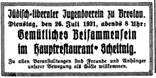
Jewish-Liberal Youth
Organization of Breslau.
Tuesday, July 26, 1921, 8 p.m.
Friendly Gathering in Scheitnig, the main restaurant.
All members and supporters of our movement are welcome guests at our events.

Jewish-Liberal Youth Organization of Berlin.
Sunday, July 31, 1921
Morning walk in Grunewald
Meet on the platform of the Zoo station at 9:15.
Departure at 9:20.
Return toward 2 o‘clock.
From Ferdinand Lassalle’s Youth.
We read an essay from the pen of Dr. Willy Cohn, Breslau in the “Israelite Weekly for Switzerland” and share the following. The Editors.
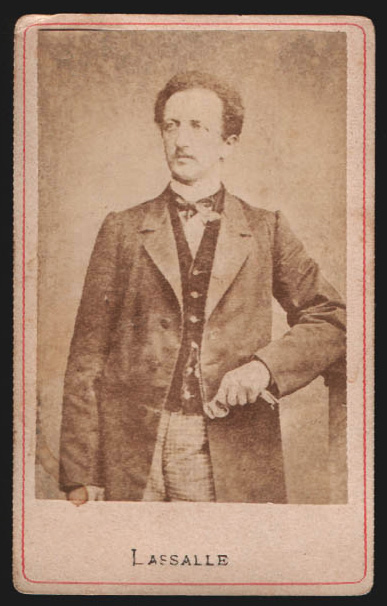
Perhaps it’s no coincidence that the greatest propagators of socialist thought, Karl Marx and Ferdinand Lassalle, stemmed from Jewish blood. Taking the side of the oppressed and the persecuted is deeply grounded in the essence of Judaism.
We too easily let Lassalle, the thinker and fighter for all of humankind, overshadow Lassalle, the Jew. Indeed in his later years Jewishness did recede completely behind the task he dedicated himself to. However, his youth was spent in a Jewish milieu that I’d like to tell a bit about, especially as the diary that he kept as a boy let us see quite deeply into his development.
Ferdinand Lassal [sic], which is his actual name, was born in Breslau on April 13 in the house at 6 Rossmarkt, the son of Heymann Lassal and his wife Rosalie née Heitfeld, as an old book listing births that is kept in the archive of the Breslauer synagogue congregation. Rossmarkt is still an area for Jews who feel the need to live together.
It’s here the boy grew up and matured early—almost 14 he was a full human being endowed with the greatest intellectual talents but also with some failures such as exaggerated self-confidence and conceit. Yet filled with a fiery spirit that touched everything. As a 14 year old he decided to keep a diary with the intention that “these pages are meant to hold all my actions, my errors, my good deeds. I will most conscientiously describe no only what I do but also the motives for these actions.” And this he did honestly and without polish. In this diary we see the positive but also the tricks he played that did were not always so harmless. Pious he was not—he had a far too critically analytic mind. Interesting is this note in his diary: “In the afternoon I bought a lottery ticket. It was number 79 886. If I were Catholic, I’d have a priest bless it and sprinkle it with holy water. My blessing must work.” However, the young Ferdinand felt himself to be thoroughly Jewish, which another passage shows: “Along the way I talked with Bloch. He wanted to give himself an “Air” and called himself an atheist. But when he saw that I had a different view, he backed out. We talked a lot about the transmigration of souls [Seelenwanderung], about Geiger (the contemporary Breslau rabbi who sympathized with the Reform side) and Judaism and he wondered that I was so committed to the Jewish faith. The donkey! As if one couldn’t eat treyf [not kosher] and still be a good Jew! I told him this and indeed, I believe, I am one of the best Jews on earth without observing the ceremonial laws. Like the Jew in [Edward] Bulwer[-Lytton]’s “Leila” I’d bet my life that I could rip the Jews from their oppressed condition. I wouldn’t fear even the gallows itself if I could make them into a respected people again. Oh, if I followed my childish dreams, it’s always been my favorite idea to stand at the head of the Jews, weapon in hand, and make them independent.”
What would he say if he could see today how the old-new land is in the processes of becoming once more the homeland of the Jews, without using weapons. The Breslau rabbi Abraham Geiger, whom we’ve already mentioned, made a significant impression on the boy. He sometimes wrote about his sermons and attempted to work through their ideas for himself. But he also sought to draw something joyful from his Jewishness to brighten his school days. It touches us as tragi-comic when he writes on March 19: “Today is Purim. I had thought about skipping class before but today I did it.” School was not at all his favorite place. His time at the Breslau Magdalen Gymnasium was replete with all sorts of things that he was guilty of and came to a premature end. He was dismissed and went to Leipzig to attend a trades school which suited him even less. It was here that he heard about the terrible persecution of Jews in Damascus. He was outraged and threw these lines down in his diary. “Oh, it’s terrible to read, terrible to hear, without our hair standing on end and all feeling in our heart turning into anger. A people that endures this is terrible, whether it avenges or tolerates the treatment. True, horribly true is the reporter’s sentence: “The Jews of this city tolerate horrors as only these pariahs of humanity could without having a terrible reaction.” So even the Christians wonder about our passive blood, that we don’t rise, an prefer to die on the battlefield than from torture. Were the persecutions that the Swiss reporter is thinking of more grave? Was there ever a more justified revolution as that when the Jews of that city rose up, set fire in all directions, blew up the powder tower, and killed themselves along with their torturers? Cowardly people, you don’t deserve a better fate! The trodden-upon worm hunches over, but you bow down even deeper. You don’t know how to die, to destroy. You don’t know what righteous revenge is. You don’t know how to bury yourselves with your enemies and rip the flesh from their bones in the death struggle. You have become a lowly servant!”
One regrets most deeply that Ferdinand Lasalle later loses touch completely with Judaism. What could this man have achieved for our community if he had used the powerful fire of his oratory on our behalf? The end is connected to the beginning. After a restless, turbulent life he found his death in a duel in Geneva. Eternal rest, however, he found in the Jewish cemetery of his hometown, Breslau. His grave continues to be a pilgrimage site for the countless workers who want to feel close to their leader on the anniversary of his death.
Going Home, Final Installment of the WWI Novella.
by Bidsche Hohnsalz — Zehlendorf.
Link to my translation of the entire novella
An Interesting Certificate.
The lawyer, Bendix from Breslau was kind enough to allow us to print this document from his family’s records:
Concerning the report from August 7 of this year, we remit to you the privilege granted on January 1508 [not a typo] with the notice that the Jews Abraham Jonaszkiewicz and Michel Bendix of Krotoschin received permission to brew beer and still have it from now on since the Christian brewers cannot prove an exclusive right.
Furthermore, this permission is a boon for the public given the current conditions since the Christian brewers are extraordinarily high given the price of grain.
Posen, September 1, 1824.
The Royal Prussian Government 11. (Signature)
To the Councilor for the Krotoschin County in Krotoschin.
Nr. 1313
Submit the copy of the above decision with the original document to the Honorable Magistrate as well as the Brewers’ commune that they acknowledge Abraham Jonaszkiewiez.
Krotoschin, October 2, 1824.
The Royal Prussian Councilor of Krotoschin County, v. Borch
To
An Honorable Magistrate
Nr. 5441. Here.
Submit a copy of the above to p. [sic} and Michel Bendix as notification.
Krotoschin, October 19, 1824.
The Magistrate
To the followers of the Old Testament religion, Abraham Jonaszkiewicz and Michel Bendix. Here.
The authenticity of the above copy is affirmed.
With regard to the report from the 7th of this month granting the Jews Jonaszkiewicz and Michel Bendix the beer-production concessions.
Per copiam decreti.
Our decision on September 1, Number 1313, stands for the cited reasons and they shall not in any way be hindered in the business of brewing beer. It has been shown that the city council’s protests were motivated by guild loyalty and self-service at the public’s cost.
To the Councilor of Krotoschin County in Krotoschin.
Copy to the Magistrate in Krotoschin per the October 6th instruction.
Copy of the October 7th document.
Posen, October 12, 1824
The Royal Prussian Government II.
Pro vero copia.
To the followers of the Old Testament religion, Jonaszkiewicz and Michel Bendix in Krotoschin.
Nr. 696
The two copies of the Government’s decisions from October 2, 1824 Nr. 5441 and from October 12, 1824 Nr. 696 are exact copies of the documents in the county records, as we attest here.
Krotoschin, March 14, 1830.
Royal Councilor of Krotoschin County.
Aus dem Reich.
Berlin. One of the most important duties of the Aid Society in the near term is to make it possible to help the eastern Jews who have fled to Germany establish contact with their relatives overseas as soon as they are identified and to motivate them to help the refugees. The American Jewish organizations, the Joint Distribution Committee (JDC) and HIAS [the Hebrew Immigrant Aid Society] have already declared their readiness to participate.
Should the refugees want to leave Germany after having received the necessary support from their overseas relatives the Aid Society will help them get the documents required for emigration.
To execute a comprehensive, systematic operation the Aid Society of German Jews has secured the assistance of trusted individuals and committees throughout the Reich.
In consideration of the great importance of this operation we are planning, that serves the interest of our fellow Jews from the East as well as the interest of German Jews, we are publishing the first list of places where Eastern Jews who have lost contact with their relatives can turn to for help. Additional lists will follow.
- List of trusted representatives and their addresses.
Braunschweig: State Rabbi Dr. Rieger, Steinstraße .
Bremen: Rabbi Dr. Rosenak , Parkallee 15/17 .
Breslau : Ernst Muyr , Kornerstraße 10 .
Kassel : State Rabbi Dr. Waller.
Darmstadt : Theodor Meyer, Bleichstraße 26.
Düren: Alexander Bendix.
Düsseldorf: Rabbi Dr. Eschelbacher , Kasernenstraße 67.
Emden: Jakob H. von der Walde.
Erfurt : Rabbi Dr. Salzberger.
Fürth: David Lehman, i. Fa. Lehmann u . C . , Bahnhofstraße 1.
Frankfurt a . O.: Max Struck , Schmalzstraße 3 .
Frankfurt a . M.: Israelite Aid Society, Langestraße 30.
Glogau: Max Moses.
Göppingen: Rabbi Dr. Tänzer.
Göttingen: Rabbi Dr. Behrens, Bunsenstraße 12.
Hagen: D. Strauß , i. Fa. Kaufmann u. Strauß, 12 to 12 1/2.
Hamburg: Aid Society of German Jews, Ferdinandstraße 14.
Hannover: Rabbi Dr. Freund , Stiftstraße 11.
Hildesheim: State Rabbi Dr. A. Lewinsky.
Konstanz: Siegmund Schwarz, Döbelestraße 16, Weekdays 1 – 2.
Lübeck: Martin Mansbacher , Antonistraße 2, afternoons [sic]7 to 9.
Magdeburg: Leonhard Sperling, Kaiserstraße 16.
Munich: Union of Israelite Charitable Societies, Herzog-Maxstraße 5, office hours: 10 – 12.
Rostock: Arnold Bernhard, Schnickmannstraße, hours: weekdays 10 – 12.
Saarbrücken: Gilbert Worms , Kaiserstraße 22.
Ulm a. D.: Rabbi Dr. Straßburger.
Zwickau i. Sa.: Wilhelm Grünberg, local Israelite administrative
Berlin. The Russian Monarchists on the Jewish Question. A Russian paper published here reported about a secret conference the Russian monarchists held in Reichenhall. Officially, the Jewish question was not discussed at this conference, however, the request was made not to blame the Jews for the destructive bolshevist movement. Among Jews and non-Jews were equal numbers of communist and anti-communist elements.
Potsdam. The Flag Scandal. In Tremmen, Osthavelland County, the cornerstone of a war memorial was laid. Since all the inhabitants had donated money, the left-wing parties insisted on raising the colors of the [Weimar] Republic next to the black-white-red flag. Immediately, a tumult broke out. The Veterans Association insisted on taking down the black-red-gold colors. Reverend Dietz refused to give his speech if this “hateful rag” stayed on the flag pole. The head of the memorial committee, the land owner Fritze from Tremmen, immediately resigned from his position. When the excited farmers got physical and calls like “Down with the Berliner Jewish flag!” “Down with the dirty rag!” were shouted stirred them up even more, the men of the leftist parties brought the Republic’s flag into the Spritzenhaus to rescue the ceremony. The crowd followed and insisted on the flag’s destruction. In the end, the only thing left to do was to bury the flag in a field. Then, Reverend Dietz returned to the podium and spoke on the betrayal of the front and the Jew-government.
Hanover. Antisemitic Emergency Currency. The Hanoverian city of Tostedt is distributing 50-pfennig bills that are “decorated” with a most spurious antisemitic image: a tree from which two Jews hang and nearby is a mob of crows, holding back as though they don’t dare touch the bodies. A saying that mentions “profiteers” adorns the intellectual image. Political baiting can’t be carried out with any less of a conscience.
Görlitz. To benefit Jewish Children’s Aid, Cantor Paglin (of Dresden) held an evening of song on July 5. Staying true to the spirit of the event, he chose only works by Jewish composers. The program started with the great Eleazar aria from Halevy’s “The Jewess,” followed by two songs by Rubinstein (Heine’s poems set to music), serious songs in Yiddish [the original German is “Jargon.”] by Braunstein (“Sand and Stones”) and Arno Nadel (“Aheim”) and ending with a colorful medley of mostly cheerful Yiddish folksongs. It takes a very artistic person to create such a varied program; the task was a complete success. A singer with a marvelous voice like Paglin’s is assured extraordinary success. He possesses a conquering tenor, a voice of heroic brilliance that can hit a high C effortlessly. It says a lot about the singer that he never put the material to tasteless use; he kept to a musical sensibility and highly artistic interpretation of the musical content of the works. This faithfulness to the spririt of the work shows him to be a true artist! The lively applause expressed the audience’s gratitude for this artful performance but also for the artist’s willingness to serve such a good cause.
Königsberg in Prussia. The Neuhauser Jewish Vacation Home. The Jewish community of Königsberg has long been engaged in generous charitable work which was recently marked by the inauguration of their twelfth institution, namely the Jewish vacation home in Neuhauser. A great number of honorees, community representatives, and private individuals were invited. The home has been open since the 5th of June of this year [1921]. The fresh coloring and wholesomeness of the children are the best signs that its duty to provide much needed rest and recovery is being well served. Outside of school vacation times it’s open to adult men and women. The director of the restorative home [“Kuratorium”], the businessman Arthur Cohn, welcomed the guests and gave an overview of the home’s history and how it was a result of an initiative of which women’s group of the Kant lodge and a donation from the Kellers. The president of the Kant lodge, Professor Theodor Cohn, called to mind the Bible verse, “Love your neighbor as yourself” as the home’s ethical foundation and wished it a healthy future in all aspects. Rabbi Dr. Lewin represented the Jewish Charitable Aid Society and the Women’s Association for Israelite Health Care whose labor of love and social sense founded this home. The city’s chief doctor, Dr. Jankowski, praised the aim of this restorative facility and emphasized the connection to strengthening the desire to work.
Breslau Art Exhibition.
It’s a shame that large art exhibitions supported by the government aren’t held in Breslau as in Berlin, Munich, and Dresden. Then it will be seen how many noteworthy artists are active here, just like in the those old centers of German art. For some art forms, Breslau is virgin ground and we are delighted by how industriously and seriously it is being worked.
Recently the Lichtenberg Gallery mounted an exhibition on the charming Scheitniger park grounds that offered such a bounty of the interesting and the beautiful. Anyone who didn’t see it truly missed something.
Young, groundbreaking talent that deserves every recognition and support was on display, for example, Conrad and Alfred, sons of the famous Breslau artist and engraver Carl Scheu. It was regrettable that Alfred Scheu did not exhibit a single poster or iron works since all of this young artist’s work, especially his oil paintings, reveal exceptional talent. Alfred and his brother Conrad have significant abilities that promise a great future. Conrad Scheu made us acquainted with several of his posters. His great revelation of the “Miracle,” the astounding verve he shows in how he depicts the ape with just a few strokes (a poster for the zoological garden), his Bastion poster (where the B is a waving flag) are masterpieces. Gerhard Stein’s “Vote German” poster and his flier with the death mask were also very interesting.
A number of Jewish artists [male and female] were represented with works typical for them and refuted in an extraordinary way that antisemitic tale that any fine or applied arts activity has been driven from German Jewry by commercial activity.
How exquisite were the silhouettes of the Berlin artist, F. Lewin! They took an honored place in the large collection of silhouettes.
Charlotte Berend, Corinth’s wife, was represented by her “Self-portrait with Young Daughter” whose composition and broad strokes recalled her husband’s style: her drawing style of which there were several examples is more independent.
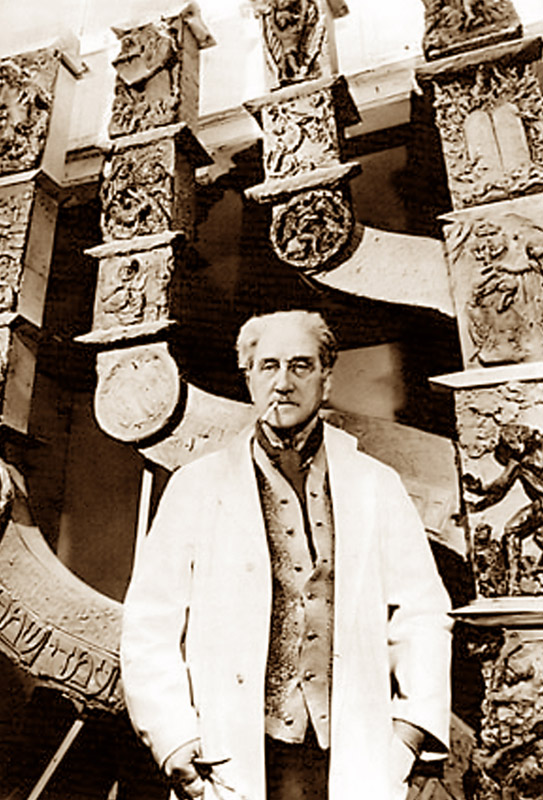
Jewish sculptors were represented by the extraordinary “Flutist” by Benno Elkan and Rudolf Marcuse, who became famous for his amazingly lifelike youth who is fighting off a snake, showed an enthralling new work, “The Fencer.”
Tamar Hayardeni /Attribution / Wikimedia Commons
From our old masters we could admire two of Max Liebermann’s works: his portrait of Heinrich Thannhauser, which belongs to his best portraits, and the painting of an old farmer. The magnificent study in green and black of his wrinkled face with little eyes that peer slyly is unfortunately in a private collection and a state gallery’s negotiations to acquire this valuable painting have failed.
Jewish artisans’ skill was displayed with the interior décor of the Breslau design firm, Ignatz Walsch—the dark red bedroom with a contemporary cabinet. The library designed by the Hauswaldt firm with its built-in bookcases was very tasteful.
Breslau’s own Otto Schwartz’s iron door was glorious.
A general observation is that the exhibit was open for far too short a time—one would very much have liked to have seen it leisurely a few more times.
Dr. L[udwig] D[avidsohn]
A Poem by Walter Brinitzer.
If you want to know God
You must decipher Yggdrasil
Ring by ring
Aware of the world’s Creator
Penetrating its body and its soil
Then will it reveal its seed
And decode its mystery
Then you’ll behold the sun-drunk
God’s spirit-born sparks
And in sweet ecstasy before the Creator
Your heart will glow with the many suns.
Paradise’s bright glory
Reveals to you God’s might.
Aus der Presse.
Unrest Continues in Palestine.
The Kölnische Volkszeitung [sic] learned from its reporter that the atmosphere in Haifa [sic] between Arabs and Jews is still so tumultuous that the the latter, despite their number and their influence, could not be accepted in the chamber of commerce with the same rights. So, they saw themselves forced to form a separate chamber of commerce exclusively for Jews with the permission of the authorities.
The Cologne newspaper writes: The daily newspapers have already reported to its readers that the hatred between Arabs and Jews in the city of Jaffa [sic] has erupted in a terrible way that led to 50 deaths and over 250 wounded. The majority of the murdered and wounded are Jews. Naturally everyone blames the opponents. The Arabs claim that the Bolshevist Jews started the conflict and its escalation into violence while the Jews complained that the police sided with the murderers instead of stopping them. The government is taking pains to charge those that are actually guilty.
Berliner Volkszeitung [sic] published the following in an article titled, “Facts about the issue of Eastern Jews: Asylum Right for the Stateless”:
The unfortunate events at the Stargard internment camp have again drawn the public’s eye to the so-called “Problem with the Eastern Jews.” There are few issues in Germany on which one is less informed than over the immigration of Eastern Jews.
It must be pointed out that during the war the highest military commanders ordered that a large number of Eastern Jewish workers be brought to Germany, sometimes under force. It is significant that those circles who today still defend the unfortunate deportations are also those that most sharply criticize these workers of whom circa 30,000 were brought in.
The number increased under the horrible persecution of Jews in Eastern Europe. The continuous battles in Poland and Ukraine with Ukrainian, Polish, White Russian, and Bolshevik troops created unbearable conditions for Polish and Ukrainian Jews. The situation of Eastern Jews in the hell of pogroms conducted by Poles and Ukrainians is what brought more Jews to Germany. Their number however was not nearly as great as the right-wing press likes to claim. In total, between 1914 and 1921 (seven years) circa 100,000 Jews came to Germany, including those who had been forced to work during the war. For longer than half a year immigration has completely stopped; on the contrary, we can verify that emigration has increased tremendously such that it is clear that Germany is mostly a pass-through country. The Workers Welfare Bureau run by Germany’s Jewish organizations reports that of the 55,000 who had fled here 45,000 have emigrated to other countries or returned to their countries of origin.
The remainder consists of people who cannot leave Germany. Some are waiting for entrance visas to other countries, mostly to America. Others are waiting to return to their homeland, many of whom have no money or status because of the war. A special case is the Galicians who fought as members of the German or Austrian armies and were not, and cannot, become Polish citizens are now stateless. The citizenship of refugees from Ukraine remains contested. For these people there simply is no possibility of return.
The reality of the situation, the impossibility of return, and the impracticality of a mass deportation (which would also not help Germany’s reputation in the world) lead to a social-political solution of the whole problem. A social-political solution is possible—the makeup of the immigrants proves this decisively. In the main, they are honest, working people, who work productively in German industry, the trades, or agriculture. In the mines of the Ruhr region around 4,000 Eastern Jews work as day laborers, another 4,000 in the metal works, about 7,000 in the other industries of Rhineland-Westphalia, and 3,000 in agriculture. A few thousand work in the industrial regions of central Germany, and a large number as tradesmen/craftsmen in Berlin. A small percentage, slightly more than 10%, work in small businesses.
It’s against these workers that measures are being taken. The right-wing press would have you believe that the Stargard internment camp which has capacity for several thousand can and should be instantly filled with Eastern Jewish criminals. In reality, there aren’t even a hundred Eastern Jewish criminals imprisoned there. Contradicting the misleading statements by reactionary circles, the greater part of the interned are irreproachable, working people who had faced deportation when temporarily unemployed. These are the people who should be interned again long after they have found new work. Rightfully, Germany asks that its housing shortage and severe unemployment not be increased by a significant immigration of foreigners. It has been noted above that immigration has completely stopped. The small number of remaining immigrants should not cause draconian measures to be taken against them. A portion has fled the Hell of pogroms, the rest was brought unwillingly to work. There is no justification for denying them our empathy and help as long as they seek to be productive, there is no reason to deny them the right of asylum.
Breslau.
Musical Association
Friends of classical music, ladies and gentlemen, the possibility of participating in the orchestra of a respected musical association is being offered. Advanced musical dilettantes on all instruments who want to perfect their musical skills and increase their knowledge of classical music can take part in the strivings of the association—for the small sum of 4 Marks a month. The string orchestra rehearses once a week under the direction of a professional conductor and performs with a guest quartet. The association aims to 1.) foster classical music, 2.) foster social amusement. The association holds 1) public concerts, b) musical evenings for members and invited guests, c) soloist performances, d) music history lectures, e) socials, f) other delights. Especially in today’s times some educated, intellectual people might may want to turn away from light and expensive things like the cinema, the Fox Trot, etc. and spend their free time harmoniously by fostering classical music. Those interested in becoming active or passive members should contact the director Mr. R Schönfeld, Augustastrasse [?]b.
Family Announcements.
Engaged: Käte Naphtali, Breslau, to Dr. Günther Bibo, Berlin; Gertrud Amann, Magdeburg, to Paul Herlitz, Wilmersdorf; Ilse Blumkerg to Heinz Tischrigel, Breslau; Flora Dekro, Breslau to Siegfried Nathan, Löwen in Silesia; Vera Fleischer to Georg Spitz, Breslau; Betti Wolf, Rybnik, to Hermann Schiftan, Jalkowitz; Else Laskowicz to Salo Schutz, Breslau; Ilse Vorinski, Kattowitz, to Erwin Wolf, Breslau.
Married: Herbert Czollak to Mally Koppenheim, Breslau; Carl Muschel to Erika Nelken, Breslau; Bruno Salinger to Lotti Weinberg, Breslau.
Births: Sons: Franz Czerny and Gabriele née Pokorny, Breslau; Herbert Matzdorff and Edith née Rothe, Berlin; Dr. S. Ochs and Frau Graetzer, Gleiwitz; Joseph Hoffmann and Friedl née Hecker, Breslau.
Daughters: Julius Cronheim and Trude née Kretschmer, Mönschen Gladbach; Emanuel Leipziger and Liese née Kapauner, Platschkau; Walter Wollmann and Lili née Meyer, Breslau, Arthur Redlich and Grete née Schoenwald, Berlin; Martin Süßmann and Käte née Rosenthal, Breslau.
Deaths: Marie Sachs née Marcus, Breslau, Johanna Rother née Neisser, Breslau; Emma Freudenthal née Sachs, Breslau; Mieke Köppler née Grünwald, Gleiwitz; David Silbermann, Ratibor; Bianca Nathias, Breslau; Anna Koller, Breslau
Donations to the Jewish Children’s Aid
Received to date:
Ernst Wallach, Berlin . . . . . . . 1,000 Marks
Moritz Arenstein, Breslau . . . 20 Marks
Martin Saul, Breslau . . . . . . . 50 Marks
Anonymous . . . . . . . . . . . . . . 50 Marks
Mrs. Vorreuter, Dortmund . . 100 Marks
Total 1,220 Marks
We sincerely thank the donors and hope to receive more contributions to this good cause. The Jewish-Liberal Newspaper.

 Juedisch-liberale Zeitung