
Antisemitism has grown more pervasive and antisemitic acts are graver and more violent as reported in this issue. In previous issues, we read about incidents related to the Upper Silesian uprising which was a response to Upper Silesia being ceded by Germany to Poland. Now, we learn of the ingrained antisemitism of the Self-defense Militia formed in time to join in the uprising. Comprised in part of former soldiers and officers, its ad-hoc assaults were becoming well-known such that Jews knew to avoid areas near where the militia had a post. History will meet some of the members again in various capacities in Nazi organizations. The situation has become serious enough that the Bavarian Jewish delegation makes a formal complaint and the Breslau group meets with the Chancellor and the Prussian Interior Minister to plead for their support. The discussion around Jewish values and how they can be reconciled with national identity continues. A Lutheran theologian describes the true patriotism of the Jewish patriarchs and prophets and connects that virtue to the contemporary Jewish community. The discussion crescendos with an analysis of Einstein’s June 27th speech in Berlin on Zionism that lays bare the divisions of the German Jews on the question of national identity.
Articles:Little Known Models of True Patriotism by Privy Councilor [Friederich] Ed[uard] König – Bonn.
Guidelines for Revising Our Religious Services, Part 4 by Rabbi Dr. H[ugo] Fuchs – Chemnitz [Translation pending]
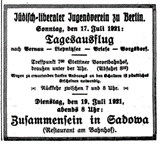
Jewish-Liberal Youth Organization Outings.
Going Home, Seventh Installment of the WWI Novella.
Einstein, the Zionist by Ludwig Foerder – Breslau.
Friedrich-Wilhelm-Victoria-Foundation raises insurance premiums.
Bavarian Jews protest against antisemitic persecution
Meeting with the Chancellor of Germany to discuss antisemitism
Help through Work and the ORT Society.
On Self-defense.
Antisemitic Incidents in Bad Langenau.
Kaiserkrone Cabaret.
Bar Mitzvah Services in Breslau’s Synagogue.
Little Known Models of True Patriotism
by Privy Councilor Ed[uard] König – Bonn
The following article was rejected by a leading Christian monthly journal for the reason that although the patriotism of the prophets is greatly admired and should be praised, the models of true patriotism should not be sought in Jewish history where Judaism was given these blessed men, especially in today’s time when we have Judaism to thank for terrible events and perhaps worse dangers in the future. The admired author graciously permitted us to publish the essay. –The Editors
It can easily come to pass that figures who had a ground-breaking effect in one direction find their other accomplishments ignored. Ambrose of Milan, who traded in the position of a Roman provincial governor for that of a bishop, was acclaimed for leading church singing in new directions. However, the general public is barely aware of his work in preserving church poetry! Everyone knows that Johann Sebastian Bach composed brilliantly for organ and his fugues flowed from an extraordinary intellect. But that he also composed beautiful music for the violin was a secret. This common experience is easily explained that some characteristics of historic individuals or whole groups have been blotted out, like Hebrew prophets’ patriotism. It is not untimely to try to clear these shadows.
This attempt must be seen as directly connected to the equally interesting and currently much-discussed topic: the relationship of the prophetic religion of Israel to human civilization. Recently the point that the prophetic religion’s realization had “Bedouin Ideals” written on its flag has been made by many. This is evident even in the great literary project “The Culture of the Present” (Vol. I, III, 2. Page 15) says that since 1906 religion started to appear as a main factor of culture. But the modern opinion about the prophetic religion is far from that claim if one considers historical facts
Or will it be noted that the acknowledged forefather of this religion, possibly an Abraham, kept away from the sites of the culture of his day? No, he even went to the rulers’ residences where the culture was most intensely fostered. Furthermore, possession of material goods was explicitly permitted and the members of this religion were enjoined to take pleasure in them (1. Moses. 12, 2 etc.). And the taming of nature, the creation of culture and use of nature are commanded: “Make the Earth your subject.” (1, 28) The virtue of industriousness, in trades as well, is often praised in these source writings, where the phlegmatic ways of the Orient are put in their place with clever irony: “The sluggard says, “There is a lion outside, I shall be strangled in the streets.” (Proverbs 22, 13) and stays inside by his oven. Yes, loyalty to the principles of the prophetic religion doesn’t even prohibit decorating one’s environment or wearing jewelry. Aren’t the bridal gifts that the fiancé is to bring the chosen girl listed with obvious pleasure (1. Mos. 24)? Even ivory palaces, i.e. dwellings richly decorated with ivory, are mentioned as a delightful property (B. 45, 9). Musical and poetic arts do not in the least oppose the Old Testament religion to the extent that these arts were put in the service of ritual. David’s poetic work earned him the epithet, the beloved of Israel’s songs (2. Sam. 23, 1).
Israel’s religion’s foundational attitude toward culture in general is reflected by the central representatives of this religion, i.e., the prophets who observed the interests of humanity. An especially interesting chapter in the history of Israel’s speakers’ relationship to culture concerns their regard for patriotism. It’s important to explore this side of their behavior, and not just because it is not well-known, but mostly because in our day it is often not recognized or is misunderstood.
How can the national mindset of Israel’s prophetic figures even be in doubt?
Starting with the first one, after whom the historical books are named (1. Mos. 20, 7), is a shining example of patriotic heroism. For the land, in which this first citizen of God’s special kingdom also found his earthly home, was embattled by eastern rulers who took Abraham’s nephew Lot prisoner caused the first patriarch to gather his more than 300 armed and trained men along with his countrymen and hurried northward after the enemies to the source of the Jordan river. They split up as the original report so clearly states (1. Mos. 14, 12) and at night attacked and vanquished the enemies, then returned home with the freed nephew and all the pillaged loot.
How energetically the prophetess Deborah, wife of Lappidoth, intervened in the national destiny of her people (leaving Moses’s deeds and sacrifices marked by his sense of nation aside)! The as yet unquenched fire of the resisting Canaanites ignited on its main oven, the northern border of Palestine. The bright flame rose as the Northern Canaanites placed their army under the commander Sisera and pushed into the northernmost regions of Palestine. But Deborah, who glowed just as brightly from religious faithfulness and love of her people, knew how to motivate the hero Barak from one of the suffering Northern tribes of Israel so that he set himself at the front of the defending army and saved his fatherland from the yoke of the Canaanites.
Enough with the evidence of the heroic participation of the ancient Hebrew prophetic figures in battles that had to be fought for the sake of the people’s national independence. We need not add that again when the Philistine threat was at its peak a prophetic hero who unfolded the double flags of faith and national feeling and understood how to bring the men and youth to such an enthusiasm that they won a deciding victory over the Western enemies. The memorial’s name Ebenezer “The Lord has helped us to this point.” [Translator has added this citation: 1 Sam. 7:12] would shine for all future centuries. No, we need not consider more of the great deeds of the prophetic men of Israel in order to show that the citizens of the true kingdom of God treasured and helped defend political freedom as the most important foundation for the external welfare of the people.
It is more important to speak about how the later prophetic figures regarded the political situation of their nation to show how they manifested the ideals of true patriotism and stood by them under the most difficult changes to the fate of their people.
Of these later prophets of the Old Testament the Demosthenes of Israel, the Isaiah of Jerusalem as we was aptly by named Hieronymus deserves a special word. At a politically and socially tumultuous time he was able to speak clearly as a true prophet who feels united to his people. Like many of his contemporaries, he forcefully emphasized that the division of their people caused by the split of their kingdom felt like an open wound on the body of the entire nation. They couldn’t suppress the pain it caused and found new ways to depict the eventual reunification of their people as a moment in its ideal future. Isaiah, too, spoke of the day when the flame of jealousy between the largest parts of the nation, Ephraim and Juda burnt out, when both, would descend upon their enemy in the West and the East like birds of prey (11, 13…). Or as another of these speakers used the now famous symbolic image of two pieces of wood that had been split from the same log would once again form a united greatness. (Ezekiel 37, 15… etc. as cited in my history of the Old Testament religion, 1915, p. 382).
However, the great Isaiah did not only join in this frequent prophetic announcement about national attitudes. He went above the typical measure of patriotism in an exemplary way. In critical moments when his people were falling from a cultural-historical high point and the failure of his religious goals, he united with his people. When the prophetic certainty came to him and he had to proclaim a difficult judgment to his people in the name of the ruler of the world, a deep sigh surged to his lips: “For how long, Lord?! (Isaiah 6, 11); and again when his wayward nation bled from many wounds after a deserved judgment he spoke, “If the Lord had not left us with a little, so would we have been (namely conquered) like Sodom and resembled Gomorrah” (Isaiah 1, 9).
In terms of fervor and suffering, the patriotism of an Isaiah could not be surpassed, but it could happen in the case of the tragic force of battles and sorrows into which the true friend of the fatherland can be drawn. But we see this particularly clearly in the fate of the priest’s son Jeremiah from Anathoth (about an hour north of Jerusalem). How moving are the testimonies of his most passionate patriotism in his speeches! “Oh, my guts, my guts! I writhe in pain. Oh, the agony of my heart! I cannot be quiet. (Jer. 4,19 after the basic text). This is how we hear this man express his infinite sympathy for the yet undeserved fate of his people. These sentences in particular give his speeches the gloomy tones that makes them so moving.
In modern times, the authenticity of this great seventh-century prophetic figure’s patriotism has been especially doubted. One has not shied away from claiming that this man was in the pay of the Babylonians. We encounter this claim with Max Duncker (in his history of antiquity) and others up to our times (Hugo Winckler, etc.), even the renowned, most objective scholars such as the great critic Carl Heinrich Graf in his commentary on Jeremiah. This charge can easily be proven unjust by the following considerations.
True patriotism is not shown by giving into the instincts of the people and setting easily attained goals for the nation and painting the horizon of the future with pink [optimistic] colors, just to stay in favor with the people. Rather, the true patriot has to keep an eye on the highest cultural-historical duty of a nation and must in no way cover up the aberrations of the zeitgeist. At certain moments in the course of history, the true patriot must submit to the higher order of things. In times of deserved or seemingly undeserved humiliation of a people, a true friend of the fatherland must light the way for the masses through the virtues of self-knowledge and lead them through the dark abyss of misfortune up to the heights where a better future dawns for the fatherland.
How could the most spiritual leaders of a people who ever existed have evaded these duties of a true patriot? How closely the religiously moral mission of the Old Testament prophets matches those duties of true patriotism!
This is the perfect explanation of the position that a speaker like Jeremiah has toward the state’s confusion of his time. Only because for this man there was an unquestionable higher certainty that after the punishing consequences of Israel’s attitude toward history’s plan devised by the world’s highest Director the period of gloom had reached its end for Israel. Only because Jeremiah insisted on submission to this historical necessity so that from the humble self-knowledge there would grow a healing fruit for the future of his people.
We are lacking the patriotism of the Old Testament’s prophetic figures and the fire to inflame our hearts as well as the light that in the dark nighttime could show our eyes the right path to climb to reach a new zenith of national life.
In part the silent deeds of so many religious leaders of Israel protected the national independence as a condition for the people’s welfare and in part the long series of their spoken words full of jubilation at their people’s good fortune and full of stirring sympathy for its sorrow align perfectly with the notable words that the deacon Ferrand of Carthage wrote to an imperial commander and governor, Count Reginus, in the early days of the sixth century, “Love the fatherland as much as yourself.”
Especially in times of national decline which unfortunately came over our people through their own fault (Compare my booklet “Religion’s Bankruptcy, 1920), the call to us sounds in the patriotic speeches and deeds of those prophetic figures: Get up and go to the fountain of self-knowledge from which alone you can draw a renewal of a national force and wash your eyes clean to see the people’s true happiness.
Guidelines for Revising Our Religious Services, Part 4.
by Rabbi Dr. H[ugo]. Fuchs – Chemnitz.
[This is the fourth part of the article by Rabbi Fuchs. The first part, published June 17, 1921, is translated here. The second part, published June 24, 1921, is translated here. Translations of the third and fourth parts are pending.]
[Outings with the Jewish-Liberal Youth Organization]
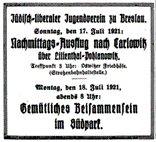
Jewish-Liberal Youth Organization of Breslau.
Sunday, July 17, 1921,:
Afternoon outing to Carlowitz
via Lillienthal-Pohlanowitz
Meet at 3: Oswitz Cemeteries.
(Tram stop.)
Monday, July 18, 1921,
8 p.m.:
Friendly Gathering
in the Südpark.
Jewish-Liberal Youth Organization of Berlin.
Sunday, July 17, 1921:
Day Trip
To Bernau – Liepnitzsee – Briese – Borgsdorf.
Meet at 7:50 a.m. at the Stettin suburban train station, outside under the clock
(Departure at 8:10)
Because of the crowd at the ticket windows you must arrive on time.
Return between 7 and 8 p.m.
Tuesday, July 19, 1921, 8 p.m.
Gathering in Sadowa
(Train station restaurant)
Going Home, Seventh Installment of the WWI Novella.
Link to my translation of the entire novella
Einstein, the Zionist.
by Ludwig Foerder – Breslau.
On June 27th Einstein spoke at a well-attended meeting about the development of Palestine in Berlin. The name Einstein has world-wide significance. The words or a man whom one calls the Copernicus of the 20th century demand being heard and respected. However, the words are also subject to criticism from those who may not be intimidated by the bearer of this great name, especially because of the power that this man has over everyone.
One can be a great physicist, but might not see as sharply into the social and political problems as into physics and mathematics. So too was the great anatomist [Rudolf] Virchow not so great when it came to political matters. What Einstein said about the Development of Palestine, and more importantly, what he did not say, will not be accepted by the non-Zionist, even one who is well-disposed to the reconstruction of Palestine, even perhaps enthusiastic about it.
“The reconstruction of Palestine is for us Jews the embodiment of the reawakening of a national feeling of unity among all Jews.” This introductory observation already reveals Einstein’s foundational error. He apparently does not know that the large majority of German Jews participate in the work of developing Palestine they don’t do it out of nationalism, but only for religious, historical, or humanitarian reasons. We don’t however want to believe that a man of Einstein’s intellectual significance is apathetic about the thought behind an action and is only interested in its result. Rather, those who inform him should consider whether this causes more harm than good because many, perhaps more than one thinks, distance themselves from active participation in case the goal really is a nationalistic one and that participation will be exploited in the service of nationalism. The promised guarantees are then robbed of their value from the outset.
The rest of Einstein’s explanations did nothing to lessen this mistrust. One can certainly agree with him when he speaks about the de-judification that followed the emancipation. It can hardly be seen that the Jews have assimilated with the people among whom they live in terms of language, who they interact, how they think and how they live. This “good assimilation” is not characteristic for someone who has been alienated from Judaism. It was much more the disappearance of the Jewish spirit, the turning away from the prophets and wise ones that caused inner ruin and then complete rejection. Einstein is wrong to wonder that despite the outer rapprochement to the surrounding world, the Jewish sensibility was not extinguished. What a thousand years have inflicted cannot be made good in a hundred. The evil tradition and the ignorance about Judaism are too ingrained in the people of other beliefs that surround us. Peace based on respect and tolerance for which Einstein longs can scarcely be brought about now by introducing a new obstacle, that is, a special nationality. Einstein himself seemed to recognize this—at least according to the political press—when he described antisemitism as “the reaction of the pppp to a national sensibility expressed through Judaism. With that, Einstein confuses cause and effect. This definition fits well with anti-Jewish arguments.
The means that Einstein uses to support his point receive our full approval as they reinforce our self-respect and our claim to our ancestors and our history. But when he goes on to say that it does not suffice that we participate in the cultural development of humanity, that we must take on tasks as “a people” that serve the development of a national unity, we must ever disagree with him. His own example teaches us something quite different. In America, in England, the intellectual, the first man to build new relationships between enemy nations is greatly admired. The honors that are heaped on this man give credit to German science and culture, that even our enemies admit have not been conquered. His work is inscribed on the tablets of German intellectual history with gold letters, even if against his will. May science always be so international. The great physicist is outside of any religious faith. He has said that he does not see himself as a German citizen and feels nothing that one could call a Jewish belief. He does not belong to the Berlin Jewish community. No one is allowed to argue with him about this. But if he feels that he can connect to Judaism only through this tie with nationalism, he (who matured abroad) has not grasped how the unassimilated (in the negative sense) think and believe they feel the same as he. Here too he need only see where his own experience leads. He said that he met Jewish people in America who had immigrated from Eastern Europe, not in Berlin. What does this prove? That because of historical developments in the East, unlike those in the West, one can only speak of a national unity of Jews [in the East.] What seems natural there would be seen here as coercion and untruth. Some German Zionists have realized this in recent years. “A Revision of Nationalism” is immanent. Maybe Einstein will take it in.
Aus dem Reich.
Berlin. The trustees of the Friedrich-Wilhelm-Victoria-Foundation had increased life insurance premiums for their clients by 100% for the period between October 1, 1920 and October 1, 1921. The rates will increase automatically by 150% for the period that started on October 1, 1921 based on the underlying agreement. Because the voluntary fund for teachers is now forced to charge their clients higher rates, the total cost for payments into the teacher’s fund is doubled.
Nürnberg. At their most recent assembly, the Bavarian union within the Central Organization of German Citizens of the Jewish Faith made the following resolution: “For over two years, organized antisemitic persecution is in swing in our Fatherland and especially in Munich. Some allow themselves to be drawn in by the nationalist mask of this movement or led astray by the systematic suspicion of us. Others follow it out of the pleasure they take in trouble making. We Bavarian Jews suffer greatly because of this. Never mind that our families have lived and are rooted in this land for centuries and done their duty despite the communal sacrifice made in the World War, unmatched insults are heaped upon us. It’s as if the Jewish people were without any honor. We formally protest and resolve as humans and as German citizens. We also turn to our fellow Jews. Maintain your inner dignity! Don’t become bitter—instead, despite all the injustice done to you, stay true to your homeland and Fatherland. Don’t retreat from hate and injustice, rather meet them with the calm and dignity of a clear conscience!”
Meeting with the Chancellor of Germany and the Prussian Minister of the Interior.
After his famous speech in the Century Hall in Breslau, Chancellor Dr. Wirth received the lawyer [Ludwig] Foerder as a representative of the Central Committee of German Citizens of the Jewish Faith and Dr. [Ernst] Fraenkel in his capacity as the chairman of the local chapter of the Association of Jewish War Veterans to discuss the grave situation that some sections of the Self-defense Militia organization have created due to their unlawful actions.
The Chancellor asked to keep the documents that Foerder had prepared. On the mention of the lawlessness that Breslau Jews faced—though they were grateful for the Self-defense Militia’s sacrifices in the action against the Poles, but considering the worrisome events of the Kapp Putsch, Dr. Wirth said that he would do everything in his power to help. He went on to say that is an insult to culture that such offenses currently take place. He would contact the Prussian Minister of the Interior immediately.
The next day, Foerder was invited to a meeting with the Interior Minister, Dr. Dominicus. As to the complaints that were presented, the minister said that in consideration of how the press from various parties explained the incidents, he did not want to disturb unity nor did he perceive a reason for these disturbances. Foerder handed the minister the evidence seeking to counter his point of view. He suggested that the means to prevent these crimes was to change paragraph 130 of the German penal code which pertained to the incitement of class hatred.
The minister, who continuously took notes about the incidents presented to him, promised to investigate the complaints thoroughly and left no doubt as to his intention to do his part to create calmer circumstances.
Breslau.
Help through Work and the ORT Society.
ORT is a society for developing trades and agriculture among the Jews of the former Russian Empire. On Monday, July 11 in the Schiedmayer Hall, Dr. A[ron] Singalowsky, the leader and founder of the society spoke on “Building the Jewish economy in the Eastern countries.”
We are publishing an essay on the topics that Dr. Singalowsky addressed in his lecture.
With astounding energy and optimism rooted in the core of Jewish life, two years have been spent rebuilding the completely ruined Jewish economy in the former Russian empire, especially Lithuania and White Russia. While the large international Jewish aid societies, especially the American ones, are still at the phase of theoretically assessing constructive aid for Eastern Europe, the Eastern Jews, pressured by the great poverty of the people, have taken it upon themselves to rebuild their economic existence on the fundamental principle of productive work.
The Society for the Development of Agriculture among Jews (called by the Russian abbreviation, ORT) with 40 years of work in the territory of the former Russian Empire, has taken on the important work of steering the founding process in the right direction and helping to lighten the effort involved.
In recent years, there has been a noticeable migration to the country among the distressed people of Lithuania, White Russia, and Ukraine. This preference for farming which was once a romantic ideology has now become an economic necessity. The destruction of the war has shown to Jews that only the farmer can withstand all storms. The expansion of agriculture among Jews caused the occupying Germans to force Jewish farmers to work fields that had been abandoned by White Russians and Lithuanians who had fled from the Germans to interior Russia. Since then, the pull of farming has taken hold in the small towns of Lithuania and White Russia. Last year, the Vilna ORT chapter found that there were 9,000 Jewish farmers out of a population of 28,000. Compared to the number of Jewish farmers who lived in this area before the war, that is a three-fold increase. In the Grodno region, the number of Jewish farmers has increased six times. A survey of 40 villages found that 17,000 out of 60,000 were employed in farming including 30% of the Jewish population. We can observe that in regions that were previously highly industrialized and had a large Jewish working class a large portion of the Jewish populations was now growing vegetables, fruit, and even grain.
ORT’s activity for Jewish agriculture consists of ensuring the education of farmers includes organizational and technical help in addition to legal support with land purchases, acquiring cheap seeds, spreading farming knowledge through popular literature, and arranging courses where farms are visited, etc. The most important aspect of the help is that ORT provides credit in the form of agricultural machines, seed, and livestock. Last year, credit of three and a half million marks was extended.
Aid for the trades consists of supporting those with master licenses and educating the lower levels. ORT supports these tradesmen by getting them machines, tools, and equipment for their work. ORT sees helping 200,000 refugees who had been deported to the interior of Russia and are now returning to Lithuania to become productive. The society finds those who were already trained in a trade work. It supports existing worker’s cooperatives and workshops as well as helping to create new ones. It provides credit with good terms for both independent tradesmen and cooperatives to buy machinery and tools. ORT has technical staff in an office in Paris and one in Berlin to purchase these. This year, 2 million French francs were loaned.
A very important part of the society’s work is the vocational training of the next generation. Apprenticeships suffered especially because of the war. Before the war, there were 150,000 Jewish apprentices—only a few remain. Additionally, there are the orphans to consider. Life is so expensive nowadays that a tradesman cannot afford to feed an apprentice. The economic catastrophe has also convinced parents that children need a way to become productive. The society has a number of shops where pupils can be taught by specially trained instructors, grow up in a work environment, and receive a general education.
ORT has chapters and committees in the cities of Lithuania, White Russia, Poland, in the regions occupied by Poland, and in the larger cities of Bessarabia.
In Germany where ORT is a registered organization in Berlin its responsibilities are:
- Developing and training technical and business staff to contribute to rebuilding the economy of Eastern countries;
- Study the various German methods of job training and apply them to the society’s work with the Jews in the former Russian Empire;
- Purchase agricultural machines and tools for Jewish farmers and tradesmen;
- Raise financial assistance keeping in mind that American societies will contribute only when they see Jews in Europe are also contributing.
On Self-defense.
One of the most blatant cases from the material that the lawyer Foerder gave to the Reichs Chancellor and the Prussian minister of the interior during their short visit in Breslau on behalf of the Central Committee. The incident, for which there are impeccable witnesses ready to testify under oath, was as follows:
On July 4th, we found ourselves in the Breslau main train station at the platform from which the train to Upper Silesia was leaving. A Jewish couple (we later learned that the husband was 75, the wife 73 years old) got into one of the compartments. When a man (approximately 30 years old member of the Self-defense militia and wearing a monocle and the crowned insignia of an officer) stood at the entrance of the next wagon noticed them he called to the conductor that he should not let the dirty Jews leave with the train. The conductor refused to do that as the couple had proper tickets. Then he leapt into the compartment the couple had entered and shoved the elderly man toward the exit, saying, “You dirty Jews can’t ride this train, you have to get out!” When the man, who had fallen, said he hadn’t done anything, the younger man kept shouting the command. The older man got off the train. The wife yelled, “Leave my husband alone!” Upon that, he turned to the woman and shoved her too. At that moment, we rushed to them and tried to convince the older man to get back on the train, that the younger man had nothing to say in this matter. The attacker turned to us and said, “Aha! You are also a Jew. If you don’t leave immediately, I’ll give you something to complain about. You Jews will all be killed.”
Other militia members got involved and they ganged up on the elderly Jewish couple. One of them (whose name is the merchant Werner Brode from Pyritz, born August 8, 1898, currently in the machine-gun unit of the Graf Bethusy-Huck Battalion) shouted, “You damned Jew, I’m going to twist your neck so that your eyes run out to your behind. You damned Jewish tribe, you’re all going to soon have the fur pulled off our body. It won’t be long until you Jews will all be killed.” He kept reaching for the dagger he was wearing. This Brode also seemed to be an officer, spoke like one, and the uniform.
The other militiamen, who looked to belong to the same group by their language and clothing, tried unsuccessfully to get in the middle of the situation.
Antisemitic Wrong-doings in Bad Langenau [now Długopole-Zdrój, Poland]. In Bad Langenau antisemitic wrong-doings take on a special significance given the nearby Self-defense militia and have already led to questionable lawlessness. On Sunday, July 10th, the publisher and editor-in-chief of Breslau’s weekly political newspaper, “Die freie Meinung” [The Free Opinion], Hans Hanteda-Fleischmann was attacked by about 25 members of the Self-Defense militia after having earlier been harassed by right-wing circles. The militiamen made threats like “Kill the Jew” while they mistreated him so as to damage his health. They tried to drag their victim into the dark garden of the Kurhaus where they wanted to act on their threats and kill him. Thanks to the intervention of a former officer, this did not happen. The attack was supposedly brought about because of a feature article in “The Freie Meinung.” Other Jews staying at the spa are being harassed and insulted with antisemitic speech and swastikas from the residents of Langenau. It is hardly recommended for Jews to visit spas near where the antisemitic Self-defense militia might be quartered, even when the towns have police to protect the people.
Kaiserkrone Cabaret. The July program is in full swing. Fritz Trostorff demonstrated his brilliant singing technique which more than met the audience’s taste. Rivello the ventriloquist is excellent in his specialty, the comedic pianist, Rosel Seledy pleased everyone. The artistry of Erena Denzer’s highly developed dance and acrobatic skills is certainly well-remembered by the people of Breslau when she performed with the Charell Ballet. Albrecht Hoffmeister is known from last month’s performances. Hilde Gardenia fits cleverly into the program. The Greiner Orchestra continues to play as well as always.

[Schedule of Services in Breslau Synagogues.]
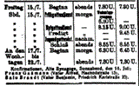
These are the Confirmation announcements for July 16th:
Old Synagogue:
Franz Gaßmann (Father: Alfred, Nachodstrasse 13)
Salo Brandt (Father: Benjamin, Friedrich Karlstrasse 23)
 Juedisch-liberale Zeitung