
Translator’s Highlight:
Against a backdrop of violence, economic devastation, and a refugee crisis, a central theme emerges—vocational education. Articles examine it from different angles and in different locales: a school for Jewish girls that combines basic education with advanced training in handiwork and domestic arts with an aim toward gainful employment, a national call for increasing the number of Jewish tradesmen that would also improve conditions for refugees, and the ORT society’s work in Germany, Poland, Belarus as a means to reconstructing the economy decimated by pogroms. ORT, founded in 1880 in Russia, is a global organization still active today. Spending some time with their photographic archives provides a glimpse into the daily life of farmers and workers through the decades. It struck me that although the articles in this issue mention only training men, the pictures complete the story by showing early exhibits of student work including women’s work and men and women learning side-by-side in agricultural classes. The mechanical workshops are noticeably reserved for men, even after WWII when ORT provided vocational training in the camps for displaced persons throughout Europe.
Articles:
Defection by Rabbi Dr. [Joseph] Norden – Elberfeld
Guidelines for Revising Our Religious Services, Part 3 by Rabbi Dr. H[ugo] Fuchs – Chemnitz [Translation pending]
Jewish-Liberal Youth Organization Outings
Going Home, Sixth Installment of the WWI Novella
Essay Competition on the theme “Religious Law and Religious Sensibility”
Where the Violence against Jews Leads
Development of Capable Jewish Craftsmen
On the Day of Aid for Upper Silesia
Remembering Hermann Klüger
Help through Work and the ORT Society
On the Vocational School [for Jewish Girls]
Aid for Ukraine
Bar Mitzvah Services in Breslau’s Synagogues
Defection.
by Rabbi Dr. [Joseph] Norden – Elberfeld.
The people of Israel – tomorrow’s Sidra tells us – has once again sinned grievously. As a punishment God has sent a terrible plague. With extreme speed, the plague reached out and it seemed the whole people would be taken. There appeared a savior in the form of the High Priest Aaron. Incense burner in hand, he walked among the people and took up a position between the dead and the living, and the plague was stopped. “He stood between the dead and the living,” wise, brave, and not terrified, without thinking of the danger he faced. To bring a whole people out of suffering, to conquer the angel of death that had breached the community’s defenses. Aaron forgot himself, and love of neighbor triumphed over love of self.
Are there still those selfless people today, who forget their “I” when others need help or rescuing from danger. We need only think of the doctors that rush to every sickbed, even when the sickness is contagious. They forget that they’ve left a wife and children at home that worry about their health and tremble—especially so when there is a terrible plague. What ability, and even readiness, to sacrifice! Like the High Priest Aaron, they take their position between the dead and the living to stop the plague. Or when we think of the men and women who walked among the troops on the front and carried the wounded away from the battlefield to ease their pain without considering that any second they themselves could be shot dead—there we must say: as much as the civilized must be ashamed that war is still not recognized as the greatest crime, we can, on the other hand, be glad that there are people who precisely in such terrible times, as we just endured, lift high the flag of love for others, put themselves, at great risk to their own lives, between the dead and the living, and performed incomparable Samaritan-like service with joyful hearts and unflappable courage.
We know that there are other plagues, plagues that don’t demolish bodies, but souls. Such a plague, for example, rules in our German Jewry starting when we entered modern life—it is the plague of “Abt.” Year over year, a large number of us drops off. That conviction is not what drives the faithless into the strangers’ camp is an open secret: we know that everywhere. A large number of cases can be explained by the ambition to gain external honors. Still, there are enough other cases where that doesn’t apply. Of these we know that external advantages weren’t at play. What causes those people to quit our community. Nothing more than a completely false concept of Judaism—as though it no longer fits our times. The more educated the person, the less he should follow the Jewish faith. One holds education and Judaism to oppose each other.
Should we watch this terrible plague with folded arms? We must do play our part to disperse this false view of Judaism. But how should we succeed at this? Aaron, the High Priest, showed us the way. He stood between the dead and the living, and the plague was stopped. We too must stand between the dead and the living, we too must put ourselves between the past and the living present to equalize the actual or only so perceived opposites. We must build a strong bridge between then and now. We must protect the present’s right; on the other hand we must show that if the present, if not to be greatly damaged, can’t lose its connection to the past. Of course, we can’t expect too much from those whose love for Judaism is practically extinguished. All of our hope is in the youth: under no circumstances can we let them grow up with this false idea of Judaism. It absolutely cannot believe that Judaism is a mummy. It must be brought to recognize that our belief is full of life, and can readily compete with any other religion. Thus it is the holiest of duties for the teachers of our religion to place themselves between the dead and the living, between the past and the present. The religion teachers will be better able to fulfill this holy duty if they know both the past and the present, are deeply knowledgeable of how our spiritual tradition came to be, and have a detailed understanding of current intellectual movements.
We have to apply this perspective to everything in Judaism—during services, when teaching, in all religious situations. No rigidity, no confabulation, no leaning to the right or the left. The High Priest Aaron is our model, he, who placed himself between the dead and the living. This isn’t an easy viewpoint, as it requires us not to get too close to the past nor to minimize the right of the present. We must try to do our duty. And if we all get to work with joy and love, with zeal and enthusiasm, then our work will hopefully be crowned with victory, “the plague stopped,” the defections will continuously decrease, and our Judaism will enter a new time to flourish.
Guidelines for Revising Our Religious Services, Part 3.
by Rabbi Dr. H[ugo]. Fuchs — Chemnitz.
[This is the third part of the article by Rabbi Fuchs. The first part, published June 17, 1921, is translated here. The second part, published June 24, 1921, is translated here.]
[Outings with the Jewish-Liberal Youth Organization]
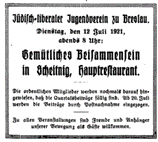
Jewish-Liberal Youth Organization of Breslau.
Tuesday, July 12. 1921,
8 p.m.:
Friendly Gathering in Scheitnig, Hauptrestaurant.
Members, the quarterly dues will be withdrawn from your accounts starting on July 20th.
Guests and supporters are welcome to join
all of our outings
Jewish-Liberal Youth Organization of Berlin.
Sunday, July 10, 1921,
Morning outing to Treptow
Meet at 9:10 a.m.: City train platform of the
Alexanderplatz train station with a ticket to Treptow
(Departure at 9:20)
Sunday, July 17, 1921:
Day Trip
To Bernau – Liepnitzsee – Briese – Borgsdorf.
Meet at 7:50 a.m. at the Stettiner suburban
train station, outside under the clock
(Departure at 8:10)
Because of the crowd at the ticket windows you must arrive on time.
Return between 7 and 8 p.m.


Treptow. Kunst Anstalt Rosenblatt Frankfurt a.M. – Deutschland in alten Ansichten DVD-ROM, Public Domain,https://commons.wikimedia.org/w/index.php?curid=846729
Going Home, Sixth Installment of the WWI Novella.
Link to my translation of the entire novella
Aus dem Reich.
Essay Competition of the German Jewish-Liberal Youth Organization’s Working Group.
In the German Jewish-Liberal Youth Organization’s Working Group’s “Messages“ it announced the following essay-writing contest.
Theme: Religious Law and Religious Sensibility in Judaism. Judges: Rabbi Dr. Goldmann (Leipzig), Rabbi Dr. Kellermann (Berlin), Lawyer and Notary Stern (Berlin), Erich Bayer (Breslau), and Bruno Woyda (Berlin). Prizes: First Prize 300 Marks, Second Prize 200 Marks, Third Prize 100 Marks. (The working group reserves the right to award more prizes per the judges’ wishes.) All members of the union of associations who are under thirty-one years of age can compete. Essays from anyone outside of this group and the competition are welcome. All submitted essays are the intellectual property of the German Jewish-Liberal Youth Organization’s Working Group which also retains the publishing rights. Please send the essays without a name but with an identifying word or phrase by October 1, 1921 to Mr. Erich Bayer at Breslau 1, Carlstrasse 13 accompanied by a sealed white envelope with the identifying word or phrase and the author’s name written on the outside.
We want to let all friends and members of the Jewish-Liberal Youth Organization know that the working group publishes a monthly paper for a quarterly fee of 4 Marks. The “Messages” can be paid for at every post office or at the association’s office: Alfred Berger, Breslau 7, Höfchenstrasse 61.
Berlin. Where the violence against Jews leads. The “World on Mondays” reports: Friday, June 3, at 4:30 p.m. in the afternoon a member of a foreign embassy wanted to buy a ticket at the Wannsee train station in Lechterfelde-West. For no apparent reason, a man, later identified as the salesman Oskar Berger of Werderstrasse 18, accosted him with these words: “What do you want here, you dirty Jew, go back to Galizien! At the foreigner’s answer that he was no Jew, Berger’s answer came: “I don’t believe you, you stink from three miles away.” Berger then shoved him in the chest before getting on his bike. On June 16th by sheer coincidence, the foreigner was able to identify the antisemitic brute and brought charges.
Aus der Presse.
Development of Capable Jewish Tradesmen
The “Craft and Trade” newspaper published the following on the “Development of Capable Jewish Tradesmen”:
The recent rush among the Jews of Germany to careers in the trades is something to celebrate. Whereas before the war, the only acceptable careers in some German Jewish circles were doctor or lawyer, and perhaps businessman, now we see that those careers that are actually productive, like agriculture or the trades, are those that can guarantee a better, more consistent income. The person who owns their own land or who has learned to make essential tools and devices will always be less affected by the swings in the market than the dealer or the merchant.
For Jews, it is of special interest to foster the training of highly skilled tradesmen. If we look at the constant issue of Jewish migration, even through Germany, we can see that it is due in part to the failure of the East to allow Jews to be trained in the trades so that anywhere they go, whether in Germany or abroad, they find it impossible to find a permanent place and accomplish something. For Jews it might be the best weapon against antisemitism to support the development of young people into skilled tradesmen. It’s also in the interest of German Jews to train the Eastern Jews who are currently here. Since immigration from the East has essentially stopped, we need only consider the immigrants that are already here. Young people will only qualify for further emigration if they have properly learned a trade. Very few of the immigrants want to stay in Germany, so the German Jewish tradesmen don’t have to fear competition. It is clear that only those who have prospects will be allowed to travel on to America or Palestine, for example. Even now, properly trained workers have many more possibilities while the unskilled can find no country to accept them.
The interests of the German Jewry on the whole are therefore best served by energetically supporting the training of Eastern and Western Jews. Obviously, training can only proceed after the required exams have been passed.
Breslau.
On the Day of Aid for Upper Silesia.
After many weeks of worrisome, doubt-filled waiting, Upper Silesia is finally free of the rebels. There is still immeasurable misery to ease in order to heal the wounds that the events of the last few months have given the severely tried region. To this end we are holding a day of aid for Upper Silesia in which everyone of us is duty-bound to participate to the best of their ability.
As in all places of worship, the synagogues will announce the charitable drive at services.
We know that we are right in assuming that our Jewish brothers will contribute help and donations for Upper Silesia. They won’t be able to keep themselves from doing so, since many divisions of the Upper Silesian self-defense forces displayed extremely regrettable antisemitic attitudes and actions in a region that owed so much to Jewish workers. The leader of the self-defense forces, General Hoefer, who always showed himself to be free of prejudice and a right-thinking man, had repeatedly taken issue with the divisive, antisemitic harassment—even commanding a stop to it. It is expected that he responded to the complaints of the two gentlemen from Oppel, who recently met with him, by giving them assurances of decisively combatting the antisemitic tendencies and will indeed do so. So, each of you, contribute to the Upper Silesian Day of Aid on Sunday as best you can!
Remembering Hermann Klüger.
On August 15, 1840 Rabbi Dr. Hermann Klüger was born in Warsaw to a religious official. During his childhood he had many deprivations. With the barest of education he was to work in business. But it was science that compelled him. He soon left the store in which he was to get his training and acquired the necessary education, especially in studying the German language, to attend the rabbinical seminary in Breslau. He received his rabbinical diploma and served very successfully as a rabbi in Warsaw and Lodz. Since his father had been a German citizen, Hermann was expelled from Poland. In 1895 he settled in Breslau. For twenty-five years he taught religion at his own school, in the high school, and in the institute for the deaf mutes. He dedicated himself to the enlightenment of his pupils with fiery zeal. He knew how to instill in them a true enthusiasm for Judaism. At the same time he quietly provided much help to the poor. His name was well-known through the results of his activity as an author. His works received broad recognition among scholars, including Christian ones. To name a few: Genesis and the Composition of the Halacha collection of Edujoth,” “The Jews in Babylonian Imprisonment,” “The Religious Education of Our Children and the Role of the Woman,” “Zion and Acropolis,” “The World of the Deaf Mutes,” “Friedrich Delitzsch, the Apostle of the Neo-Babylonian Religion.” [Catalog of Klüger’s works https://www.nli.org.il/en/a-topic/987007299607605171]
This last work has become quite relevant today—unfortunately. The author takes on the task, with some success, of “bringing the ignorance of this new apostle to light and cleansing the Bible of some of the Babylonian debris this scholar has thrown at it.”
Help through Work and the ORT Society
With astounding energy and optimism rooted in the core of Jewish life, the ORT society and its local branches have worked to rebuild the completely ruined Jewish economy in the former Russian empire, especially Lithuania and White Russia. The ORT society’s mission in Germany (officially registered in Berlin) assembles the means to repair the economy in the Eastern countries, mainly through training programs that share the experience gained here with the Jews of the former Russian Empire, by purchasing machinery and tools for craftsmen and farmers, and providing financial means so that the American societies, who will only provide aid if European Jews also do.
On Monday, July 11 at 8 in the evening in the Schiedmayer Hall, Karlstrasse, Breslau, a representative of “Ort” will hold a public meeting. One of the founders of „Ort“ in Germany, Dr. Singalowsky (Berlin) will lecture on the reconstruction of the Jewish economy in the Eastern countries.
On the Vocational School [for Jewish Girls].
The vocational school for Jewish girls held its members‘ meeting on July 4. The board reported on the dire finances of the school and that it would be closed on October 1 if it is not possible to raise funds to keep it open. In the ensuing discussion everyone emphasized that the school’s closure should be avoided at all costs. It was founded in 1801. It is a child of the Age of Enlightenment and fulfilled its mission not only to introduce Jewish girls to modern education but to also teach them handiwork. For decades it has been a girls’ school. All recognized that closing the school at this moment would be unwise. It was especially noted that it was in the interest of the Eastern Jewish children who attended the school, and other Jewish children, to keep the school. The board was assigned to form a communications committee to solicit donations to keep it open and eventually improve it. If, despite all efforts, the results were unsatisfactory, the decision to close the school would be made at a meeting in September.
Schedule of Services in Breslau Synagogues.
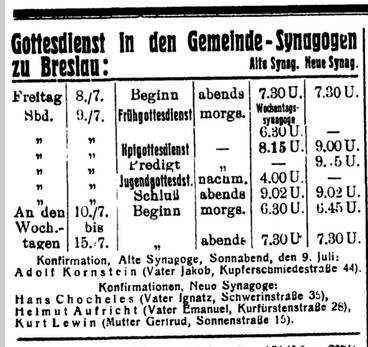
These are the Confirmation announcements for July 9th:
Old Synagogue:
Adolf Kornstein (Father: Jacob, Kupferschmiedestrasse 44)
New Synagogue:
Hans Cocheles (Father: Ignatz, Scwerinstrasse 35)
Helmut Aufricht (Father: Emanuel, Kurfürstendamstrasse 28)
Kurt Lewin (Mother: Gertrud, Sonnenstrasse 15)
Aid for Ukraine
Fellow Jews!

The history of the Jews over the centuries is terrible, painful, bloody. We Jews are used to not being entirely spared the terrors of the Middle Ages even in the more enlightened present. In the last half of the 19th century and the beginning of this century there have been almost continuous persecution of Jews and pogroms—looting, raping, maiming, murder, and arson. These happen even now.
Never, not even in the terrifying days of the Middle Ages, has such an unimaginably horrific catastrophe befallen Jews as what is happening on the edge of civilized Europe, in Ukraine.
It’s currently not possible to ascertain the whole scope of this tragedy. Sure is only that hundreds of villages where Jews live have been burned down. Tens of thousands of people have been robbed, maimed, wounded, raped, killed because they are Jews. There are thousands of Jewish orphans who have lost their brothers and sisters, their mothers, and their fathers to a massacre. These orphans wander about like hunted prey without places to stay. Thousands of adults, that were escaped with only their lives, uselessly storm westward to escape the Eastern hell. The closed borders prevent them from finding safety.
The terrible misery that has befallen Ukrainian Jews can only be relieved if all the Jews of the civilized world unite in a powerful charitable endeavor.
Even as serious as the situation is for German Jews, we must not ignore our duty towards our persecuted brethren in Ukraine. We must create an aid fund that is as large as the misfortune.
We call on you to give, to give generously to help the unfortunate Jews of Ukraine. And don’t just donate yourselves, but collect donations from your relatives, your friends, from everyone who can ease this terrible misfortune.
The Aid Society of German Jews (Dr. James Simon) The German Main Lodge Viii U.O.B.B (Counselor Timendorfer) The Aid Committee for Suffering Eastern European Jews (Justizrat Dr. Blau (Frankfurt), Union of Russian Jews in Germany (City Councilor Teitel), Central Committee of the Jewish World Aid Organization, Germany (Dr. Klee).
Send donations to Bankhaus Lincoln Menny Oppenheimer, Frankfurt.
 Juedisch-liberale Zeitung