
Given the current times as Israel is reeling from the brutal Hamas attack and creating a path for a safer future for itself and a better future for Palestinians, the “Letter from Palestine” gives us a bitter history lesson about the conflict between these peoples just after World War I when the Balfour Declaration’s consequences were being given administrative and political form.
The thirtieth issue of the newspapers has several articles that reflect the level of social engagement and charitable work of Breslau’s and Berlin’s Jewish communities. Some of the meeting minutes are a bit tedious and the officious language can be off-putting, but they give important insights into what it was like to act as a single unit and cooperate, when there many communities with different beliefs with their own priorities from Orthodox to the Reform congregations with Zionism and Nationalism spread across. I hope you’ll agree they were successful in seeking the best outcome. Another message in these articles is how dire the economic hardship was facing them–children were literally starving in Germany, especially those who had just arrived from Poland and Russia.
In this Issue
Jewish-Liberal Youth Organization Outings.
Going Home: Fifth Installment.
“How do we raise our children to be liberal Jews?”
Honorary Doctorate for Nikodem Caro.
Mistreatment of Jewish Prisoners in Stargard
Marriages under Jewish law in Germany.
Rabindranath Tagore and the Student Parliament.
The Necessity of Maintaining the Vocational School [for Israelite Girls]
Israelite Health Care Institution
Assembly of Funerary Employees
For Our Children!
To assist in having participation from as much of the German Jewry as possible in the Jewish Children’s Aid organization recently founded by the German Jews’ Central Aid Committee, this newspaper will publish the donations made every two to three weeks [Should this be a footnote? Sources in Glossary file] founded in Berlin in 1920. Similarly named organization was founded in New York in 1934.]
Please make your donations to the Post Office account #45387, Accounts Administration of the Jewish-liberal Newspaper, Breslau 1. You must state that the donation is for Jewish Children’s Aid.
We ask our cherished readers to use the rubric “For our Children” as much as possible and hope that considerate sums can be distributed.\
Letter from Palestine.
The „Israelite Weekly for Switzerland“ [“Israelitisches Wochenblatt für die Schweiz“] published a letter from Palestine that describes the great difficulties with the Palestinian situation from the Zionist pen. We bring our readers this letter as an especially valuable complement to the reports published in the previous issue. The Editors.
Jaffa, June 6 [1921]
The change in the political and diplomatic announcements is unfathomable. They have taken new and unforeseen forms incredibly quickly. Barely two months ago Churchill endorsed the unassailability of the Balfour Declaration, and now this same Declaration is being watered down and made milder, for the sake of peace with the Arabian instigators of mob violence. But let’s methodically analyze the current situation in Palestine and consider the larger context.
The mood in the whole country, especially in Jaffa and the Jewish colonies, is very uneasy. The Arabs are not pleased with the course of events and threaten openly and secretly to repeat the events of the first of May. The Jews are unarmed and not organized, prey to the worst panic-causing rumors, and are incredibly nervous. Both Arabs and Jews have been looking toward the 3rd of June, on which day, which happens to be the English king’s birthday, they await a political clarification from the High Commissioner. About this statement, legends are already circulating. On the evening before that momentous day, as I arrived in Jerusalem with other invited guests, people were conjecturing about the content and the effect of this declaration. It came. In the same resplendent room in the Governmental palace on the Mount of Olives where Herbert Samuel gave his inaugural speech on July 5, 1920, and where his eldest son married the Palestine-born Hadassah Grasowsky, the Commissioner made his declaration that to many Jews seemed to be an initial impetus toward our hoped-for attainment of Zionist goals. After a certainly interesting depiction of the progress that the country and the “people of Palestine” had made in the intervening eleven months under Samuel’s governance, he turned to the political side about which he gave a deeply significant explanation. I’m sure you have heard these via telegrams so I will just briefly review them.
First came–not a condemnation of the Arabs’ incendiary propaganda which has already led to the spilling of so much blood as many had maybe expected–but a new “Beirusch” to the already often cited Balfour Declaration. Because the Arabs are greatly upset about the British statesman’s declaration and because the children of this land must be calmed above all else. The newest version of the Balfour Declaration signals “that the Jews, who are scattered throughout the world and have loved the Holy Land since forever, could be offered the possibility of creating their homeland here and that a few of them, according to the ability of the country to absorb them—as determined by the number and interest of the current inhabitants—could come to Palestine, to help develop the country to the benefit of all inhabitants through their means and energy. Earlier, Sir Herbert Samuel had rejected the creation of a Jewish state that might rule over the non-Jewish majority., which struck the English sense of justice as too bold a proposal. Further, the High Commissioner assured that steps would be taken to convince the Christians and Muslims that their rights truly were protected.
He also spoke about immigration—he admitted that among the new immigrants, some with Bolshevist ideas had arrived, many of whom had already been imprisoned and their entry had been denied. Immigration has been paused until calm is re-established. There will be five categories of immigrants: tourists, people of independent means, people with certain professions, relatives of residents of Palestine, and people who can immediately work in Palestine. This would apply to those already on their way to Palestine. The High Commissioner reminded us that the condition in which Palestine currently finds itself does not permit mass immigration. Then Herbert Samuel promised to increasingly involve the people of Palestine in governing this country starting immediately with the introduction of municipal elections which would ensure that the interests of the non-Jewish inhabitants had indeed been secured by the League of Nations and its mandate. He expressed his regret over the incidents in Jaffa and expressed his hope that the guilty would be punished. He concluded with the assurance that a glorious future awaited Palestine and its noble, peace-loving people.
It’s hard to say what kind of impression this speech made on the country. The Jews are hurt and disappointed; the Arabs are not yet satisfied. Everyone agrees that amazing ineptitude and an astounding lack of organization are mostly responsible for this political debacle. That the English government and its highest statesman in this country have been deceived by the Zionist leadership with exaggerated claims of our ability to colonize in order to justify complete freedom to immigrate. After just a few weeks, the country’s ability to absorb immigrants was exceeded. Admittedly, our Zionist organizations burned through huge budgets in the first few years and since the last several months have nothing to contribute to the great colonization efforts. Still, the High Commissioner’s speech isn’t completely justified by our faults. The situation is much more serious and the growing resistance of the Arabs against the Europeans that has appeared here and in Egypt forces certain actions that would not be taken in normal times.
What seems to matter is to calm the Arabs who are constantly being riled up by irresponsible instigators to turn on us and the government—to chase the demons from their brains and to restore the normal relationship between the neighboring and once-friendly nations. This and human nature (discord and crisis exist on this whole planet) have caused Jews (who will lay waste to the land) to sacrifice other Jews for the good of the Arabs, which seems unbelievable. As seen from this perspective the High Commissioner’s speed loses some of its bite and we can see it as a means to an end. For us, it means we stay patient, reflect, and maintain a sensible reserve until better days come and the consequences of the current events fade. We must not, however, stop loudly and openly declaring our right, but announcements that are intended to make the position and actions of the High Commissioner more difficult are absolutely of no use and are to be avoided. It’s a tragic irony of fate that the Zionist Samuel had to go against the Zionist wishes and that after the governments of all the great nations have made us promises with such great ceremony. However, agreements alone would not be able to solve the tangled problem of the founding of the Jewish homeland in Palestine under today’s difficult circumstances. The person who must establish peace and order in this land has better things to do than make promises.
Great tension yet exists between Arabs and Jews so that every Arab celebration must be accompanied by guards and rolling canons through the streets. We should realize what our true situation is here. Then we will also be forced to analyze our own mistakes, which I have mentioned here, and if possible, eradicate them and start our work in Palestine anew, building on new, healthy foundations.
[Translator’s note: This letter was published on the front page of the “Jewish Liberal Newspaper” on July 1, 1921. The translation of the rest of the issue is forthcoming. Given the current war between Israel and Hamas, I wanted to surface this reflection by an important Zionist journalist (a contributor to Haaretz and newspapers internationally) on the situation in the British Palestinian Mandate 102 years ago.]
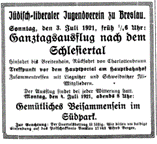
Jewish-Liberal Youth Organization, Breslau.
Sunday, July 3, 1821, early, 5:45 am:
All-day outing to the Schlesiertal
Travel to Breitenhain, Returning from Charlottenbrunn.
Meeting point: the main entrance of the main train station
We will meet with the Liegnitz and Schweidnitz JLYO members. The outing takes place regardless of weather.
Monday, July 4, 1921, 8:00 pm
Friendly Gathering in the South Park
Note that quarterly dues are owed. We request that they be sent as soon as possible to Alfred Berger’s Postal checking account #17433.
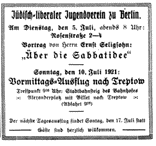
Jewish-Liberal Youth Organization, Berlin.
Tuesday, July 5 at 8:00 pm
Rosenstrasse 2-4
Lecture by Ernst Seligsohn
“On the Concept of Sabbath”
Sunday, July 10, 1921
Morning outing to Treptow
Meet at 9:10: City train platform at the Alexanderplatz train station with a ticket to Treptow in hand. (Depart at 9:20)
Our next day trip is on Sunday, July 17.
Guests are heartily welcome!
Jewish Children’s Aid.
By Eugen Caspary, director of the German Jews’ Central Aid Committee.
For the first time since its founding, the German Jews’ Central Aid Committee is asking German Jews for material support as it organizes to provide Jewish Children’s Aid. This fact sheds light on the necessity of what should happen. It was not easy for the Central Aid Committee to make an exception to its strictly held principle that the member congregations and organizations should be responsible for aid by taking it upon itself to deliver aid to the children.
Jewish Children’s Aid is so large an endeavor and what must be done is now too much for a single organization. The overused phrase “Your future is at stake,” truly applies to this case. The future is shaped by the energy of humankind for whom it will become the present. If there were ever the case where we can see our fate—and see that it can be guided by us—then it’s our children, the Jewish youth that is now growing up. That much of this youth suffers greatly from impoverishment is all too well known so we don’t have to expand on it here. “Childhood poverty” has long been one of the issues that defines our current time. For months this phrase called to us from every poster and every newspaper, sometimes as a political slogan and sometimes as a desperate plea.
Then came the German Children’s Aid society which requested our contribution to easing this terrible misery. This request was indeed justified and found open hearts everywhere. Certainly, this is one of those things that Jewish principles would not question in terms of its moral value, nor try to measure its value by statistical calculation. However, it should and must be said that the German Children’s Aid received such support from Jewish hands and hearts that the German Jewry deserves to be proud.
So why do we need Jewish Children’s Aid?
One can only answer that, “Much was donated, but it’s not enough—by far not enough. The millions collected for German Children’s Aid is just a droplet on a hot stone. It eased the need somewhat but was not a true help. The amount left for Jewish purposes was very little, though we must recognize that in contrast to previous experiences the sums were distributed fairly. The need of Jewish children remains a problem that must be solved if we want to fulfill our duty as the carriers of Jewish tradition in its most humane form—for society.
Jewish children suffer the same poverty as their non-Jewish peers from the same social class—but getting them aid is considerably more difficult because of many circumstances. For example, the fact that many Jewish children cannot eat the Quaker food because of religious reasons except for the few places these truly charitable friends set up kosher kitchens. Think of the many religious, psychological, and emotional inhibitions that make it impossible for Jewish parents to make a demand of a general charitable institution. Do not forget that most Jewish aid institutes and organizations are also responsible for education and we wish and must ensure that such an influence be felt as a Jewish one.
And thus we come to one of the most difficult and important problems of our work: supporting our institutes involved in youth well-being. Their condition can be described in one word: with few exceptions, they are all in dire need—over most of them hangs the shadow of complete collapse. This is especially true of our orphanages, whose support has hardly grown as much as the need caused by the devaluation of their funds and the extraordinary inflation of the cost of food, clothing, and shelter. A great number of these institutions have not been able to use all their space for a great while because they didn’t have the means to feed as many children as they could house.
In the cities, the lack of children’s homes, daycare centers, and children’s hospitals is felt greatly. The number of unwatched children has grown very much; the dangers in the streets are greater than ever—but existing arrangements are so threatened that we can’t even speak of the new ones that are needed. Because of this, right before our eyes, the next Jewish generation is slowly but surely foundering. The only thing missing is money—shouldn’t we be able to raise a couple million from German Jews to maintain our schools, children’s homes, etc.?
Another task is even more urgent. Summer is almost upon us and we have to use it to give the thousands of Jewish children living in big cities the chance to get a couple of weeks of rest? Our vacation camps and vacation homes must be outfitted with the necessary medical staff and medication which is now in very short supply. Where should the thousands go that are “only” undernourished, anemic, and exhausted, the only medication needed being sunlight, fresh air, movement and good food to regain some strength to face the threat of a winter that will be as harsh as ever? For this purpose the Children’s Aid needs significant funds, but above all the loving readiness of Jews in the countryside and small towns to take in city children for shorter or longer stays. This way they can practice charity in the most beautiful and noble form that exists—direct from person to person.
Another problem—the refugee children! Thousands from the East, and more recently thousands more from Upper Silesia, Pomerelia, and Posen. An indescribable misery! It’s always the same picture: in the daytime, no shirt to wear, at night, no bed. It’s unimaginable to those who remember their own childhood as a golden time, or are able to make a happy time for their own children. Here we see a group that is growing up that if it manages to find enough energy in this misery to survive, it will become the sworn enemy of everything that exists, constantly accusing those that did not come to their own, especially those closest to them. Where are the means to show you, to show all German Jews the kind of terrible future this coupling of misery and guilt will bring? Here is one of the great proving grounds for the worth and unworthy of your existence as human and as Jew!
Let’s not talk about the moral aspects—those are self-explanatory. Don’t let “the bad times,” the “unfavorable moment,” the “uncertainty of the situation” be excuses when it comes to helping those for whom the “bad” time is a terrible time, who never had a “favorable” moment and whose condition is mercilessly certain. I won’t say how dishonorable it is to avoid a moral duty by pointing to the government’s tax form. But I can impress upon you three things:
First: Jewish Children’s Aid has at least the same claim on you as the general aid collection did.
Second: Jewish Children’s Aid requires, according to the traditional Jewish principle, that everyone give according to their wealth, their blessings, that the Eternal, your God, has given. We are not begging for alms: German Jews should not expect themselves to give only a token donation. We ask you to meet a human and Jewish necessity. We’re not talking about alms here, we are talking about a true sacrifice.
Third and last: Jewish Children’s Aid is more than about the present, it’s about having the foresight to care for the future. What do we know about the future? Only one thing for certain: the next Jews will not have it easier than we have it; they will have a much harder time of it. Throughout Germany, there is a sense of what a bare life the future brings. All values go up and down—the only constant is the value of the healthy person whose body and soul are prepared to struggle with life.
Is it worth heaping up money and valuables in light of the baseless swings in valuation? Where is the economist or the true politician who would not be ready to claim as the most important principle: “Create healthy people!” Lovely words from [Martin] Buber call youth “the eternal potential for nations’ good luck.” In our case though, it’s less about luck than about existence itself! The German Jewry of tomorrow are those Jewish Children’s Aid wants to help become exactly that. And maybe our divisions will finally do something good. Whether you are liberal/reform or Orthodox, Zionist or aligned with the Central Committee [of German Citizens of the Jewish Faith], you all have an ideal image of Jewish life and must want the next generation to make it happen. So then, make your dream real! Give to the Jewish Children’s Aid. Show what your ideal Jewish life is worth. You all need strong, healthy, confident, capable defenders of your ideas. But if you let the young grow up in misery and want, with weak bones and blood-starved brains, you won’t be fighting for your ideals or against your enemies. That the older youth especially must participate in the work for the younger ones with all their strength goes without saying.
You are responsible for the lives of thousands of young people, you are responsible for the Jewish future in Germany.
Whoever is aware of this will donate to Jewish Children’s Aid to the degree their Jewish conscience moves them.
Aus dem Reich.
Berlin-Charlottenburg: From the Liberal Association. In a meeting of the Liberal Association for the Affairs of Berlin’s Jewish Congregation, the dentist Lipschitz and the lawyer Plonsker spoke on “How do we raise our children to be liberal Jews?” Mr. Lipschitz began by explaining that about 30 years ago in Berlin there were two religious schools that had far fewer pupils than they could accommodate. Gradually, religious life grew stronger, in part because of the founding of the Central Committee and the Liberal Association. However, the Zionists understood better how to draw in the youth with their illusionary goals whereas the Liberal Association was to late in organizing the Youth Associations. The Orthodox believed the five books of Moses were divine revelation, the Bible and the later writings through to Schulchan Aruch had to be followed to the letter as divine laws. Liberalism cannot share this point of view. The law of children’s development should not be constrained by religious perspectives—only what human rationality determines is right after thorough examination should guide us. Teaching and life must be harmonized: this idea about childhood development is nothing new, by the way, and goes back to Ezra. To answer the question of how we should raise our children to be liberal Jews we must above all be clear that the concepts of “liberal” and “indifferent” are not the same as the Orthodox try to position them. The Liberals must show that they too have positive goals. Regarding that which is in keeping with reason is of course in first place keeping the Sabbath holy, at least on Friday evenings and holidays: that Chanuka and not Christmas should be celebrated. Every Jewish boy and girl must be bar or bat mitzvahed—even more important than that is the one or two years of preparation for this. Religious education needs improvement so the position of a religious school inspector must be created. More youth must attend religious services, especially Friday evenings. During school vacations, they should also go to synagogue on Saturday, but the religious service along liberal lines with more German prayers. Jewish reading rooms must be used more. The youth associations should build the foundation of liberalism. The Berlin Youth Association does not have many members but the type of activities it has are of the highest quality. It tries to further the understanding of religious life and liberalism. The group’s leader was lacking this in his own youth. The most important thing in youth development though is what the children see at home—they must be filled with love for the old traditions. Liberalism also builds the youth up for the fight against apathy and Baptism [conversion to Christianity]. Liberalism does not want to destroy, but to build on the foundation that it has recognized to be good. Raising children to liberal Judaism is not just the duty of the home and the lay people, but above all, the rabbis and the teachers. Lively discussion followed the lecture. Especially noteworthy were Dr. Hochfeld’s statements: Zionism is so attractive to young people because its goals are more political than religious because it seeks the impossible just like the extreme political parties that are also so alluring to the youth. Orthodoxy and Zionism are both on the offensive; liberalism is on the defensive. Being on the offensive has its own kind of energy while the defense suffers from a certain kind of complacency. In strength can lie weakness—Orthodoxy and Zionism start agitating in school. This unscrupulous agitation doesn’t sit well with Liberalism, but it needs to agitate as well. Judaism is not a collection of rigid teachings and principles; rather, it’s something that has developed historically and is something fluid. Heartfelt piety is more valuable than religious forms, which doesn’t mean that these are unnecessary or worthless—they play a role in Liberalism as well for they are a means of expression of the religious life, they are supporting beams, but not chains of bondage. Liberal Jews should also nurture these religious forms.
Going Home. The fifth installment of the novella set during WWI.
Link to my translation of the entire novella.
Berlin. By a unanimous vote, the faculty council of the Agricultural College gave an honorary doctoral of agriculture degree to Professor Nikodem Caro, born 1871 in Lodz. This unusual award was given to the privy councilor Professor N. Caro (who also serves on the board of directors of the college of Jewish science) on the occasion of his 50th birthday because of the process that he developed with Dr. A. Frank that took oxygen from the air and converted it to useful nitrolime. The ability to create nitrolime served Germany during the war when it could get no saltpeter from Chile but even now is of great importance to agriculture and industry. Some plants that manufacture the artificial nitrogen for use on farmland depleted after the long war employ thousands of workers. In 1906, Caro received the silver medal from the Association for the Promotion of Commercial Achievements [Verein zur Beförderung des Gewerbefleißes].
Berlin: Immigration into Mexico. The number of emigrants who want to go to Mexico has recently grown very much. It outstrips the ability of this country to absorb them.
The news from Mexico is that it is a country of day laborers, of workers. 90% of the population lives on salaries which means that there are some 14 million proletariat in Mexico. Therefore, sending workers to Mexico is like sending coffee to Brazil or saltpeter to Chile.
The kind of immigration that Mexico needs is not workers—at least until its economy and industry develop and provide more occupations. Rather, it needs immigrants who acquire land and work it with machines or those that can found new industries with their capital.
Workers without means should be strongly urged not to go to Mexico for the foreseeable future.
Stargard in West Pomerania. The Prussian Minister of the Interior dispatched a representative to investigate the poor conditions at the prison camp and to determine how to punish the guards who abused the interned Eastern Jews. The investigation is now closed with the decision that the guards Erich Otto, Willnow, and Raps are to be removed from service and be charged with criminal offenses. Three more individuals are still being investigated. The prisoners confidently claim that a guard beat them with a club so hard that the club broke in two. The guards deny this. It is a fact though, that a guard’s club was found broken in two after the fire. The accused guard claimed that it broke in two when he hit the ground with it. The guards say that they were goaded into mistreating the prisoners. The investigation found that the unfortunate victims had indeed been beaten. Starting immediately, all guards will have to sign a document where they pledge to cease any abuse. Whoever breaks this pledge will be let go immediately. One hopes that the fired bullies do not get off scot-free, but that they serve their well-earned punishment. [[Translator’s note: See the camp’s use after WWI to deal with Eastern Jewish immigrants and the mistreatment of prisoners that precedes this investigation. This camp eventually became a POW camp in WWII, Stalag II-D.]
Munich. (Marriages under Jewish law in Germany.) The Bavarian Supreme Court recently made a decision that drew much attention in the farthest legal circles and which the Ministry of Justice published in the state’s announcements so that the marriage license bureaus would be aware of it. The facts and the reasons for the judgment are summarized as follows: The female plaintiff, S. P. and her husband belong to the Mosaic religion and are Lithuanian citizens (formerly Russian). They were divorced by a Munich rabbi on July 20, 1919 according to Jewish rites per the divorce document. The plaintiff would now like to marry the Polish citizen Sch. D. in Munich and applied to the Marriage Bureau of Munich to have any obstacles to the new marriage cleared. The Marriage Bureau rejected the application citing Section 1309 B. G. B and Article 30 E. G. B. G. B, because the German laws recognize only divorces granted by courts. The divorce granted by the Munich rabbi did not clear the impediment to the new marriage. This complaint moved through the Bavarian courts, starting with the local court responsible for making decisions on individual matters like this (per Section 11, Paragraph 3 P. St. G.) and now came to the supreme court—all the courts found for the Marriage Bureau. “These are the legal findings: The question whether a legal process executed under religious authority such as a divorce can be seen as applying in a civil context, without any regard to the religion must be answered with no, even for foreigners. There was no legal divorce, even if the divorce was recognized as fully compliant with another country’s law and was seen as valid by the foreign government.
Aus der Presse.
Polish Crudeness. In the “Germania” paper a member of the parliament, Dr. Herschel, reported this episode from Upper Silesia: “During the attack on Loslau the leader of the Polish insurgency, Michalski, had his horse shot out from under him. He ordered that his warhorse be ceremoniously placed on the Jewish hearse and the Jewish citizens were commanded to accompany it as the city was being taken by the rebels. This is not a story that was made up for the more mature youth, but one that is a genuine event supported by sworn witnesses.”
Rabindranath Tagore and the Student Parliament. The “Berliner Volkszeitung” reports: When Rabrindranath Tagore’s European trip was announced, a Free German group asked Asta (the student government of a German university) if the poet-philosopher could give a lecture at their alma mater. The president of the student parliament was in an embarrassing situation since he had never heard of this man with the strange name so he asked for an explanation. Someone with a dueling scar called out in a buffo bass voice: “No explanation needed. He’s probably some Jewish rabbi. We fraternities decline the request on the basis of folkish-nationalistic considerations.” There was hearty agreement. Despite all objections of the Free Germans, the decision was made, accompanied by the academic stamping of feet, not to invite Mr. Tagore because his visit would not suit the “seriousness of the times” nor the “significance of German honor.” – No comment needed. The Editors.
[Translator’s note: Rabindranath was a Bengali poet and philosopher who won the Nobel Prize for Literature in 1913. Here we have an example of rampant antisemitism combined with cultural ignorance.]
Breslau.
The Necessity of Maintaining the Vocational School [for Israelite Girls]
The vocational school for Israelite girls faces a consequential decision. The school has kept the Jewish spirit alive in its pupils while making them useful members, not only of our community, but of society as a whole, for over one hundred years. War and revolution have shaken its financial security so much that its continuation is in doubt. But exactly now the school has shown its special value with regard to the many refugee children who are in urgent need of care and a good education. Whoever has a social instinct and a warm heart for the suffering youth of our community should not be apathetic about this institution. It has consistently been recognized by the Breslau school administration and needs our community’s support in this time of crisis. On Monday, July 4 at 6 p.m., in the synagogues’ representatives’ hall the central meeting will decide whether the means can be found to maintain the vocational school or whether it must be closed. All friends and patrons of the school are being notified and asked to come in large numbers. This is especially true for those who have supported the school in the past and care deeply that the means and ways can be found to maintain it.
Israelite Health Care Institution.
On Sunday the 26th. June 1921, the General Assembly of the Israelite Hospital and the Burial Society met after the prescribed three-year interval. The chairman Eduard Sachs opened the meeting. The election of the board resulted in the almost unanimous re-election of the outgoing board members. To replace Justice Councilor Joel who left due to illness Heinrich Oschinsky was elected to the board with 205 votes. Furthermore, Hermann Jacobowitz received 62, and the master tailor, Draier, received 34 votes. Some votes were split. Eduard Sachs presented the annual report in detail and pointed the members to read the detailed management report.
The chairman then submitted a supplementary management report in which he provided detailed information about the great difficulties faced by the hospital during this time of great need. He gave the numbers for the extraordinary increase in operating expenses, with which unfortunately the income couldn’t keep up, so that large deficits were unavoidable. Here too our co-religionists’ outstanding willingness to make sacrifices is demonstrated. Only by generous donations to the hospital by noble humanitarians could the board maintain the hospital and share blessings with the poor and sick. The chairman expressed his deepest gratitude to everyone involved, including the noble donors and the friends and patrons of the institution, who participated in its humanitarian efforts. He then made a plea to all community members to continue their goodwill towards the hospital and Burial Society with generous grants to give the hospital the opportunity to survive these difficult times, which unfortunately are not over yet and that the preservation of this proud symbol of Jewish charity is secure. He trusts the consistent charity of our co-religionists, who have so far performed so outstandingly so that the hospital always has new friends and patrons who will maintain this hospital which is a blessing to our community in the future. He also recognized and thanked our congregations’ members, the doctors and hospital administrators, the honorable ladies, the Association of the Eighteen Men and the doctors assigned to the district’s poor.
During the administration and business report Mr. Loewy, the banker, included a request from the local chapter of the Orthodox group Agudath Israel, which referred to kashruth observation and the Sabbath in the hospital and requested greater assurances that the religious rules be more respected than in the past. A debate ensued during which the rabbis reported that they had just inspected the hospital a few days before and found that all the preparations for observing kashruth dietary laws were exemplary. Of course, that doesn’t mean that all the employees would follow them correctly. It became clear that the rabbis should be in charge of supervising religious observations. The board pointed out that as long as the housekeeping committee and the lady volunteers were already closely monitoring whether the rules were being followed, that was satisfactory. But they agreed to give this suggestion of having the rabbis take over the monitoring further consideration. After more discussion, the assembly agreed to the board’s solution. The city councilor Georg Less, Isidor Cohn, and Adolf Lewin were re-elected as the financial auditors and Elkan Weiss and Ignatz Walsch were newly elected as deputies.
After Professor Dr. Wohlauer thanked the board for the outstanding administration of the charitable institution for which he was responsible, especially during this difficult economic situation and which could not be valued enough, the meeting ended.
*We too would like to call upon the members of our community, to generously support and donate to the hospital, the old-age home, and the infirmary for contagious diseases whose future existence is highly endangered by the dire economy so that these charitable institutions that are so important to our community continue to be a blessing to our neediest co-religionists. The Editors.
Assembly of Funerary Employees
The congregations‘ employees responsible for burials held a meeting on Monday evening in the rooms adjacent to the chamber music hall. They had invited a number of the congregations‘ representatives. Only the liberal representatives attended. Two representatives for the employees articulately described…
…the problems of this lowest paid group of salaried employees and how these difficulties came to be. They had to struggle for the barest existence and needed to have some improvement as soon as possible if they were not to go under financially. They called for a financial subsidy to be paid out immediately and a general improvement of their employment conditions. The congregations’ representatives who attended the meeting promised to energetically take up the cause of the justified requests made by the employees.
Editors’ Notices
The series of articles “Guidelines for Reforming our Religious Service” by our esteemed colleague, Rabbi Dr. Fuchs (Chemnitz) will conclude in our next issue.
Having received many inquiries on this topic, we can divulge that the so well-received piece “A Lifetime of Memories from an Old Woman” came from the pen of our highly regarded colleague, Mrs. Regina Reitzer (Breslau). The Editors.
Family Announcements
Engaged:
Trude Nürnberger to Manasse Militscher, Breslau
Käte Glaser, Hindenburg OS, to Erich /Kochmann, Dominium Egarsee
Gertrud Friedensstein, Berlin to Dr. Max Naphtali, Charlottenburg
Married:
Arnold Kellhaus and Meta Heilborn, Breslau
Edgar Wilda and Lonny Wall, Breslau
Carl Glatz and Liesel Liebes, Sorau NL.
Born:
Son: Dr. Fritz Guttmann and Trude, nee Wachsner, Kattowitz; Walter Engel and Herta, nee Aber, Breslau; Dr. Willy Bürger and Ilse, nee Schiff, Elberfeld
Daughter: Dr. Willy Cohn and Lina, nee Haberer, Berlin
Deceased:
Hermann May, Breslau
Estella Scheinmann, Breslau
Julius Cohn, Waldenbrg
Hermann Hammerschmidt, Breslau
Emanuel Saul, Berlin
The Services Schedule for Saturday. July 2 lists these events:
Old Synagogue:
Confirmations:
Ernst Riesenfeld (Father Eduard, Zimmerstraße 4a)
Kurt Schein (Father Benno, Freiburgerstraße 8)
Artur Tuch (Father Leopold, Herrenstraße 17/18)
New Synagogue:
Confirmation: Werner Kramer (Father Paul, Freiburgerstraße 26)
Wedding: At the Lessing Lodge, Sunday, July 3 at 3 p.m.
Arthur Lubinski and Miss Margarete Bergmann, daughter of Mr. Heinrich Bergmann, Gartenstraße 18.
 Juedisch-liberale Zeitung